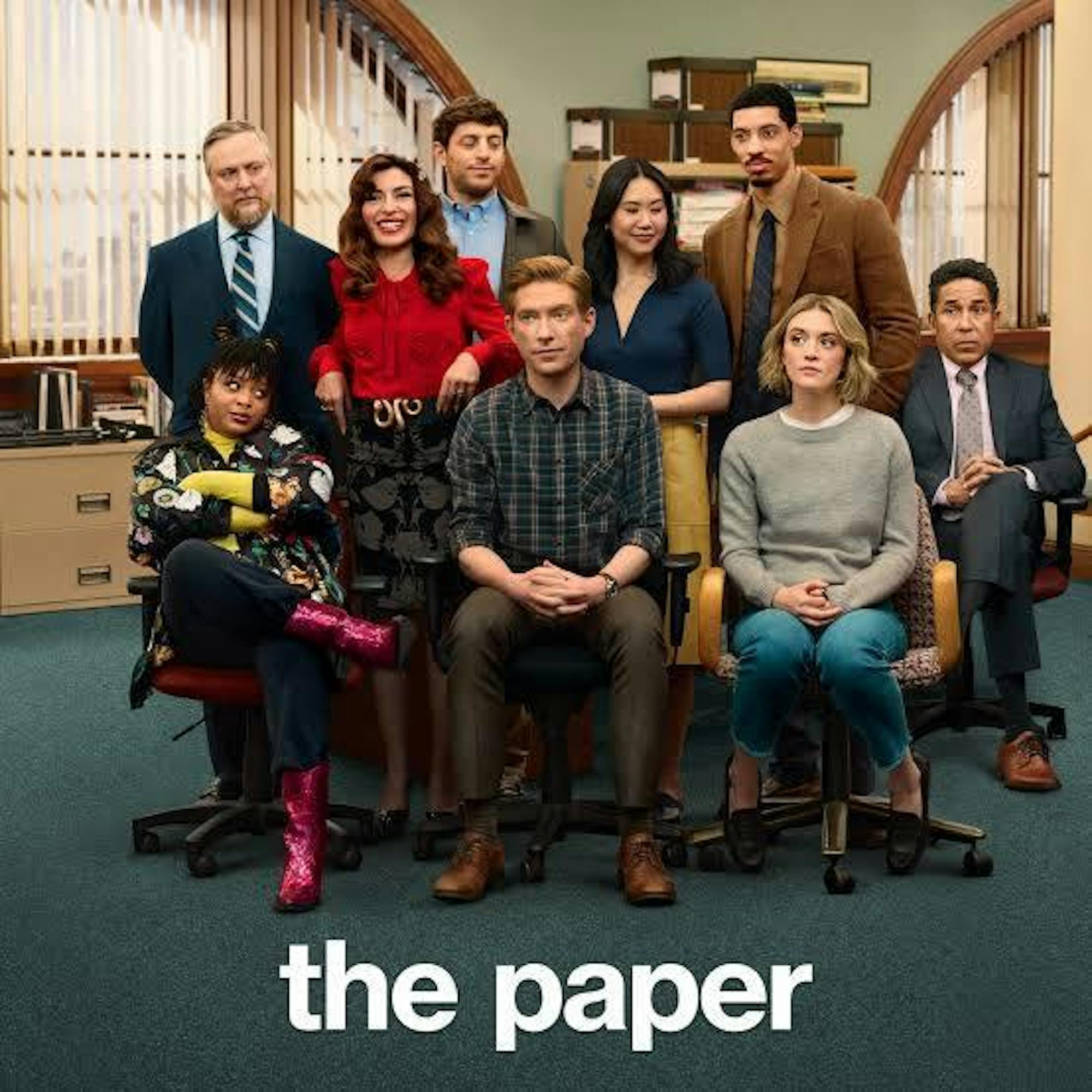
Twenty years after the premiere of The Office, showrunners Greg Daniels and Michael Koman imagine the fictional documentary crew of the original sitcom returning to film a new subject: the staff of a failing newspaper led by a new editor-in-chief. Initial reactions to The Paper’s marketing wondered whether a spin-off of one of the most beloved shows of all time was really necessary. The Paper has come in with something to prove, and its cast and crew are dedicated not only to innovating beyond the format of their predecessor, but also to highlighting the importance of local journalism through the show. The Sun was invited to a roundtable discussion with cast members Chelsea Frei, Melvin Gregg and Ramona Young to hear about their process.
In the premiere, we follow new editor Ned Sampson (Domhnall Gleeson) as he arrives at the historical Toledo Truth Teller, once one of the most important papers in the Midwest, but now relegated to Buzzfeed-style clickbait articles and low-cost content from the Associated Press. Accountants and corporate workers make up most of the staff, with Chelsea Frei’s Mare Pritti serving as compositor and Sabrina Impacciatore’s Esmeralda Grand working as managing editor fighting for control with her new boss. Over the course of the season, Ned turns a ragtag team of sales reps and staffers into the newsroom of a successful local paper.
The Paper captures much of the original charm and humor of its predecessor, while also turning attention to an industry in need of support. Through conversations with local newsrooms, the cast gained a deeper understanding of the importance of local journalism. According to Chelsea Frei, they hope that The Paper “reminds people to subscribe to their local paper” in a time when local news is more important, and sometimes harder to find, than ever. The show hopes not just to recreate the magic of The Office, but to use humor to bring light to an important issue. In the show’s first episodes, we watch as Ned enthusiastically explores the history of the Toledo Truth Teller, sharing the paper’s most influential articles with a less-than-eager newsroom. Ned believes wholeheartedly in the power of local journalism and the importance of connecting audiences with news that’s relevant to them. Over the course of the season, the rest of the cast begins to share his passion.
The Paper also deftly handles the challenge of bringing over enough from The Office to capture the attention of fans, while also innovating to capture a modern audience. Actor Melvin Gregg (who plays sales representative Detrick Moore) explains that trying to recreate the exact comedy of The Office “would be a disservice to myself and to those characters.” For Gregg, it was better to create his character from scratch, forgoing any background knowledge from their predecessor. The characters of The Paper (excluding Oscar Nunez as Oscar Martinez, reprising his role from The Office) are entirely new and distinct, not caricatures of beloved characters of the past. The Paper’s greatest asset is the creative team’s commitment to creating something entirely new, within the mockumentary genre that made The Office take off.
The Paper comes at a strange time in television history. Far from the era of primetime sitcoms that granted The Office such success, the media landscape of 2025 isn’t exactly built for a show like The Paper. What makes the series work is the cast and crew’s ability to not create a carbon copy of The Office but to instead try to meet modern audiences where they are. The Paper is thoroughly modern and clearly set in our time, allowing the showrunners to juxtapose the analog nature of a local print paper with the digital age. This also draws a comparison between The Paper’s classic sitcom format and its release on streaming, rather than cable TV. The Paper is clearly aware of its own potential to become outdated, much like the Toledo Truth Teller. In its first season, much like The Office, the series is clearly finding its footing. In future seasons, I hope to see how The Paper can continue to innovate, not only to distinguish itself from what came before, but to connect with modern audiences in a digital era. In some ways, there is no better genre for a series trying to draw attention to a struggling art form than the sitcom.
The cast and crew of The Paper are dedicated to creating something entirely new and finding ways to connect with modern audiences, all while encouraging viewers to seek out and support local journalism. As the series begins to find its footing, and its audience, it has already become clear why, in the digital age, such a show is necessary. In future seasons, I hope that The Paper will continue to grow its audience and bring much-needed support to local journalism.
Nicholas York is a junior in the School of Arts and Sciences. He can be reached at nay22@cornell.edu.
Nicholas York is a member of the Class of 2027 in the College of Arts and Sciences. He is a columnist for the Arts & Culture department and can be reached at nyork@cornellsun.com.