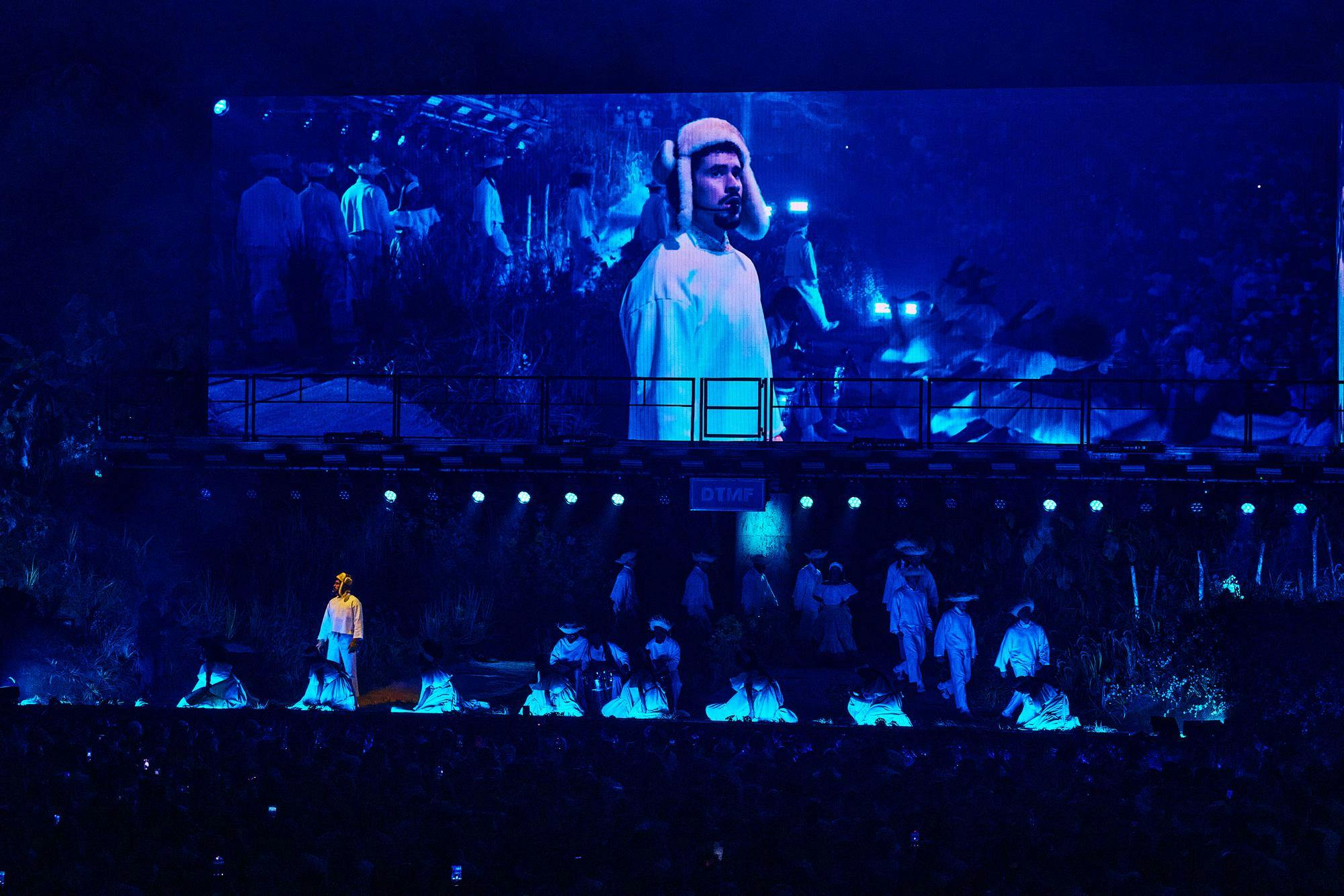
Bad Bunny headlining the 2026 Super Bowl halftime show is norm-establishing, not disrupting. Music has historically been on the front lines of social change. In the absence of a governing force, music can rally communities together. While pushback persists against Bad Bunny’s future performance, civil unrest against the current administration has been simmering since Kendrick Lamar’s performance in 2025.
“The revolution ’bout to be televised, you picked the right time but the wrong guy,” Lamar stated off the bat. From dancers dressed in red, white and blue forming the U.S. flag to Samuel Jackson presenting as “Uncle Sam,” typically depicted as a white man, Lamar’s performance was a call to mobilize. So often, what stops the populace from uniting is a lack of shared knowledge or understanding. A universal bridge to this gap is art; here, it is music. 2025 was the first time a president of the United States attended the Super Bowl. President Donald Trump’s presence while Lamar commented on the political climate was direct, insofar as art can serve as resistance. The field has at once become the playing ground for social change and for reconstructing the relationship between the government and the consent of the governed.
Bad Bunny’s world tour for DeBí TiRAR MáS FOToS features no dates in the U.S. This is not malicious but protective of his fanbase. Mass deportations are a priority for the current administration, with the Immigration and Customs Enforcement doubling its arrests, increasing the number of detainees and ICE employees. However, due process concerns are emerging as well as ICE profiling citizens based on their ethnicity, such as Kenny Laynez from West Palm Beach, Florida, a U.S. citizen who was detained for six hours and then released. Bad Bunny decided to have no tour dates in the U.S. in fear that ICE would profile attendees and conduct mass arrests. Except now, the Secretary of Homeland Security, Kristi Noem, stated that ICE will be at the event. She said on The Benny Show that “only law-abiding Americans who love this country” should come to the Super Bowl. The irony laced in this moment is that Bad Bunny is Puerto Rican — Puerto Rico is a U.S. territory. NFL fans who are questioning the halftime show choice are suggesting that Bad Bunny is not a citizen despite being born in Puerto Rico, effectively unveiling ignorance on U.S. citizenship. His Puerto Rican fans are also U.S. citizens. Noem’s comments illustrate the continued ethnic profiling aspect of ICE; it’s not immigration enforcement, it’s anti-immigration.
One user on X, Danica Patrick, commented that “No songs in English should not be allowed at one of America’s highest rated television events of the year … not just for sports.” Her response is just one of the many that dislike Bad Bunny’s Spanish songs. What’s significant here, though, is that Spanish is the most common non-English language spoken in American homes, as seen in the 2019 census. Despite Spanish being a commonly spoken language, there is pushback against a Spanish-speaking artist. Once again, the reactions to the announcement illustrate the anti-Hispanic and xenophobic sentiment among some groups, facilitated by ICE’s increased funding and media attention.
Bad Bunny just hosted the Season 51 premiere of SNL and commented on the halftime show criticism with a stitched-together clip of FOX News reporters stating, “Bad Bunny is my favorite musician and he should be the next President.” Bad Bunny then went on to speak in Spanish, celebrating the accomplishments of all Latin people in the U.S. and their impact on the country. It was not translated; instead, he said we, the audience, have time to learn Spanish before he performs. This overt jab at monolingual culture in America was well done.
Choosing Bad Bunny as the halftime performer is a direct move against the current administration’s priority to target Hispanic people in the United States, with detention centers like Alligator Alcatraz. The artist has been open about being against ICE, most recently with his SNL monologue. There is a common sentiment to keep politics out of sports, music or other aspects of entertainment. This leads to a presumption that artists should not express their political beliefs for fear of bringing politics into art. However, politics is in everything, and artists like Bad Bunny being open about their opinions should be the norm. The cognitive dissonance here is that people’s familiarity with patriotic ideas causes all to forget that it is just as political as the performance from Lamar and soon, Bad Bunny. The national anthem is played at almost every sporting event, from high school games to the NFL; an establishment of post-war patriotism solidified during World War II. Former President George W. Bush threw the first pitch of game three at Yankee Stadium during the 2001 World Series, providing some security to a country in despair. Sports events have always been a place for politics; they have a unifying power. Sports is a chance to see the nation as a united front. With Bad Bunny’s performance, the nation can become a united front against the increased use of ICE. Bad Bunny is not disrupting the status quo by performing; he is contributing to the conversation.
What makes music the best way to collapse distance in domestic politics? To bring the conversation to one stage? It is the musicality and rhythm. You can dance to “Tití Me Preguntó” without understanding the lyrics because you enjoy the tempo. Public opinion is malleable and relies on readership and engagement. But public opinion of a catchy song? Anyone can dance, and that’s what makes music so accessible and the best stage for reconstruction and unity. In 2026, that stage is the playing field.
Sophia Romanov Imber is a sophomore in the College of Arts and Sciences. She can be reached at sromanovimber@cornellsun.com.
‘Long Story Short’ is a column focused on the intersection of politics and entertainment. It runs occasionally.

Sophia Romanov Imber is a member of the Class of 2028 in the College of Arts and Sciences. She is the associate editor for the 144th Editorial Board and was a former assistant arts editor for the 143rd Editorial Board. She can be reached at sromanovimber@cornellsun.com.