The song “Count the Ways” from The Last Dinner Party’s new release From the Pyre is a good microcosm of everything I love about the band. The song is simultaneously orchestral and gritty, with a deep, buzzy bassline that feels charged, both electrically and erotically, which creates such a sense of melodrama. You can feel the desperate longing in Morris’s voice as she gasps, “I count the days / Since I could recall your face.” In fact, Morris’s voice acts as an anchor amidst the intricate production, which includes everything from the band’s vocals reminiscent of a choir to sliding strings over the aforementioned bass. There is so much going on in the interplay of vocals and instrumentation. The song is melodramatic, sonically fascinating and deeply emotional. And it creates such a full-bodied listening experience, one where I feel as if the song is seeping into my skin and expelling all these emotions.
The Last Dinner Party is a five-piece band from London consisting of Abigail Morris (vocals), Lizzie Mayland (guitar), Emily Roberts (guitar), Georgia Davies (bass) and Aurora Nishevci (keyboard). They formed in 2021 before being launched into virality in 2023 with the single “Nothing Matters” and released their debut album Prelude to Ecstasy in 2024.
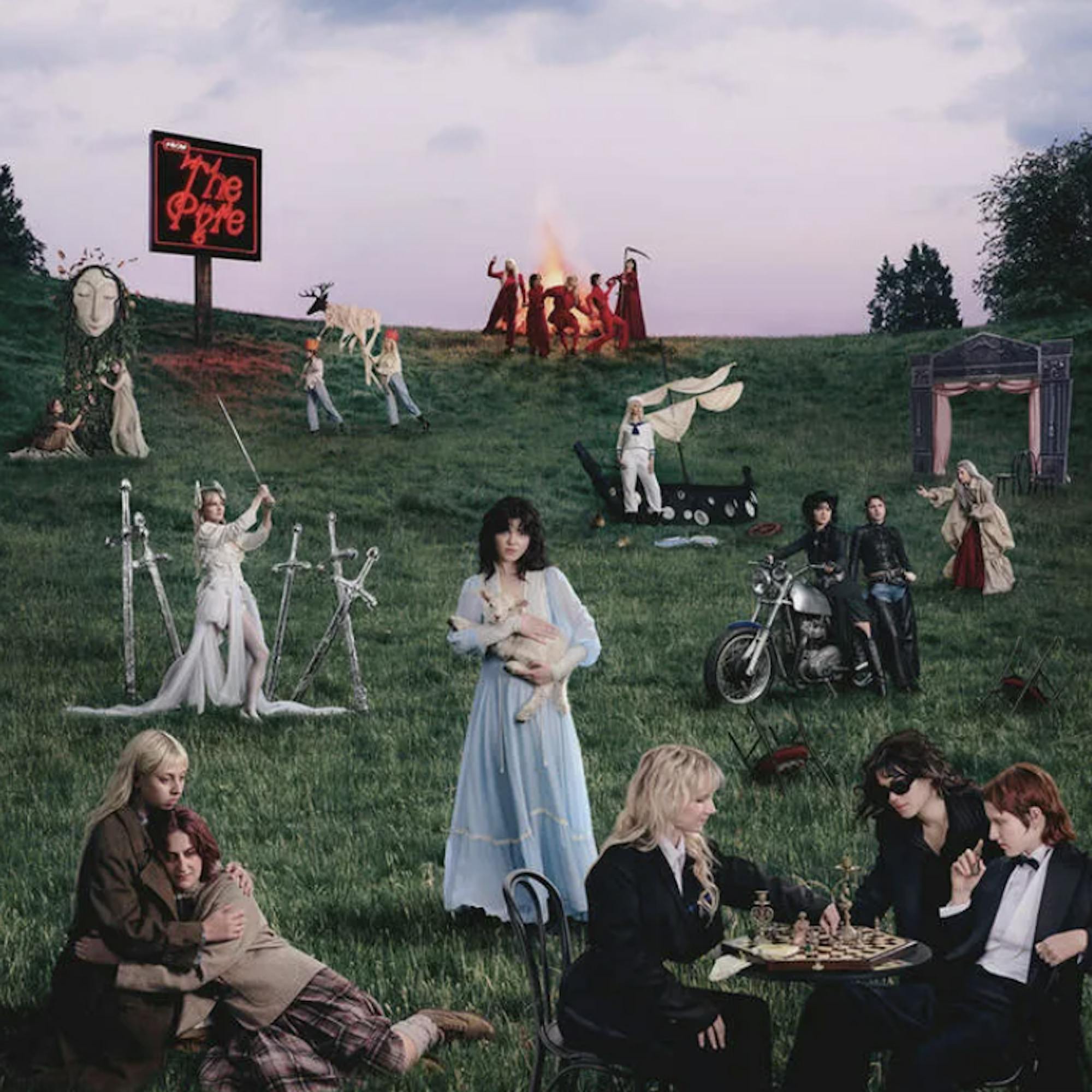
“From the Pyre is a collection of stories, and the concept of album-as-mythos binds them,” The Last Dinner Party’s Spotify reads. “The Pyre itself is an allegorical place in which these tales originate, a place of violence and destruction but also regeneration, passion and light. The songs are character driven but still deeply personal, a commonplace life event pushed to pathological extreme.”
I think perhaps the album’s concept is best exemplified in how many of the songs intertwine love and death. In the breakup song “This is the Killer Speaking,” we are told we have been ghosted through a line comparing our lover’s response to seeing our father’s grave. The bridge is delightfully angry and messy, from the increased tempo to the vocals breaking into screaming, which then concludes in a very deliberately placed last note as the piano breaks into glissando. The album opener “Agnus Dei” features Morris asking, “Am I enough to make you stay?” right before pivoting into, “Oh, here comes the apocalypse / And I can’t get enough of it.” Longing is situated with the end of the world. Let us welcome all the mess of grief and love and everything that comes with them and burn at the pyre.
“Rifle,” which Financial Times calls “supernatural psychedelia” is an anti-war piece that is told from the point of view of a mother whose son has gone to war. The song is immense in its production, including sudden tempo changes carried by intense, frantic guitar and a bridge sung entirely in French with only piano accompaniment. The chorus, which features the band singing “ah” over heavy rock instrumentation, feels almost condemning in its hellish, horror-movie resonance. It is also utterly haunting with lyrics like, “Rising from the tomb / Of your mother’s womb / Are you happy now?”
And of course, there are other stories and experiments that The Last Dinner Party has shared through this album. “Woman is a Tree” is another haunting piece, opening with dissonant vocals and instrumentation that has the tone of a funeral dirge. The folk chants interspersed between some of the verses are both beautiful and a little unsettling. It is a song that is atmospheric and easy to get lost in. “Sail Away” describes a nostalgic yearning for youth over mellow piano that sounds almost small and childlike. Sailing away becomes escaping reality, with an outro that makes me so damn sad in its repetition of hoping to go anywhere / everywhere, as if saying it enough times could make it come true.
The song I’ve found myself utterly stuck on is “The Scythe,” a pre-release single that has had me entranced since its release. I’ve been repeating lyrics like, “Don’t cry, lie here forever / Let life run its course” like a mantra, stuck on the simultaneous hope and grief undergirding the song.
The song is a meditation on loss through the dual modes of death and breakup. Morris said in an interview: “This song began 9 years ago, like a prophecy. I wrote it before I had known anything of grief or heartbreak, how a relationship ending feels exactly the same as that person dying. Once you know how it feels to lose someone you enter a new realm from which you can never return. … The Scythe comes for everyone and you shouldn’t be afraid about what’s on the other side.”
In the chorus, Morris sings, “Don’t cry we’re bound together / each life runs its course / I’ll see you in the next one / Next time I know you’ll call,” over softer production and ghostly backing vocals. Maybe it is how everything in this song alludes to all the people I’ve lost and will inevitably lose that strikes me particularly hard. I want Morris’s certainty when she sings, “I’ll see you in the next one,” so badly, but it is so hard to not get caught in the absence in this life gestured to by this line. And maybe it is the idea of letting life run with the uncertain hope that it will be okay even if it didn’t work out here that also gets to me.
Maybe it is this character-driven exploration of personal grief pushed to the extreme that keeps me in the atmosphere of From the Pyre, looping the songs over and over again. I get the opportunity to “make myth of [my] own life as [I] listen” (as the band calls for) by exploring my love and grief invoked by their storytelling and lay that down at the Pyre.
Pen Fang is a sophomore in the College of Arts & Sciences. They can be reached at pfang@cornellsun.com.
Pen Fang is a member of the Class of 2028 in the College of Arts and Sciences. They are a staff writer for the Arts & Culture department and can be reached at pfang@cornellsun.com.