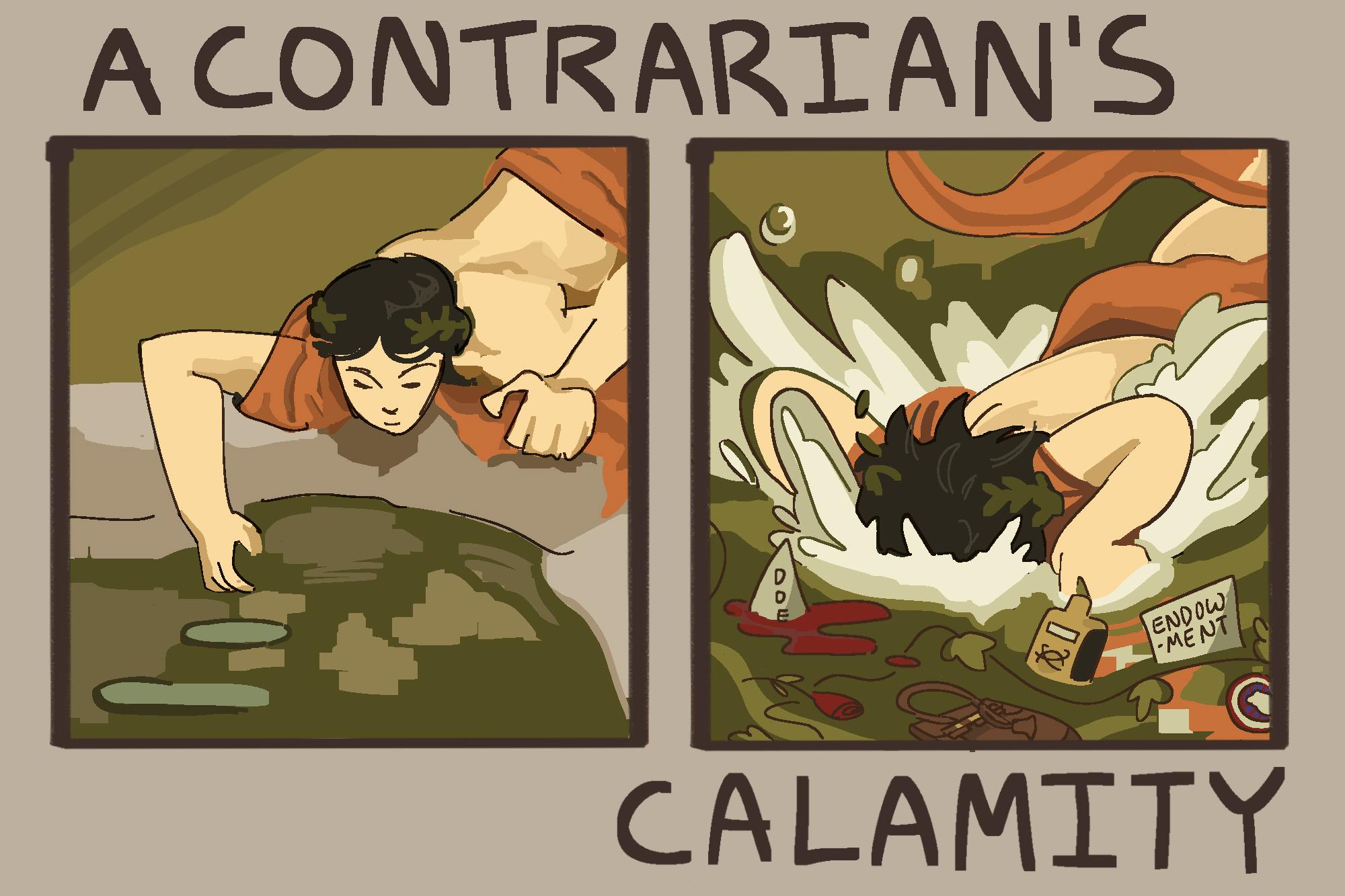
When calamities hit, as they so often do, most expect the drama of storybook catastrophe. This word, so pointlessly attached to beliefs in a doomsday event that plays out like recycled role-playing-game narratives or World War Z (2013) with its calamitous-looking Brad Pitt, isn’t so black-and-white. Disasters are not immediate. War is isolated in physicality and brute force, yet pervasive in its soft-power and chatty politics. And democracy dies not “in darkness,” but after repeated, conspicuous headblows — to the point of concussion.
My Calamity is a reflection of our calamity: an ongoing, slow burn of political agency, of humanity. This is obvious on the national and global fronts — from the federalized D.C. and her woeful (still) unrepresented constituents, to the fury in Gaza and a Sino-Bhutanese border on the tipping point. Through implicit, less “in-your-face” ways, our social and cultural surroundings present an ambiguous terror, too. Increased surveillance and content oversight farce as earnest protective measures but disenfranchise our trust in one another, forcing speech into domains decided by the state, the “coldest of all cold monsters,” in Nietzsche’s words. But it is especially at Cornell where, albeit confusingly, these manifestations are born, and where calamities make themselves known before lurching outwards. I hope — reader, Tankie, occasional lesbian — to clear this confusion.
Who is to say the University isn’t doing the usual rigamarole? To pay the bill, do your language requirement, get the degree and return with big bucks for an inevitable Clocktower reup is too simple an explanation for us big brains to accept. The campus is and has always been a testing ground for next-generation politics: from the upending of Willard Strait in ‘69 to Hans Bethe’s involvement in the Manhattan Project, from which fellow dorky nuke scientists fell into professorial roles. Things are calmer, if not less apparent to us now. But look close enough, and the calamity is abound.
The examples are understated but endless: A substitute for human ingenuity is made each time “vibe-coding” replaces Python in classtime. Cutthroat club competition separates the wheat from unworthy chaff, forcing slews of untailored suits into sweaty evening halls for the rush of acronym-boasting. Personality and passion are continually overshadowed by an admissions process which hasn’t innovated beyond replicable personal essays, lagging behind our elite peers who’ve reprioritized the need for sociability and moral character in their criteria. And on expression, a mere glance at our history shows that a largely youth-led resistance to campus and national politics has been replaced by oldheads who probably know President Perkins and The Ronettes better than Kotlikoff and Kehlani. Yet we still haven’t kicked the youthful folly that doomed such predecessors in their fight for civil rights, which began the trend of collective demands over mutual consensus with admin.
All of this isn’t to spell doom or regurgitate a predictable newscycle. There’s no use in reframing a complex political climate to suit the wants of student eyes and ears. That would be too easy and even more naïve, and Jubilee exists for a reason. It exists, rather, to make you think. Or at least read (something — anything!). Knowing that our exiting classes frequent the upper rungs of society is equally worrying as it is critical, in the sense that our progeny will, in one way or another, reshape broader society. It’s imperative then, that this column realizes the implications of our thoughts and actions as they rise in the present, and picks them apart with some quasi-journalistic rigor and a hint of satire, of course.
The Calamity will be as much yours as it is mine. If you feel inspired to extend your support, bring to light an oversight or burn the paper copy to ash, I have accomplished my goal. Because in a time of disorientation with the issues of today, a period marked not by debate and rationality but willing ignorance, a mere encounter with this paper, with those of my fellow opinion columnists and an unchartered world of alternative, sometimes wrong viewpoints, are potent cures against the powers that be.
The Cornell Daily Sun is interested in publishing a broad and diverse set of content from the Cornell and greater Ithaca community. We want to hear what you have to say about this topic or any of our pieces. Here are some guidelines on how to submit. And here’s our email: associate-editor@cornellsun.com.

Francis Xavier Jaso '28 is an Opinion Columnist and a Government and Economics student in the College of Arts & Sciences. His fortnightly column A Contrarian’s Calamity defies normative, dysfunctional campus discourse in the name of reason, hedonism and most notably, satire. He can be reached at fjaso@cornellsun.com.