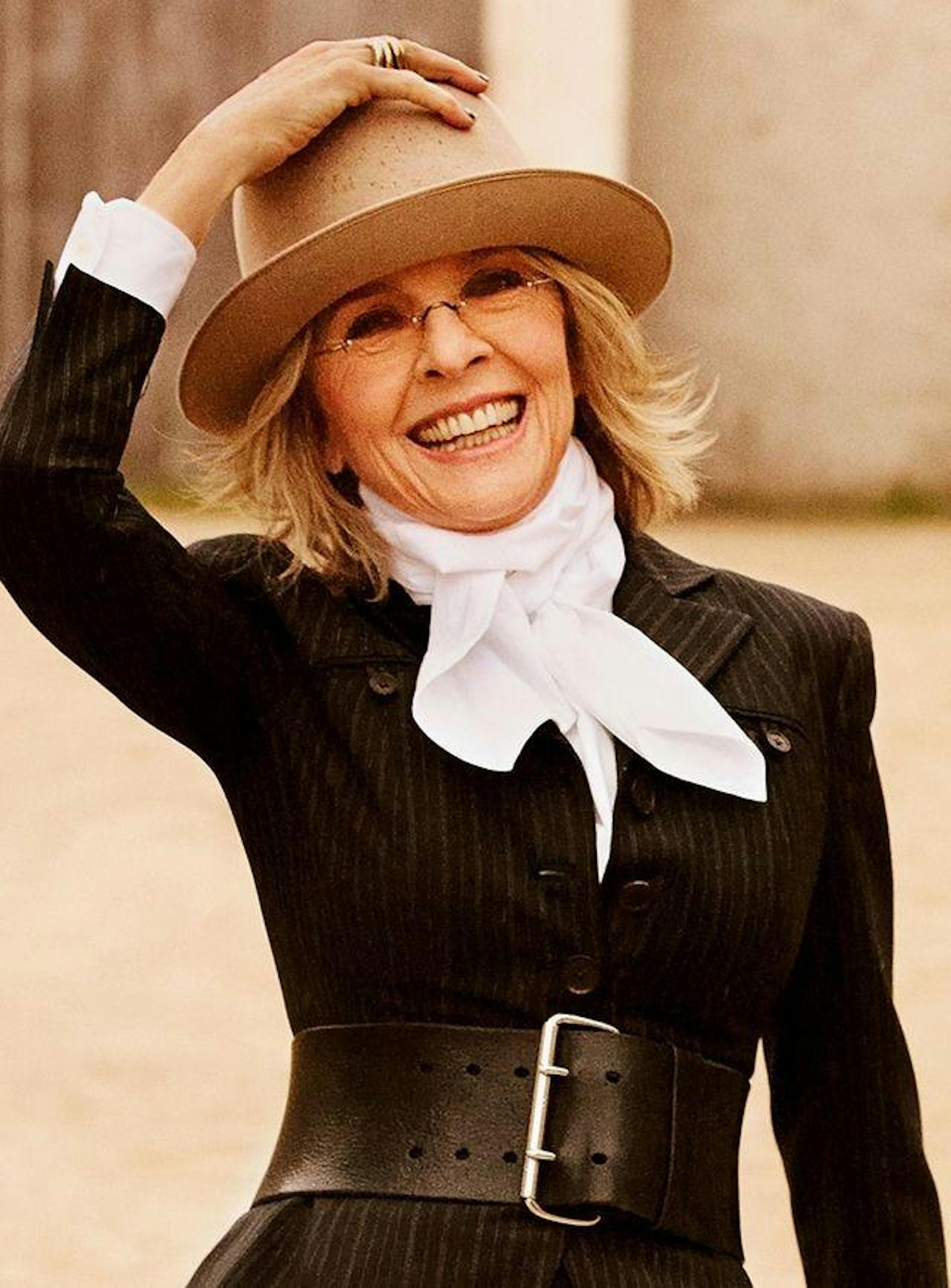
Oscar-winning actress Diane Keaton died at age 79 this past week on Oct. 11. Since the news, many collaborators and friends have issued statements on the positive impact she made through her life. She wore many hats: she influenced fashion from the ’70s onward in her adoption of men’s vintage clothing; she was a photographer who released piquant mixed-media pieces; she adopted and raised two children; and of course will be canonized most of all for the indelible impact she has left on film.
With over 70 acting credits and a career spanning six decades, Keaton was a major force in the industry. She appeared in the Godfather films as Kay Adams-Corleone, Michael’s wife, and in 1977 she won an Oscar for her performance as the titular character in Annie Hall. It is perhaps her role in this film, which was written as a semi-biography of her from Woody Allen’s perspective based on their real relationship (Keaton’s real last name is Hall), that best typifies what she uniquely brought to cinema. The character Annie Hall essentially is her.
In Annie Hall, she brings to the screen a new archetype, a kind of modern woman that hadn’t been represented before, or at least not widely. Her personality is a complicated mix of self-deprecation and nervous tics while at the same time being brazenly maverick and genuine. Many film critics have written about her performance, and to borrow some particularly memorable and apt descriptors, she is “the golden shiksa from the provinces who looks cool and together… but has only to open her mouth,” to reveal herself as “a social bungler,” “speaking in endearing little whirlwinds of semi-logic,” and in the words of Allen, “a nervous breakdown in slow motion.” She is intensely relatable. She speaks what most would keep as inner monologues out loud, “oh boy what a dumb thing to say… what a jerk…,” upon their first meeting, beaming at Allen in the hope this will void the need to say something (and probably saying the wrong thing). She is so resonantly awkward. She drives fast, comically swerving around obstacles by an inch, and when opportunity in the form of a producer funnily played by Paul Simon comes, she doesn’t balk but takes it head on, travelling across the country despite Allen’s protests.
She, as in real life forms liaisons with men (Woody Allen and Warren Beatty) similarly poised in the arts and imbibes from them a helping cultivation of her own aesthetic tastes, but it feels as if just as soon as she meets them, she springs off in a new direction propelled by her own edifying impulse. She isn’t fettered when she senses something on the horizon, but she takes and develops upon the good of every relation while it lasts. There is a vulnerable admittance of the intermingling between the identity of the partner and the self in Annie Hall. After they’ve broken up, Allen happens to see her going to a play he had recommended. And it’s an earnest reflection on how we inform our identity from the relationships we’ve had, but at the same time become more and more ourselves. When he meets her afterward, she’s still marching to her own wild tune, sparking along as if all the arbitrary turns of life had been her idea from the start, which I feel we all tend to believe.
Outside of Annie Hall, Keaton tackled many roles: her self-professed favorite, Something’s Gotta Give alongside Jack Nicholson (for which she received a fourth Oscar nomination and won a Golden Globe), a string of collaborations with Woody Allen in Love and Death and Manhattan and with her subsequent partner Warren Beatty in Reds. What most people likely know her from is her character Kay Adams in the Godfather trilogy. And though she voiced that in the first movie, she felt the role to be somewhat flat, and her experience on set mirroring that of her character as one woman among a crowd of men, she brought as much humanity to the role as could have been hoped, as a broken shell corroded by Michael’s ever-growing coldness.
And as a person, I think we can look to Keaton’s legacy for inspiration. She pursued her love of acting, and often expressed gratitude toward her mother for encouraging it. Like Annie Hall, she did what she wanted to do whether or not there was an intellectually patronizing Woody Allen in earshot, and saw the good in it all.
Tommy Welch is a senior in the College of Arts and Sciences. He can be reached at tsw62@cornell.edu.
Tommy Welch is a member of the Class of 2026 in the College of Arts and Sciences. He is a staff writer for the Arts & Culture department and can be reached at twelch@cornellsun.com.