


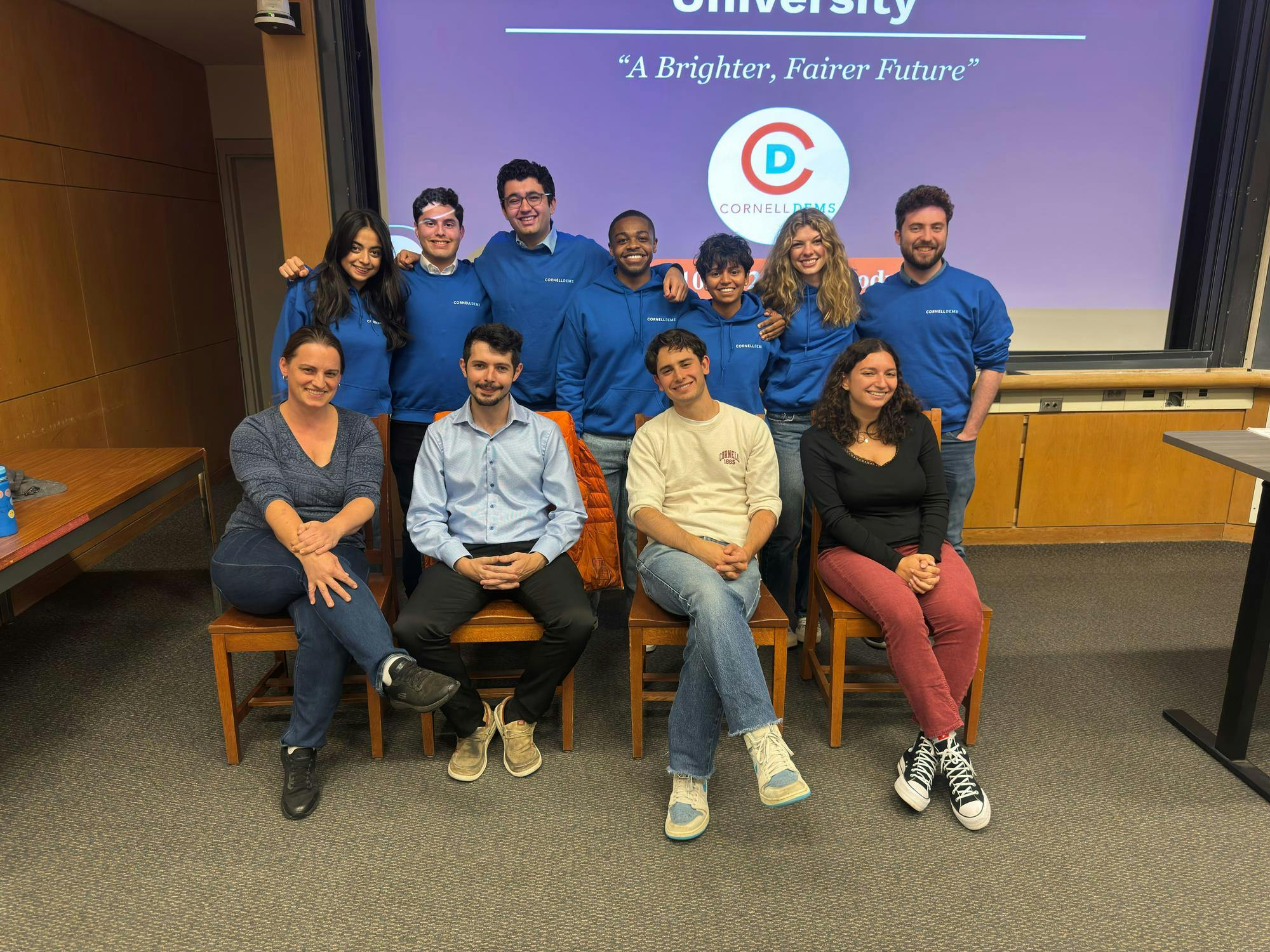
Four local Democratic candidates running for positions on the Ithaca Common Council and Tompkins County Legislature answered a range of student questions during a local candidate panel hosted by Cornell Democrats on Monday.
The panel included Tompkins County Legislature district four candidate Adam Vinson ’25 and district five candidate Prof. Judith Hubbard, earth and atmospheric sciences, as well as Robin Trumble and Hannah Shvets ’27, who are running for the fourth and fifth wards of the Ithaca Common Council. The four candidates spoke about the changes they look to implement if elected to their respective positions and discussed increasing Cornell’s contribution to the broader Ithaca community.
When asked how he would work with Cornell if elected to the county legislature, Vinson said that the county would benefit if Cornell contributes “what they owe.”
“Even just a small portion of what they owe could really offset some of the costs that we have to levy on other sorts of just regular residents,” Vinson said. “It would be good to have other sources of revenue, and right now, Cornell University doesn't give us that.”
In the past, many in Ithaca have called on Cornell to contribute more to the city, citing the University's tax exempt status. Preliminary Tompkins County 2024 assessment data shows that the University's property exempted from taxes totaled more than $3.8 billion and that $781 million of that tax-exempt property lies within the Town of Ithaca. However, in 2023, Cornell pledged to provide $4 million in an annual voluntary contribution to the city for 15 years and signed an agreement in 2024 to annually contribute $425,000 to the Town of Ithaca for 10 years.
Hubbard said that one of her main initiatives if elected is to try and fix how property taxes are distributed in Tompkins County. She claims that, over the last five years, the property taxes of individuals have increased greatly while commercial properties only saw a marginal uptick in taxes by comparison.
She suggested opting into a system of tax that could be implemented at the city and county level, which would “fix the ratios” of property taxes and lessen the imbalance.
For Trumble, it is Ithaca’s entertainment scene he wants to see the most improvement in.
“I've been pushing for more focus on the entertainment districts,” Trumble said. “That involves primarily, first and foremost, pushing bar times from 1 a.m. till 2 a.m. … I think a lot of people are underestimating how quickly we're losing our musical scene here.”
Tompkins County law currently requires alcohol sales to stop at 1 a.m. However, as a longtime service worker and current bartender at Personal Best Brewing, Trumble told The Ithaca Voice that bartenders earn most of their income in the last two hours before closing.
Shvets spoke about holding landlords “accountable,” an issue at the heart of her campaign since its launch in February. Shvets said that landlords should be capped on how much they can increase their rent. She also said that landlords have to be subject to higher standards of building maintenance.
“I know a lot of people live in apartments that are currently falling apart, with mold on their walls, and poor air conditioning that doesn't work, flooding and when they put in requests, they don't get any response from the landlord,” Shvets said. “Having regular check-ins with landlords, having higher codes of enforcement [is important].”
Shvets’ campaign is endorsed by several Ithaca-based organizations, including Ithaca Tenants Union, Cornell Young Democratic Socialists of America, and the Ithaca Democratic Socialists of America.
Niles Hite ’25, who serves as the president of Cornell Democrats, said that one of his goals with the event was to increase students’ awareness about the individuals running in local elections.
“This is a good opportunity for them to learn who their people that are representing them are, because there's generally a lack of transparency when it comes to local elections,” Hite said.
According to Hite, some residents may harbor “animosity” toward students who vote in local elections because many do not permanently reside in Ithaca. He emphasized that it is still important for students to participate in local elections because students are also part of the community.
“[Ithaca] is their home now, and they're here nine months out of the year compared to the three that they're at home,” Hite said. “You should vote here because you live in your community.”
Jenelle Rosales ’29 said she found the event intriguing because it provided a platform for candidates who may go on to create the laws affecting Cornell students.
“I thought it was really important, being a Cornell student, to see who the people are who are possibly going to be representing me,” Rosales said.
The event showed Hite the eagerness of students to participate in local elections. He said that the most effective way to create change is at the local level.
“I think that just shows general student enthusiasm to be engaged with the local governance process,” Hite said. “The best way to make change happen is to participate in local elections. Be the change that you want to see.”
Clarification: October 22, 5:22 p.m.: This article has been updated to reflect that the University in 2023 pledged to provide $4 million in an annual voluntary contribution to the city for 15 years.

Dalton Mullins is a member of the Class of 2027 in the College of Agriculture and Life Sciences. He is a senior writer for the news department and can be reached at dmullins@cornellsun.com.


