

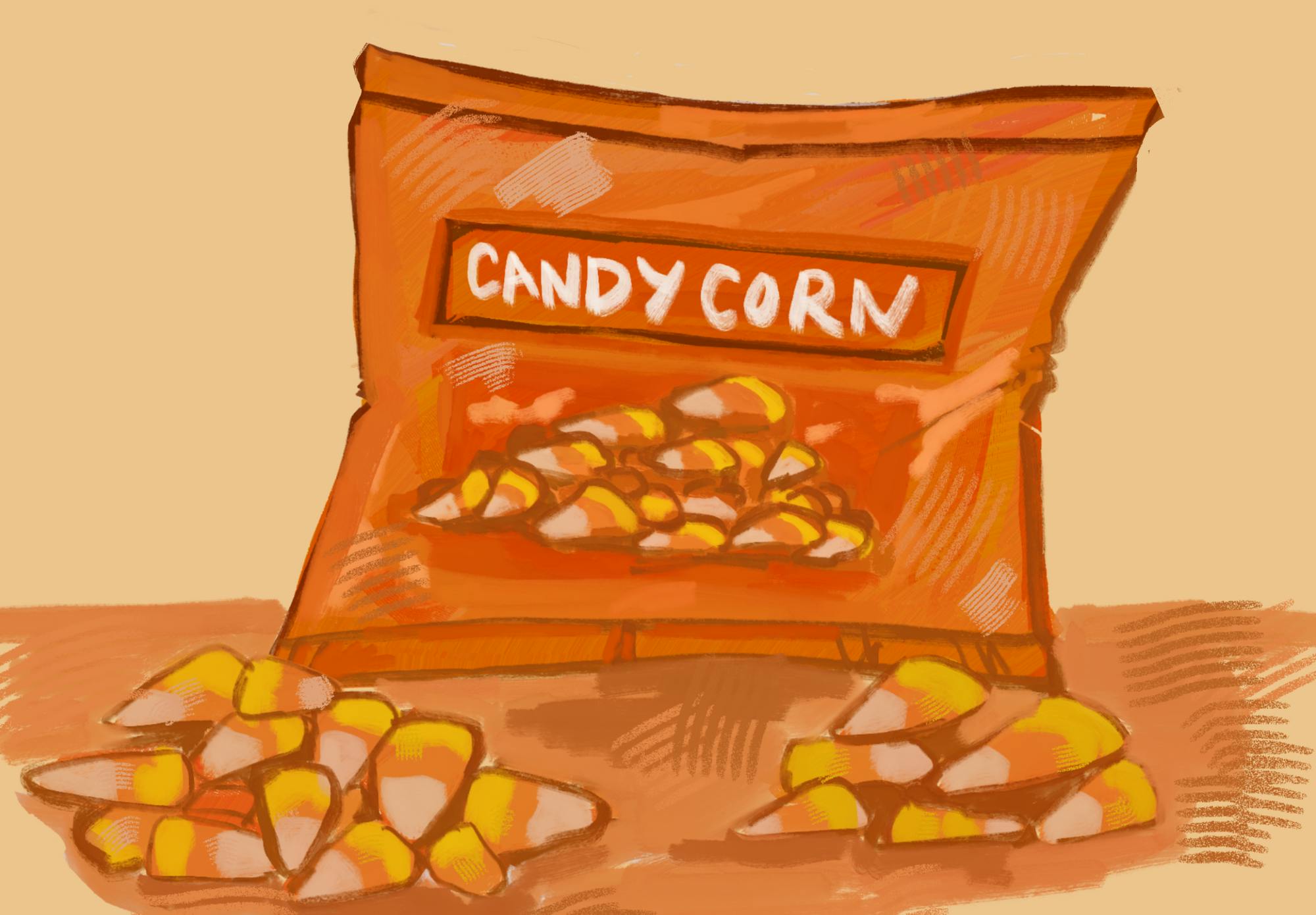
It is no secret that candy corn remains one of the most controversial confectioneries of Halloween. But why? Is it the unappealing way it looks more like a traffic cone than a corn kernel? Is it how your fingers imbue their weight in Red 40 before you can even pop it in your mouth? Is it the waxy, yet simultaneously hard texture that makes you wonder whether you ate a candle or swallowed your own tooth? I think the answer is more fundamental than that. To find an answer to our saccharine snag, we must look at what makes a quality candy.
Common favorites such as Milky Way, Twix, Reese’s Cups and Sour Patch Kids all have one thing in common —a combination of flavors and textures. For instance, Milky Way bars have nougat and caramel encased by a layer of chocolate, while Sour Patch Kids feature a sweet chewy gummy and a pleasant burst of sourness from its citric acid dusting on the outside. What I am getting at is that these candies are involved and complex — which is pretty opposite of the essence of candy corn.
Eating candy corn is like asking for seven pumps of caramel at your local Dunkin’ without the actual drink. Your tongue is buzzed with sugar, and you are left craving something to balance out that ungodly sweetness. After that gustatory assault, you are left with this chalky, waxy paste in your mouth, bringing you back to the time you curiously sampled the mud mask your aunt left after her last visit home (Just me? Never mind.) For all of the ways you can enrage your dentist, why candy corn? It seems like a waste of a cavity if you ask me.
Let me repeat it for those in the back: candy corn should be off the menu come late October. When you eat a kernel, all you taste is sickening sweetness, with nothing else to follow. Without the option of alternate flavors and colors, this Halloween disaster candy is all we are left with (though I doubt more flavors of candy corn could even help at this point). All in all, let us agree to leave candy corn on the figurative candy corn cob and not the bags of hapless trick-or-treaters.
If you are still unconvinced, think about this: every year, entire aisles of candy corn go untouched until November 1st, when they are shoved onto the clearance rack next to off-brand pumpkin spice candles. Do you ever see people stockpiling them like they do KitKats or Snickers? Of course not. Candy corn is the fruitcake of Halloween: tolerated, re-gifted and rarely finished. Even nostalgia cannot save it. Some claim it is “tradition,” but tradition alone does not make something good. If that were the case, we would still be handing out candied apples wrapped in wax paper, and no one is begging for those either.
So this October, let us do ourselves, and the children of America, a favor. Fill their bags with chocolate, gummies or even pretzels. Just leave the candy corn on the grocery store shelves.
And if you really want proof, just look around Cornell during Halloween week. Collegetown houses throw parties stocked with every variety of sugar imaginable, but you will notice the candy corn bowl is always the saddest one…half full and abandoned, like a group project Google Doc with no contributors. Dining halls like Keeton and Cook House make an effort with festive displays, even putting candy and sweet treats out by the registers for students to rummage through. But the candy corn? It lingers long after the brownies and chocolate chip cookies are gone. Even Libe Café, where students will line up twenty deep for pumpkin muffins and chai lattes, could put out a jar of candy corn and it would sit there untouched like it is part of the décor.
Cornell students are experts at stress-snacking — just look at the shelves of chips and chocolate raided during prelim season. Yet candy corn never seems to make the cut. That role is reserved for the emergency ice cream pint from Bear Necessities or a giant cookie from CTB.
So let us be honest with ourselves: if even a campus full of overworked, under-slept college students will not eat candy corn, then maybe, just maybe, it is high time we admit it was never that good to begin with.
I am also sure that there will be naysayers. Some will argue that candy corn is about more than flavor, but also tradition, nostalgia and the cozy feeling of fall. They will say that its iconic tri-colored design belongs in the Halloween canon, that biting into a waxy kernel is like biting into memory itself. And I will give them this: candy corn does look festive in a bowl, and it does photograph well for seasonal Instagram posts. I also do associate the candy with strictly Halloween, whereas other sweets such as chocolate may be less seasonal or event-specific. But we have to draw a line between something that is decorative and something that is actually edible. Candy corn just isn’t it.
Sahil Raut is a junior in the School of Industrial and Labor Relations. He can be reached at ssr247@cornell.edu.


