

If you are lucky enough to be obsessed with something, you might find yourself willing to go the distance, even if this goes against your core principles or those of the people around you. For me, that obsession is the natural world, particularly biodiversity. It is the driving force behind my passion and career, and it is what led me to a profound moment in my life: I tried whale meat.
Why, you might ask? Isn’t this a direct contradiction of the principles of a conservation ecologist? In part, yes, but my core thesis here is that some truths cannot be understood until they are experienced. Despite the reality that the experience may have a dark side, it is where theory meets practice.
There were physics professors who reluctantly contributed to the building of the atomic bomb, not knowing if theory would meet reality. Indeed, in 1939 Albert Einstein wrote in a letter to President Roosevelt: “In the course of the last four months it has been made probable … that it may become possible to set up a nuclear chain reaction in a large mass of uranium by which vast amounts of power and large quantities of new radium-like elements would be generated.” The physicists that later participated in the Manhattan Project knew full well that being part of such an effort had an ugly side, one that was used with horrific consequences.
The list of such paradoxical actions is endless, and perhaps it’s just what we do as humans. We are, it seems, if nothing else, excellent at justifying our actions. And in my case, that justification found its way to whales — and, well, to eating a piece of one such animal.
Whales are part of a remarkable group of animals, and their evolutionary history is a testament to the drifting lack of progression of life on Earth. The common ancestor of all vertebrates — a group of over 70,000 species, including fish, reptiles, amphibians, birds, and mammals — lived in the ocean. That ancestor gave rise to an amphibious creature that lived at the ocean-land interface. From there, evolution's magic began to work on land, giving rise to rodents, early mammals and many of the diverse forms we see today — from the beef cow and the domesticated pig to bats and primates like us. In and amongst that sprawling evolutionary tree was a branch that gave rise to what zoologists call cetaceans: ocean mammals, such as dolphins and whales. Remarkably, sea cows (manatees and dugongs) and seals are part of two other, entirely independent, radiations from land mammal ancestors back to the sea. The evolutionary journey of a whale from a small, wolf-like land animal, to a semi-aquatic creature like what paleontologists call Pakicetus, and finally to the majestic ocean-dwellers we know today, is a specular story of adaptation and change.
For an evolutionary ecologist like me, the genetic evidence is clear. Whales are closely related to cows and sheep, placing them in the same order — Artiodactlya, the even-toed ungulates — with their closest living relative being the hippopotamus. This biological knowledge is concrete, based on DNA sequences and phylogenetic analyses. And yet, even with that knowledge, the thought of eating whale meat brought to mind the texture of blubber and the sensation of something fishy. I experienced a mental conflict between biology and brain. So, on a family vacation to one of the three countries in the world that openly defies the international ban on whaling, I decided to confront that discomfort —- where I forced reconciliation between the theoretical and the practical.
The international ban on commercial whaling, effective since 1986 under the International Whaling Commission (IWC), was a crucial response to the declining populations of many whale species due to centuries of over-harvesting and incidental bycatch from large-scale fisheries. While whale meat was certainly a sustainable part of the diet of many indigenous cultures for millennia, industrial whaling had made it unsustainable. Still, Iceland, Norway, and Japan have not agreed to the IWC ban, though 88 other countries have. Most commonly, they hunt the minke whale —an estimated 500 to 1,000 are harvested per year. Given that there are hundreds of thousands of minke whales worldwide, these countries argue that a small, regulated hunt is sustainable and in line with their traditions. This complex issue, a conflict between conservation, cultural practice and economic interest, provides the backdrop for my experiment.
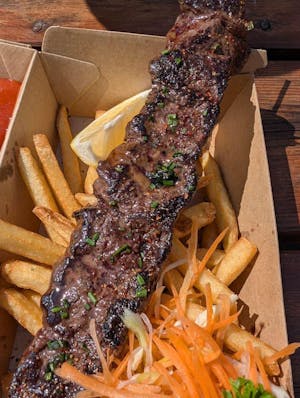
The meat itself looked like liver. Dark red strips piled on some ice in a cooler. For about $40, I received a skewer with around a quarter pound of meat, served alongside a pile of french fries. Notably, there was no blubber and it was decidedly beefy. It was not a subtle similarity, the meat had the distinct, earthy, mineral flavor of a rich cut of steak. Eating the whale turned abstract knowledge into reality.
The act of eating whale gave me the opportunity to confront intellectual knowledge of evolutionary relationships with sensory perception. My cognitive dissonance was resolved in a way that reading a textbook could not accomplish. I hope you'll forgive me, not for eating whale meat, but for the clarity that this act brought to my understanding of nature. It was an uncomfortable reminder that sometimes, the only way to fully understand a truth, is to eat it.
The Cornell Daily Sun is interested in publishing a broad and diverse set of content from the Cornell and greater Ithaca community. We want to hear what you have to say about this topic or any of our pieces. Here are some guidelines on how to submit. And here’s our email: associate-editor@cornellsun.com.
Anurag Agrawal is the James A. Perkins Professor of Environmental Studies in the College of Agriculture and Life Sciences. He is a field biologist and studies the Ecology and Evolution of Botany and Entomology. His column Candor and Chlorophyll runs periodically this semester, and was introduced here in 2024. He can be reached at profaagrawal@cornellsun.com. He also posts his pieces on bluesky.


