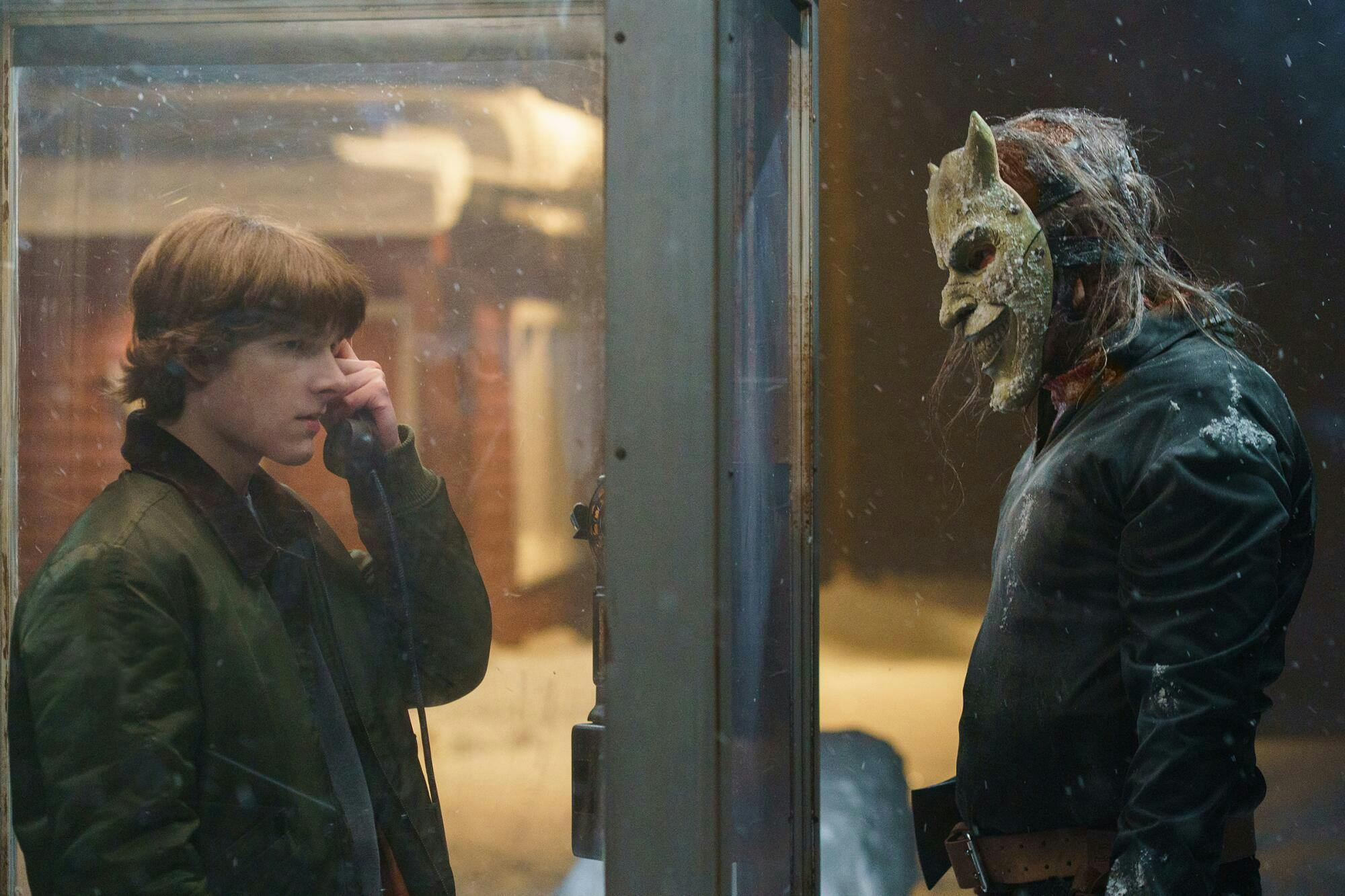
Following the 2022 release of teenage-dominant slasher era tribute and big screen adaptation of Joe Hill’s short story of the same name, The Black Phone had fans conjuring up rumor after rumor of an eventual sequel. Despite the largely positive reception and box office success achieved by the film, many were skeptical about whether or not there was room for more. After all, writers Scott Derrickson and C. Robert Cargill didn’t really leave any loose ends untied by the end of the film, with The Grabber, portrayed by Ethan Hawke, meeting his grisly demise at the hands of Finney Blake, portrayed by Mason Thames, assisted by the killer’s past victims in a heroic and compelling final sequence. Finney reunites with his sister, Gwen (Madeleine McGraw), who had been plagued with eerie, supernatural dreams throughout the film that provided valuable insight into the killings of past victims of The Grabber along with Finney’s possible whereabouts. It seems as if there are no questions left to be answered, no slashers left to be taken down. And yet, the phone is ringing again, four years after the events of this first installment.
Set in 1982, four years after the traumatic events that turned two innocent teenagers’ worlds upside down, The Black Phone 2 presents us with a battle-hardened Finney Blake who has turned to smoking as a means to cope with his trauma. This time around, Gwen has the spotlight as she becomes the primary mechanism by which the plot advances, experiencing a resurgence in her supernatural dreams which now serve as a connection between the living and the dead. In her sleep, she encounters distressing visions of the murders of three young boys in 1957 at Camp Alpine, a local Christian youth camp where Finney and Gwen’s mother had worked as a counselor at the time. Contrary to the first movie, Gwen’s visions don’t pull any punches in terms of gore factor — a certain change in direction from the more moderate displays characteristic of the film’s predecessor. As Gwen’s dreams begin to amp up, leaving her deeply distressed, Finney begins receiving mysterious calls from a payphone that turn out to be from none other than The Grabber, calling from hell. As Gwen and Finney seek to uncover the truth behind The Grabber’s origins and get rid of their nemesis for good, they embark on a trip to Camp Alpine that places them right in the splash zone of The Grabber’s hellish mischief.
All who enjoyed the mystery-driven plot and gritty atmosphere of The Black Phone are sure to find things to love about its continuation. The gloomy color grading, the immersive period piece environment, and the lingering involvement of the undead are all returning tropes in this second installment. A particularly interesting motif that is introduced in the film is that all of Gwen’s dream sequences are captured on an 8mm lens, allowing for a grainy, found-footage vibe that brings the viewer to the edge of their seat in suspense each time. These sequences establish a sort of obvious duality between the dream realm and the waking world — a trope which becomes a defining characteristic of the movie. The classic opening credits sequence also makes a comeback, accompanied by the spine-chilling theme that returning viewers will certainly recall. The film also brings back the ongoing beef between the foul-mouthed Gwen and condescending adults, as well as the healthy dose of campy optimism that sets these movies apart from the rest of the modern horror scene. I feel that this sequel did a spectacular job at preserving the precedent set by the first film while adding a strong dose of originality and even being unafraid to take more risks than its predecessor.
The performances in this film certainly delivered; to start, Madeleine McGraw’s portrayal of Gwen in The Black Phone 2 may even outclass her performance in the original. Scene after scene she brings raw, unfiltered emotion to the table as she portrays a young girl who is forced to see things that no teenager should ever have to see. She has her moments of heroism, moments of distress and certainly moments of the unapologetic sass that serves as her character’s trademark. In his portrayal of an older, more mature Finney Blake, Mason Thames does a splendid job of placing that trauma-hardened shell over a once-carefree young boy. He certainly portrays the duality that governs Finney’s character in this film, teetering on the line between the suppression and denial of his trauma and the emotionally-charged courage to face it. Miguel Mora makes an unexpected yet welcome return, portraying the role of Ernesto, the younger brother of Robin, Finney’s primary undead ally in the first film (whom Mora also portrayed). The innocence and obliviousness of his character provide a nice contrast to the solemn demeanors of Finney and Gwen as he becomes the final third to their trio. Last but certainly not least, Ethan Hawke reprises his role as The Grabber, and though his face is hardly shown throughout the film, he certainly resurrects the demonic essence of his character through his spine-chilling voiceovers and intimidating physicality.
If you’re comfortable with the handful of dark themes explored, including the murder of children and the unhinged desires of a morally-depraved villain, then this film will surely be a quality watch. As The Black Phone 2 delivers a compelling and undoubtedly entertaining story, it also shines an important light on vulnerable themes like family trauma and critiques of religious fundamentalism. All things considered, it is certainly a welcome addition to Scott Derrickson’s filmography and the perfect film to keep viewers spooked this Halloween.
Jordan White is a freshman in the College of Arts and Sciences. He can be reached at jiw39@cornell.edu.

Jordan White is a member of the Class of 2029 in the College of Arts and Sciences. He is a columnist for the Arts & Culture department and can be reached at jiw39@cornell.edu.