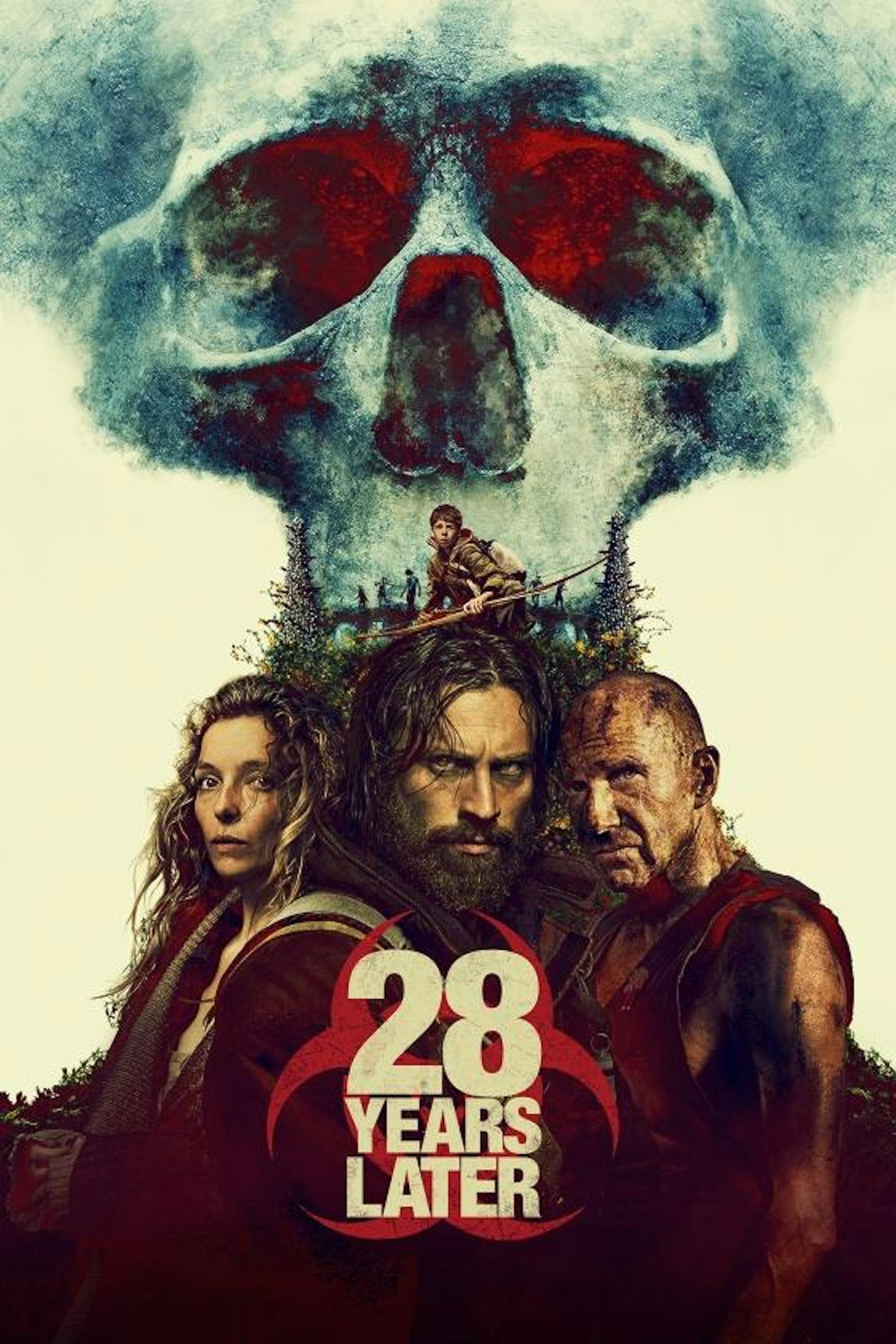
This summer has been a great one for movies, and between blockbusters like Superman and Jurassic World: Rebirth, it might be easy to let 28 Years Later slip by. In the long-awaited follow up to 2002’s 28 Days Later and 2007’s 28 Weeks Later, writer Alex Garland and director Danny Boyle return to imagine what the UK might look like nearly thirty years into the zombie apocalypse. 28 Years Later might not have the mass appeal of other summer releases, but 3 months after seeing it in theaters, it’s still on my mind.
28 years after the Rage virus outbreak, British society has remained frozen in time. After almost three decades isolated from the rest of human society, the quarantine zone still reflects the cultural iconography of 2002. Beyond that, in the absence of government, we find that society has created cultlike communities still upholding traditional cultural norms.
It is in one of these communities that Boyle introduces his protagonist, 12-year-old Spike (Alfie Williams.) While his mother, Isla (Jodie Comer), is left at home suffering from an unknown illness, his father, Jamie (Aaron Taylor-Johnson,) trains his son to hunt down the remaining infected. Isolated on the gated island of Lindisfarne, we see children attending school, women completing domestic tasks and men training the next generation of hunters. Spike’s world is limited to the island and the teachings of his father. The conservative culture of Lindisfarne is all he knows, aside from the odd story from life before the outbreak.
In some ways, 28 Years Later is best categorized as a coming-of-age story. It is only when Spike leaves the island for the first time that his world expands and he begins to reckon with the failings of his father’s teachings. Jamie’s insistence that the infected are "soulless" is challenged by Spike’s discovery that the mindless zombies of 28 Days Later have begun to form a culture of their own. So-called Alpha zombies have evolved into intelligent beings that lead their own functioning societies.
Spike’s discovery of the world beyond Lindisfarne is facilitated by his mother, portrayed beautifully by Comer. While her illness causes others to doubt her capabilities, Spike’s trust and love for his mother allows him to find empathy for those his father and the rest of their society have cast aside. Spike is also willing to do the unexpected to save the people he loves. When Jamie refuses to seek out Dr. Kelson (Ralph Fiennes,) a former GP whose strange ideas have pushed him into exile, Spike searches for the only person who might be able to help his mother.
Spike’s internal struggle comes to a head when he and Isla discover a pregnant infected woman going into labor. While the soldier escorting them reacts with violence, Isla chooses to take the hands of the woman, helping her through an intimate moment. It is here that Spike finds himself at a crossroads between the world he has left behind and the world he is discovering for the very first time. He chooses to help Isla, thereby casting aside his father’s lessons and instead embracing the empathy of his mother.
28 Years Later is a horror film, but its scares are much fewer than its predecessors. Whereas the first two films enjoy imagining how the world might respond to such an outbreak, Garland and Boyle are now more interested in exploring how society will change in the wake of the apocalypse and how, in many ways, it will stay the same. Jamie and the island reflect the closed-mindedness of our own world and human beings’ tendency to return to the familiar in times of struggle. Meanwhile, Spike’s journey tells the story of a young boy breaking free of traditional society, finding companionship in unexpected places and forging his own path into the unknown. In many ways, this is a story as old as time.
28 Years Later is the first in a new trilogy set in this post-apocalyptic world. To begin this new story, it makes sense that, in many ways, 28 Years Later shows a shift away from traditional horror and towards a deeper commentary on society that will continue to be explored. I, for one, am incredibly excited to see what Garland and Boyle choose to explore next.
Nicholas York is a junior in the School of Arts and Sciences. He can be reached at nay22@cornell.edu.
‘Projections’ is a column focused on reviewing recent film releases. It runs every other Monday.
Nicholas York is a member of the Class of 2027 in the College of Arts and Sciences. He is a columnist for the Arts & Culture department and can be reached at nyork@cornellsun.com.