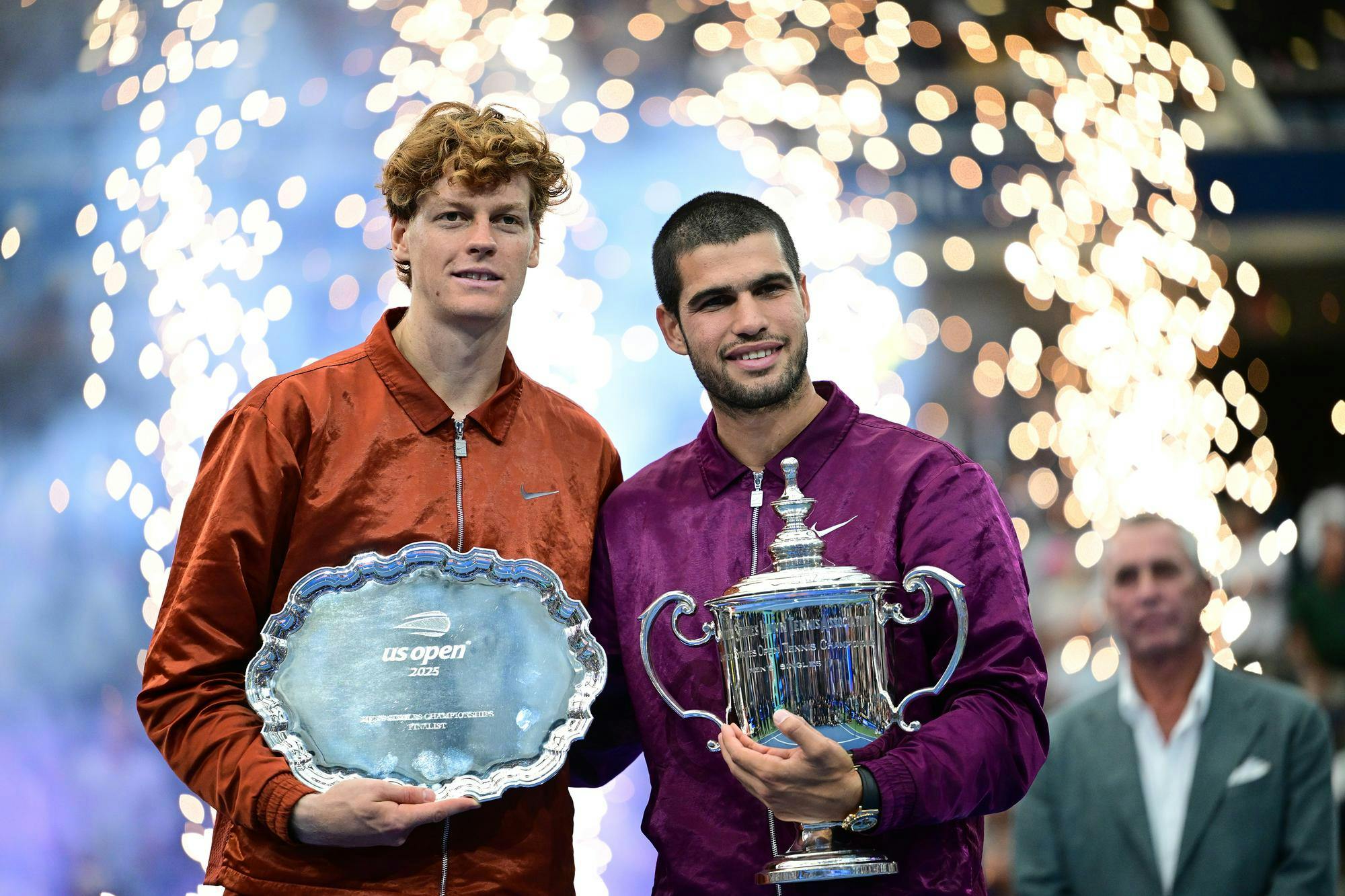
Last week, Jannik Sinner and Carlos Alcaraz met at the final round of the US Open, their fourth Grand Slam meeting this year. For those who might not be well-versed in tennis, that’s all of them. Alcaraz even joked with Sinner upon receiving the trophy, “I see you more than my family.” The two are currently dominating men’s tennis … and many people’s daydreams.
Nowadays inside thoughts are easy to broadcast to the world, and people aren’t shying away from expressing their love for the two players. Admiring their game, style, who they are as people, and even their looks can be done in a respectful manner; however, there’s been an outpour of online content transposing these real life people onto Art Donaldson and Patrick Zweig — fictional best friends turned lovers(?) turned enemies of Luca Guadagnino’s Challengers. The 2024 sports romance follows the professional tennis players and their convoluted relationships with Tashi Duncan, an ex-tennis player. Bursting with sexual tension, the film is a love triangle, one that connects on all sides at some point. While this definitely makes for a compelling story, it seems people are forgetting that’s all it is: fiction.
Instead, they’re treating real athletes like characters, crossing lines left and right. They’re watching Carlos Alcaraz and Jannick Sinner’s rivalry and making it sexual.
As fan edits likening the two athletes to these characters roll out in the wake of the US Open, it's becoming increasingly clear that some fans can’t distinguish between fiction and reality, and instead are actively bypassing the line to make real people fit into fictitious roles — sexually charged ones at that. As one X user wrote, “jannik lost but at least the homoerotic sincaraz tiktok edits are gonna eat.”
“Sincaraz” is a ship name that alludes to a romantic relationship between the players, and it comprises a whole category of edits. One TikTok user spliced clips from the movie with clips from the US Open and other Sinner/Alcaraz matches with the love song “Sienna” by The Marías, highlighting the lyric “like you” multiple times to equate Alcaraz to Patrick and Sinner to Art. Shipping fictional characters is a normal part of being a fan, one that can make interacting with content more engaging by giving viewers something to root for, but doing it with real people is just plain weird. Not only does it broadcast an insinuation of a sexual relationship between people who are essentially colleagues, but it does so without their knowledge or consent.
Other people are going fully parasocial with it and inserting themselves into the Challengers triangle. Another TikTok user shared clips of Alcaraz and Sinner during the US Open with the text “how do i become the zendaya in this situation.” This refers to Tashi, Zendaya’s character, who ping-pongs between the two boys throughout the film, not always monogamously. One of the most pivotal scenes of the movie, which is featured in the trailer, follows what appears to be the beginning of a threeway between Art, Tashi and Patrick. Basically, this user is very loudly proclaiming that she wants Sinner and Alcaraz at the same time … yeah. At the time I’m writing this, 45.3 thousand people seem to agree.
Because of the nature of TikTok, these edits are reaching people who don’t even watch tennis. Their only knowledge of Sinner and Alcaraz is limited to what they get from them, leading some to believe that the two are in a relationship. “ban #sincaraz yaoi shit.. pls like this is SO bad. Non tennis people actually think that they are lovers,” writes @jannikfritzz on X.
Unfortunately, the sexualization of athletes as a result of a misuse of sports media has become somewhat of a widespread phenomenon in recent years, and isn’t unique to Sinner and Alcaraz, or even tennis. Because of athletes’ celebrity status, it’s easy for fans who have only ever seen them through screens to forget that they are not, in fact, fictional characters like those of Challengers. They are real people who can be made to feel uncomfortable by situations like this one, and yet the users who create this content don’t appear to recognize the issue.
So, how has this objectification become normalized online? It’s a unique product of the internet and the widespread media literacy crisis. Media Literacy Now writes that part of media literacy is the ability to “create media … in a way that is thoughtful, conscientious, safe, and responsible.” Users like these and many of those who support their content aren’t able to discern what proper use of social media is. They sexualize and objectify athletes with complete disregard for the implications of what they are doing, and because of the internet, are easily able to broadcast it to thousands of people without consequences. Even worse, algorithms tend to present this content to users who are likely to enjoy it, so creators are even rewarded for their actions when others with a similar lack of media literacy react to their content with praise. Round and round we go.
The issue doesn’t lie in sports media like Challengers, but in consumers’ inability to think critically and separate the real world from fiction. We each have the responsibility of interacting with the content we consume appropriately and of being mindful about the messages we send out into the void of the internet. However unlikely it may seem, there’s real people on the other side whose lives and personal relationships can be affected by what we post.
Next time Sinner and Alcaraz meet at the net with a friendly hug, which is inevitable with how well they’re both playing, remember to keep the fiction at the movie theater. This is the big leagues.
Rafaella Gonzalez is a senior in the College of Arts and Sciences. She can be reached at rgonzalez@cornellsun.com.

Rafaella Gonzalez is a member of the Class of 2026 in the College of Arts and Sciences. She is a staff writer for the Arts & Culture department and can be reached at rgonzalez@cornellsun.com.