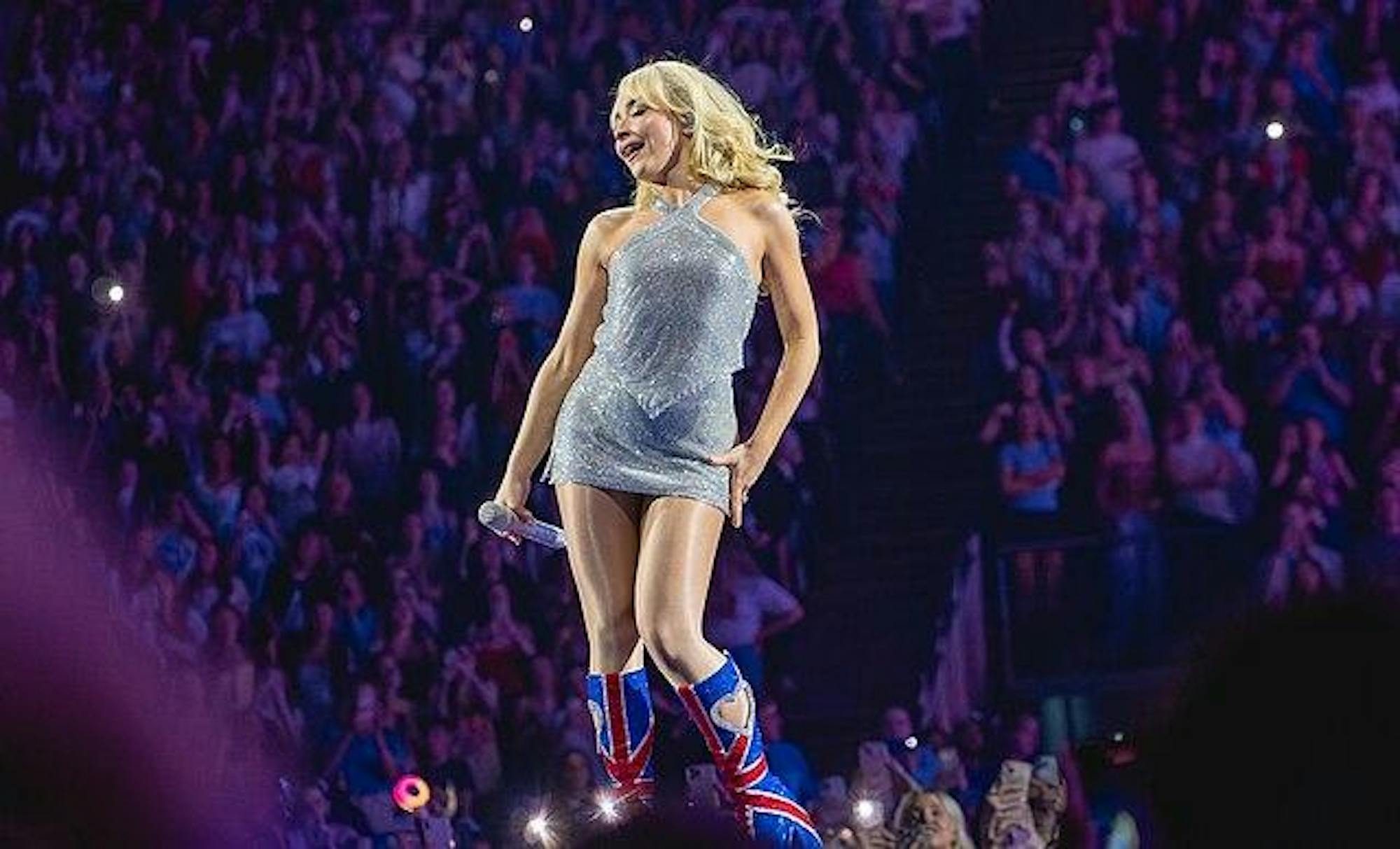
Around a week ago, the MTV Video Music Awards was broadcasted nationally, with 5.5 million viewers tuning in to see who made the cut of the most watched and loved music videos of 2025. Of course, our usual suspects like Tate McRae, Sabrina Carpenter and Ariana Grande were in attendance. Tate and Sabrina even graced our screens with performances of their hit songs “Revolving Door” and “Tears.”
Growing up, watching music award shows was a big part of my childhood; my family would pile into bed and anxiously wait for the celebrities to line up on the red carpet. This was the era of Rihanna, Miley Cyrus, One Direction, Bruno Mars and Justin Timberlake — a little different to our music economy of recent days. And while, of course, these performances were exciting, the main focus was still on the music, the singing, the art. Recently, with the rise of TikTok, I’ve noticed a downward spiral regarding the quality of music that is being put out by larger record labels. It’s hard to say whether the grade of music created has decreased, or if listeners simply care less about the music and more about the persona of the musician.
Music relies heavily on the musician: the persona brings to life the music, the album, the story of the sound. However, music cannot rely solely on the artist. For example, Tate McRae’s VMA performance which wowed not with her singing but with her dancing. McRae originally gained a following through being a dancer, something that she has clearly carried over into her recent career of being a popstar. While her performances are exciting and detailed with advanced choreography, the music itself is nothing special. Her voice, while not terrible, is being used in a genre where it can’t reach its fullest potential. As of late, there has been pressure on musicians from record labels to produce music they know will sell well. Whether on TikTok or the radio, these musicians are a commodity blocking them off from experimenting and truly expressing themselves through their music.
Benson Boone is another great example with his sparkly outfits, side gainers and overall lackluster music. His songs are mediocre, but his persona is exceptional. No one is going out of their way to see him yell “Moonbeam Ice Cream,” but they are going to see him do a backflip in a head-to-toe sequin-covered suit. And yet, a five-minute-long video of Boone standing in one place, wearing a plain black shirt and black pants singing Harry Styles’ “Sign of The Times” came up on my TikTok feed and I was riveted. For the first time, I could hear his true voice and a snippet of the talent that everyone seemed to be so clued in on. Boone, normally a singer of upbeat radio pop songs, leaned into a slower ballad that fit perfectly into his range. I was appalled. Why wouldn’t he sing these types of songs that so clearly fit his vocal range? Why is it that these musicians churn out shallow and frankly unoriginal music that doesn’t push the boundaries, but dedicate time and effort into creating a popstar persona?
Sabrina Carpenter had been hoping to break into the music industry for years after her time on hit show Girl Meets World. It wasn’t until she put on a pastel corset, bleached her hair and incorporated witty outtros that she started gaining popstar recognition. The ditzy persona launched her into the spotlight, not her bewildering vocal talent or introspective music. Audiences love a spectacle, preferring a performance over true and raw talent. Since the rise of Tik Tok, there is such an oversaturation of talent that vocal abilities are simply not enough to get noticed anymore. Now, you need a unique angle that makes you different from the rest of the pool of talented musicians. Music is no longer about the music itself, but who you cater to and how you present yourself.
Eve Riskind is a junior in the College of Arts and Sciences. She can be reached at elr229@cornell.edu