

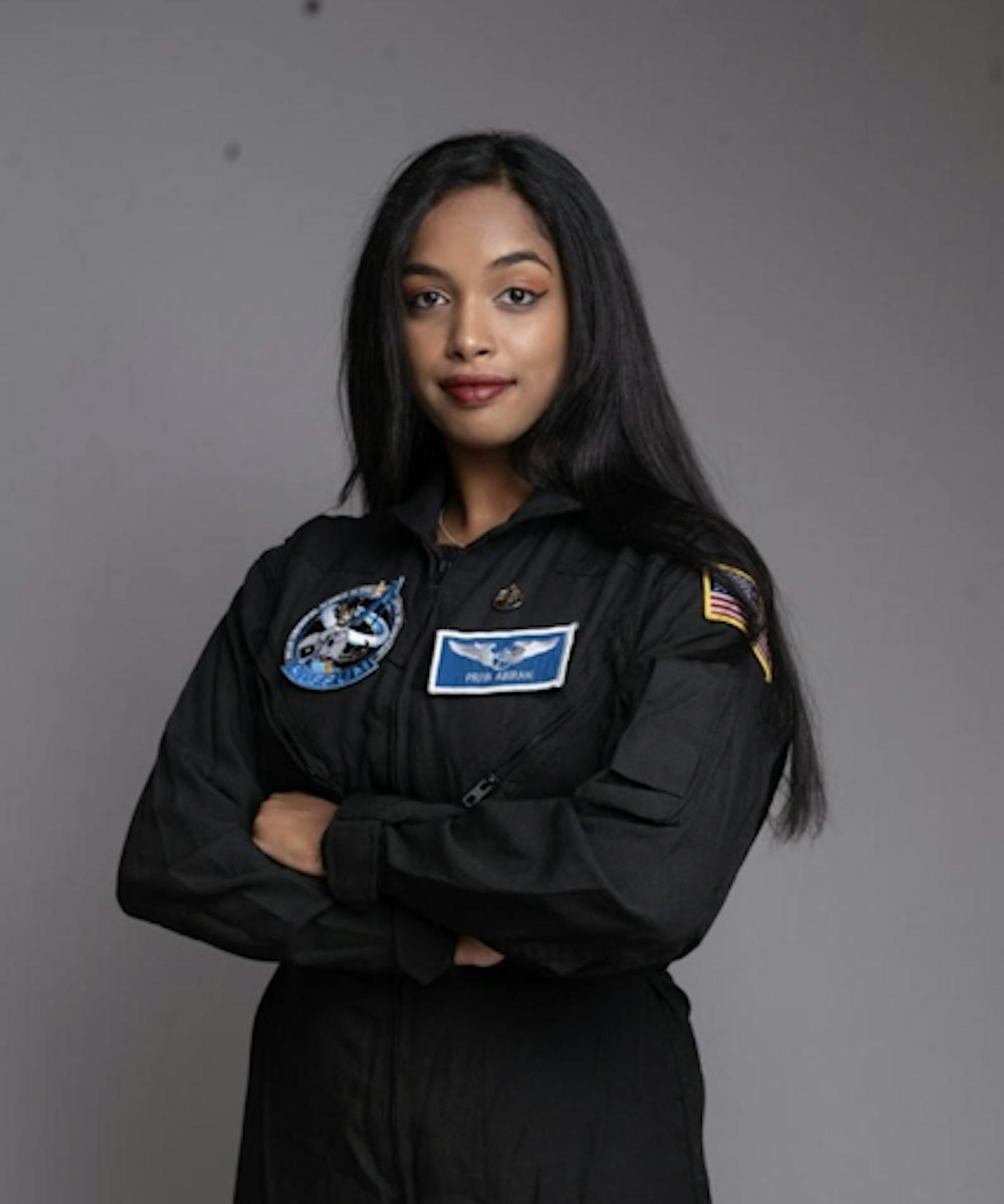
When Priya Abiram ’26 visited NASA for the first time at seven years old, her father pointed to a rocket and told her, “Rockets are the hardest thing man has ever built, and it is even harder to fly in one.” In that moment, a deep fascination with space was born, leading to her mission to become an astronaut and help lead the nation towards solving its greatest challenges.
As a member of the Cornell Rocketry Project Team’s Recovery and Payload subteam, Abiram designs, assembles and launches high-powered rockets. She has contributed to key systems on the rockets, such as the guided recovery system — which steers a rocket to a precise landing point after launch, the deployment mechanism for the rocket’s main stage separation — or the catalyst for takeoff, as well as the overall launch vehicle layout.
Abiram also worked on a ram-air parachute that can autonomously land at a target site. Cornell Rocketry is striving to achieve guided descent, a process where a rocket actively steers and decelerates the rocket for a controlled landing at a specific point. They have been close to achieving this advancement, a proud accomplishment of Abiram and the team.
Abiram dreams of landing on Mars, not only to explore, but also to act as a bridge for the next generation of explorers.
“The ability to conquer areas outside our comfort zone excites me to not just build civilizations on other celestial bodies, but to bring our planet to a common vision,” she wrote in an email statement to The Sun. “Through the journey, I look forward to leaving a mark by showing the next generation, and our future alien friends, what our species did with our time here.”
Abiram has already had significant experiences in the aerospace industry through internships at organizations such as NASA, Blue Origin and Inversion Space. These experiences have allowed her to experience firsthand the structured, systems-driven approach of major aerospace organizations. One of her favorite projects was designing and testing a full-scale drop test vehicle for parachute recovery systems at Inversion Space.
Drop-test vehicles are designed to be dropped from a certain height to determine how a prototype reacts to impact. Often, these vehicles are used as trials to see if safety and structural standards are being met. Abiram worked on a prototype designed to simulate how a real payload or spacecraft would land with a parachute.
Public speaking and scientific communication are key markers of Abiram's journey. Through speaking to aspiring engineers at conferences or presenting her research at the International Astronautical Congress — where she won second place — she aims to inspire others and share her unique perspectives on space exploration and beyond.
“I enjoy breaking the stereotype and being the inspiration to young girls as I rise above social and cultural norms,” she wrote. “I take pleasure in sharing my unique perspective of our planet, redefining our limits, and inspiring others about their passion.”
Abiram also emphasized that, at its core, the aerospace industry is a human frontier. Though the industry involves satellites, rockets and other technical aspects, people are behind these advancements. She thus emphasizes the importance of interdisciplinary collaboration, mentioning groups such as policy experts, public affairs teams, business professionals and more. In the future, she plans to work towards making the aerospace industry more collaborative and human-centered.
In the future, Abiram hopes to complete her Master’s in Aerospace Engineering and work full-time as an aerospace engineer, working on human spaceflight and life support systems. She also hopes to earn an MBA to eventually become an astronaut and a launch director, all while continuing to inspire the next generation.
“When opportunity doesn’t knock, build a door. Don’t take no for an answer,” Abiram wrote as advice to those aspiring towards goals similar to hers, especially women and other underrepresented groups in the industry. “Show up as your full, authentic self, and don’t be afraid to take up space—literally and figuratively. Make noise, make moves, and remember that you belong in this industry.”
Bhavya Anoop can be reached at ba436@cornell.edu.


