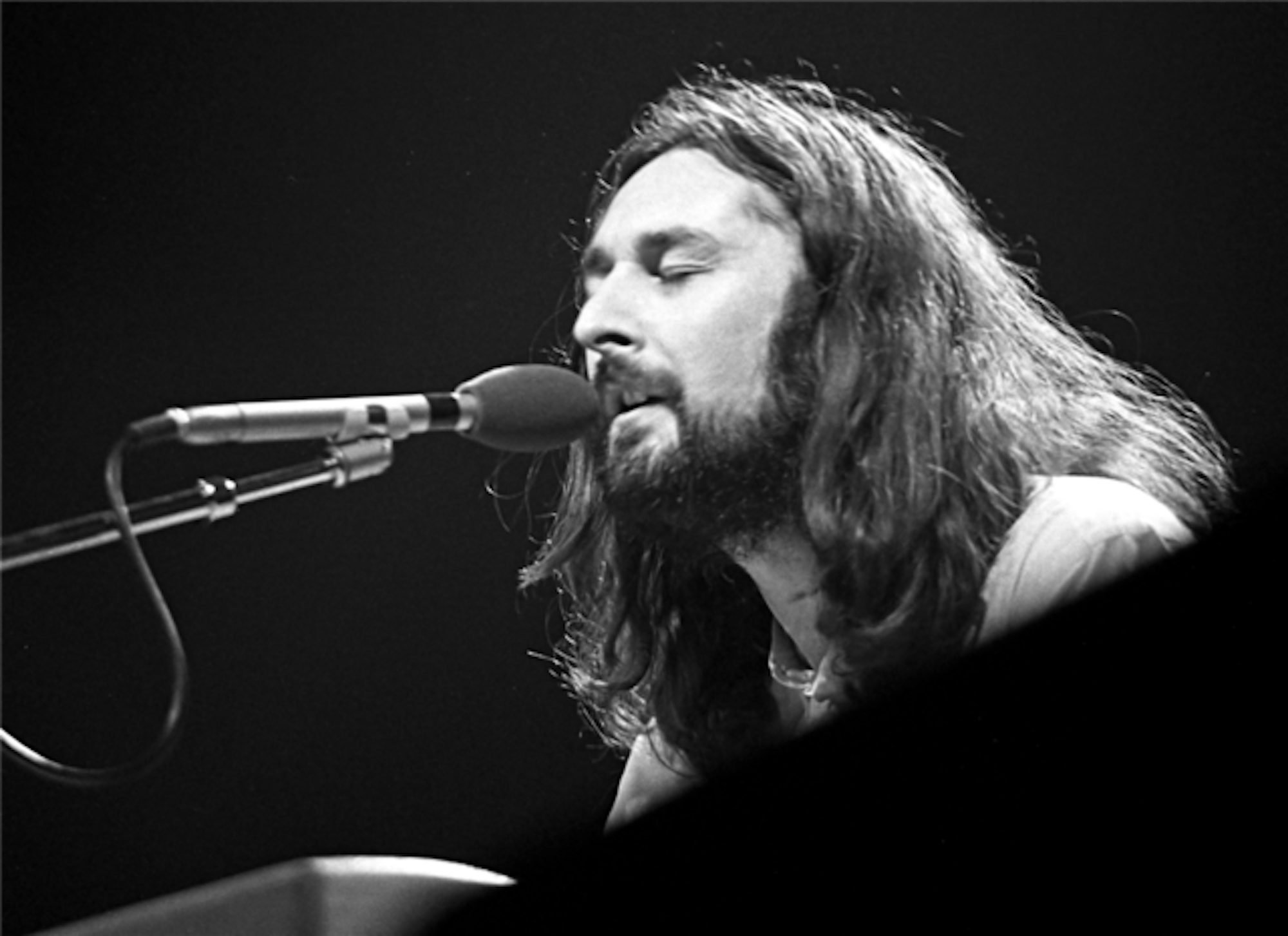
The seventies were a period of rapid musical innovation and tireless exploration, and no other band explored the intersections between the blues, progressive rock, jazz and classical music as persistently as Supertramp did. Led by the one of rock history’s most prolific yet overlooked songwriting partnerships in Roger Hodgson and Rick Davies, Supertramp took a seemingly unlikely match and produced a writing force as revolutionary and infallible as the likes of Jagger-Richards, King-Goffin and Lennon-McCartney. The death of Davies on Sept. 6, 2025, marks the end of their marathon career.
Rick Davies was born in Swindon, Wiltshire, England in 1944 to a working-class family. A snare drummer at school, Davies eventually taught himself the piano and formed Supertramp with Roger Hodgson, a private-schooled multi-instrumentalist from Oxford. Their differing backgrounds are apparent in their most lauded works which tackle a range of subjects, including disillusionment, spirituality, self-discovery, yearning and the British education system. This contrast extends to their singing voices; Davies grounded Hodgson’s thin, keening countertenor with his earthier baritone. By 1974, their classic lineup was established, comprising Hodgson on guitars and keyboards, Davies on keyboards, as well as John Helliwell on saxophone, woodwinds and keyboards, Dougie Thomson on bass and Bob Siebenberg on drums. Supertramp’s keyboard-laden arsenal attracted comparisons to progressive rock and fruitless attempts from critics to pigeonhole them into a category. One association stuck; the Wurlitzer piano became an integral part of their signature sound.
Supertramp broke through in 1974 after signing to A&M Records and releasing Crime of the Century. The album showcased Hodgson and Davies’s writing dynamic at its best; the track listing alternates between Hodgson’s and Davies’s songs, as well as several co-writes. Hodgson’s “Hide in Your Shell,” “Dreamer” and “If Everyone Was Listening” are lighter, loftier, even whimsical at times. Davies’s “Bloody Well Right,” “Asylum” and “Rudy” are bluesier, hardier and more ruminative. Co-writes “School” and “Crime of the Century” bookend the album. The album opens with a blues harmonica solo courtesy of Davies, before Hodgson begins the verse on his guitar, singing about the limitations of the British education system and the disillusioned youth it produces. The song leans far into Supertramp’s progressive tendencies, building up to a blistering piano solo from Davies as the rest of the band kicks in. On the title track, another fading piano solo closes the album. Crime of the Century remains one of the most powerful rock albums of the ’70s, and a redefining statement on the concept album and progressive rock.
Several years of touring followed and Supertramp scored another hit with Hodgson’s “Give A Little Bit,” their biggest song to date. 1977’s Even in the Quietest Moments… closed with the momentous “Fool’s Overture,” an eleven-minute semi-orchestral masterpiece written about humanity across history and inspired by Winston Churchill’s wartime speeches. At the turn of the decade, the band relocated to Los Angeles, a decision that would influence much of the writing for their biggest album. 1979’s Breakfast in America topped the U.K. and U.S. charts upon release and saw the band take a more commercial approach to their songwriting and recording. The album loosely centers around themes and dreams of traveling, as well as feelings of disillusionment and childlike wonder that accompany the trip. Hodgson’s “The Logical Song” is another product of his boarding school education, a condemnation of its failures in guiding lost youth on their journey to adulthood. The title track expresses British stereotypes of America as a fictitious traveler’s thoughts on the matter and ends with one of Helliwell’s most beloved saxophone solos. “Take the Long Way Home” is another exploration of self-discovery and the desire to find a sense of belonging. Davies’s “Goodbye Stranger” takes the traveler’s point of view and explores the excitement of travel, as well as the sentimentality in leaving places and people, even strangers, behind. The verses dance upon Davies’s bouncing Wurlitzer, describing a wanderer’s bittersweet farewells and desire to keep on moving. Hodgson starts the chorus in his light countertenor and is joined by Davies trading lines as the band kicks in. The instrumental second half sheds all the emotion and accompanies the roving narrator with an uptempo jam. Hodgson plays the band out with a career-defining guitar solo that winds over, under and between Davies’s pounding Wurlitzer.
Breakfast in America as a whole became a career-defining magnum opus for Supertramp. Retaining their meticulously-produced sound but distilling their writing into the short-song format, Supertramp soared beyond their critics’ stringent categorizations and blended the blossoming tradition of British prog with well-written pop songs. Hodgson and Davies’s voices lend themselves perfectly to the everyman’s sing-along while offering a distinct contrast rarely heard in popular music.
The following decade saw Supertramp’s decline as the rift between Hodgson and Davies began to grow and the cracks began to show. Hodgson departed in 1983, and the band continued with Davies as principal songwriter. They lasted another five years before quietly stepping away from the limelight. A reunion with Hodgson followed a decade later, along with several returns to the road. By the 2000s, Davies’s Supertramp and Roger Hodgson were touring separately. The band’s intermittent touring halted with Davies’s cancer diagnosis in 2015. He remained retired until his death a decade later.
Supertramp’s legacy, sealed at last, is as grandiose as it is saddening. One can only wonder at what could have been had Hodgson and Davies written in each other’s presence for another decade. Some partnerships remain as essential as they are flawed, and sometimes there is nothing more to do than appreciate the music and remark at lost potential. Supertramp leaves us with decades of music, with the legendary partnership of Roger Hodgson and Rick Davies and with the twinkling of the Wurlitzer. Silenced as they are without Mr. Davies, their music remains to be heard, somewhere, even in the quietest moments…
Josh Yiu is a junior in the College of Agriculture and Life Sciences. He can be reached at jy793@cornell.edu.