

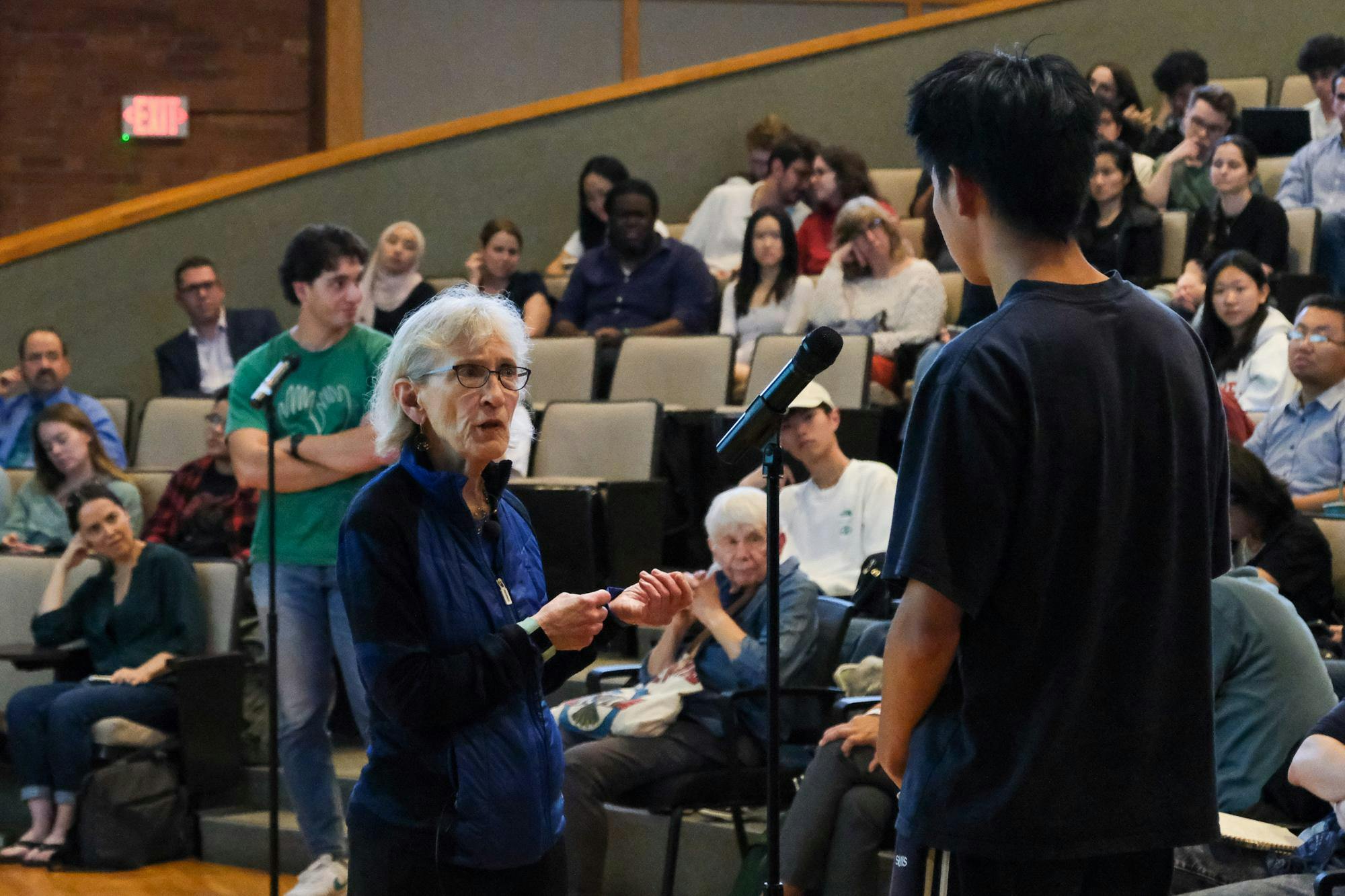
Claudia Goldin ’67, awardee of the 2023 Nobel Prize in Economics and Henry Lee Professor of Economics at Harvard University, held her lecture “Why Women Won” in George Staller Auditorium on Thursday afternoon to an audience of approximately 450 students and faculty members. Goldin spoke on the evolution of women’s rights throughout history, describing the increasing gender equality in the economic and political field as a win for women, before hosting a Q&A session.
Describing women’s rights as the legal, political and social rights equal to those of men, Goldin introduced “Why Women Won” as the journey of expansion for the rights of women, beginning in the 20th century.
According to Goldin, greater attention was drawn to the women’s rights movement through the Civil Rights Act in 1964, and many Americans began to agree that women should have a greater role in the workplace.
“In the late 1960s, an overwhelming majority of Americans thought women could be employed, even if their husbands could support them,” said Goldin. “One of the best-known questions was ‘should a married woman work for pay if her husband could support her,’ and while we think World War Two was a turning point, women themselves didn’t think they should be in the labor force if their husband could support them.”
Despite the increased notion that women should be able to take on a bigger role in politics and the workplace, as well as increasing support for feminism, Goldin highlighted the rise in the opposite sentiment: more traditional, pro-family ideals.
“With the 1960 election, women became a pivotal political force, fortuitously and almost accidentally giving them Title Seven, and then the [U.S. Equal Employment Opportunity Commission], that led to the formation of a huge list of women’s rights,” Goldin said. “The Supreme Court delivered a surprise gift to the women’s movement in January of 1973 that was recently taken away, and these gains led to the appearance of a more radical women’s movement and the rise of anti feminist, pro family groups.”
The “gift” Goldin refers to is the Supreme Court’s 1973 ruling of the case Roe v. Wade, which recognized a woman’s constitutional right to an abortion. It was overturned in 2022.
With the active role of women in these movements, Goldin conveyed how imperative these gains were to the lives of women. “I find it impossible to imagine my world would be the same had women’s rights remained as they were when I entered this institution as an undergraduate,” Goldin said.
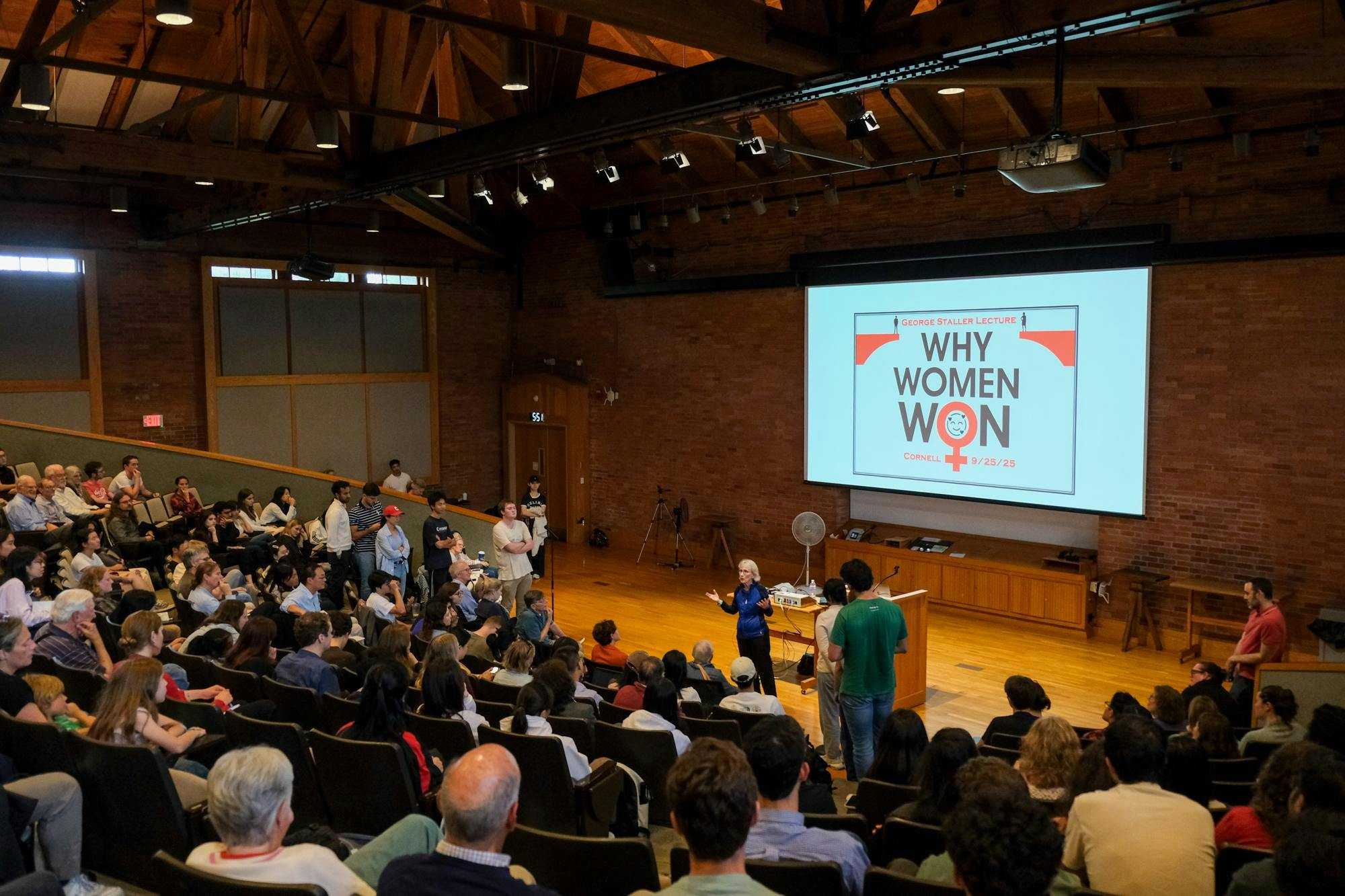
The event was well-attended, with people standing in the back of the auditorium and sitting on the stairs once seats filled up. Students were engaged with the lecture. Jessica Hung ’26, an exchange student from Taiwan, expressed her excitement following the event as someone who previously read Goldin’s book. For Hung, attending the lecture was an honorable and rewarding experience.
“I think it’s really interesting to see how she views and frames American history with past data on the ideas of men and women,” said Hung. “I think the biggest takeaway is that there’s still a lot to worry about because even though women, like she says, gained rights on paper, there is still a long way to go.”
Similarly, Scott Kadir ’27 enjoyed learning about Goldin’s view of history and the jokes she made during the lecture. The people attending and the atmosphere of the event, for Kadir, felt open to conversation and questions, inspiring him to look at historical events through a different lens.
“We often focus on how oppressed groups lost, but she shifted the perspective to how these previously oppressed groups actually won, and I find that really inspiring,” Kadir said. “She shifted my perspectives from saying this is how things were to things got better. Women did win; however, that doesn’t mean there’s still no improvements to be made.”
For both Kadir and Hung, Goldin’s lectures not only explained the historical context behind the women’s rights movement and its impacts on the rights they have today, but also the parts that can be further improved.
“We should have [a] more optimistic outlook about the issues we face today,” said Kadir. “Rather than seeing oppressed people as oppressed, maybe we should look at them as people who fought through, like the women’s rights movement explained by Professor Goldin.”

Ashley Lee is a member of the Class of 2028 in the School of Industrial and Labor Relations. She is a senior writer for the News department and can be reached at alee@cornellsun.com.


