

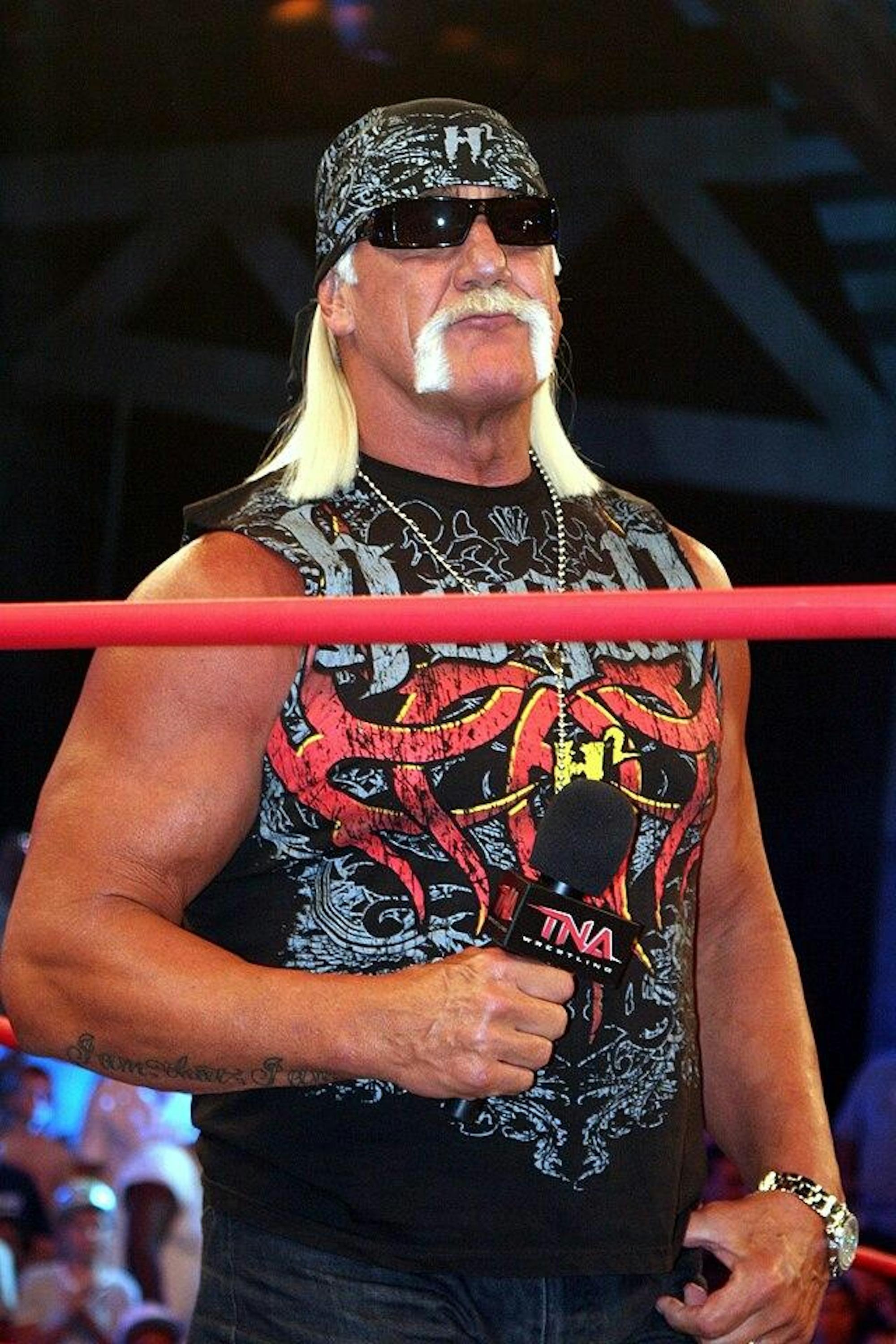
We never really thought that Hulk Hogan would die. He was literally given the nickname “The Immortal One,” the ultra-blonde, ultra-jacked all-American, once the closest thing in US pop culture to a living breathing superhero. It had been this way for nearly 50 years; the bandana and horseshoe mustache gracing practically every kind of merchandise anyone can think of. The image of Hulk Hogan, and all the signifiers we associate with that person and brand, can only be compared to someone like Elvis Presley. However, it did not feel like that during Hulk Hogan’s final appearance at the WWE, the place he honed his “Immortal” status, when he was soundly booed out the building as he tried to hawk his beer brand. No farewells, no one-last-promo, no leg drop, just Hulk Hogan confronted with a crowd that had had enough of him.
Whether we like it or not, professional wrestling in the United States would not be the same without Hulk Hogan. Born Terry Bollea, he would slowly but surely construct this character, one that would dominate American pro-wrestling for decades. He borrowed heavily from the likes of “Superstar” Billy Graham and Dusty Rhodes, turning himself into this American flag-waving behemoth. He was the perfect star for Vince McMahon in his quest to turn the territorial wrestling of the 1970s and early 1980s into the national phenomenon we know today. He had the kind of bankable look fit for lunchboxes and episodes of Hulk Hogan’s Rock ’n’ Wrestling. He talked like no one else, lacing his shouting sessions with “Mean Gene” Okerlund with “Lemme tell ya something, brother,” and “What’s ya gonna do, brother.” He was the consummate babyface, the heroic good guy who body-slammed Andre the Giant and reminded kids to “Eat your vitamins and say your prayers.” For many, he was their first love when it came to this strange, unique art form, practically inspiring an entire generation of wrestlers and fans.
He may have had this enormous influence on pro-wrestling, but this influence wasn’t necessarily always positive. One couldn’t acquire the transcendent status of a Hulk Hogan in a business like 1980s wrestling without leaving a trail of backstabbing and bitterness. And Hulk Hogan was one of the most infamous backstage office politicians in pro-wrestling history. He was ruthlessly protective of his position in every wrestling company he worked at, frequently using his influence and favor to remain a top star. His win/loss record testifies clearly to his politicking; he only lost 26 times in a decades long career spanning different eras. Hulk Hogan always had to look good in a wrestling ring, even if it wasn’t best for other wrestlers.
Hulk Hogan was certainly not the first or last backstage office politician in the wrestling business, nor was he the originator of such a culture. Pro-wrestling can be quite cutthroat, especially in the era Hogan was coming up in, where your status and position was always hanging by a thread, wrestlers enduring horrible travel schedules and working through injury to stave off the threat of replacement. Yet at the same time, Hogan used his influence to crush any possibility of real change in the treatment of wrestlers. In 1986, Jesse “The Body” Ventura tried to unionize professional wrestlers to secure better healthcare and retirement benefits, but Vince McMahon got wind of this and threatened to fire anyone who attended union meetings. Who informed Vince McMahon? “It was Hulk Hogan who cut my legs out from under me,” Ventura would later recall in a televised MSNBC interview. “Hulk Hogan went to Vince McMahon, ratted me out, and subsequently later on cost me my job.” Hogan greatly benefited from the favor he had with Vince McMahon, and he was willing to maintain this position at the expense of his fellow wrestlers.
The average person doesn’t know much about Hulk Hogan behind the cameras. All we ever got to see was the all-American American, with the WWE doing everything it can to maintain this lucrative image. If this story had ended pre-2015, with Hulk Hogan living on the legacy he has built, then this story would be much simpler. His last appearance at a wrestling ring would be filled with loud cheers echoing throughout the entire stadium, with Hogan, the gracious hero of American popular culture, electrifying the crowd with his sheer charisma. Then July of 2015 happened.
In that month, The National Inquirer published recordings from a leaked sex tape involving an anti-black racist rant by Hogan. He uses racial slurs as he discusses his daughter dating outside her race, even saying that he is “racist, to a point.” If Hogan had truly apologized and committed himself to improving himself, his statements would not have tarnished his legacy to this degree. It is the fact that he tried to make excuses for his racist rant in an interview with Good Morning America, stating that he learned that the n-word was used liberally in his hometown neighborhood, as if that excuses what he said at all. Even in his apology to current WWE wrestlers backstage, he opened his speech with a warning to be “mindful about being recorded without their knowledge” without addressing the issue head-on. This is the final image of Hulk Hogan, the man who would sooner ally himself with the MAGA movement than do anything to take accountability for his actions.
When dealing with a problematic celebrity, conventional wisdom tells us to "separate the art from the artist.” It is a lot more difficult to do so with a figure like Hulk Hogan, because the line between Terry Bollea and the “Immortal” Hulk Hogan has been so blurry, it’s difficult to tell which one we are seeing. Hogan was both one of the most influential wrestlers in human history as well as a figure who consistently made choices that harmed others. When it comes to Hulk Hogan, we must have both of these versions of Hogan in our minds.
Basil Bob is a junior in the College of Arts and Sciences. He can be reached at bob27@cornell.edu.

Basil Bob is a member of the Class of 2027 in the College of Arts and Sciences. He is a staff writer for the Arts & Culture department and can be reached at bbob@cornellsun.com.


