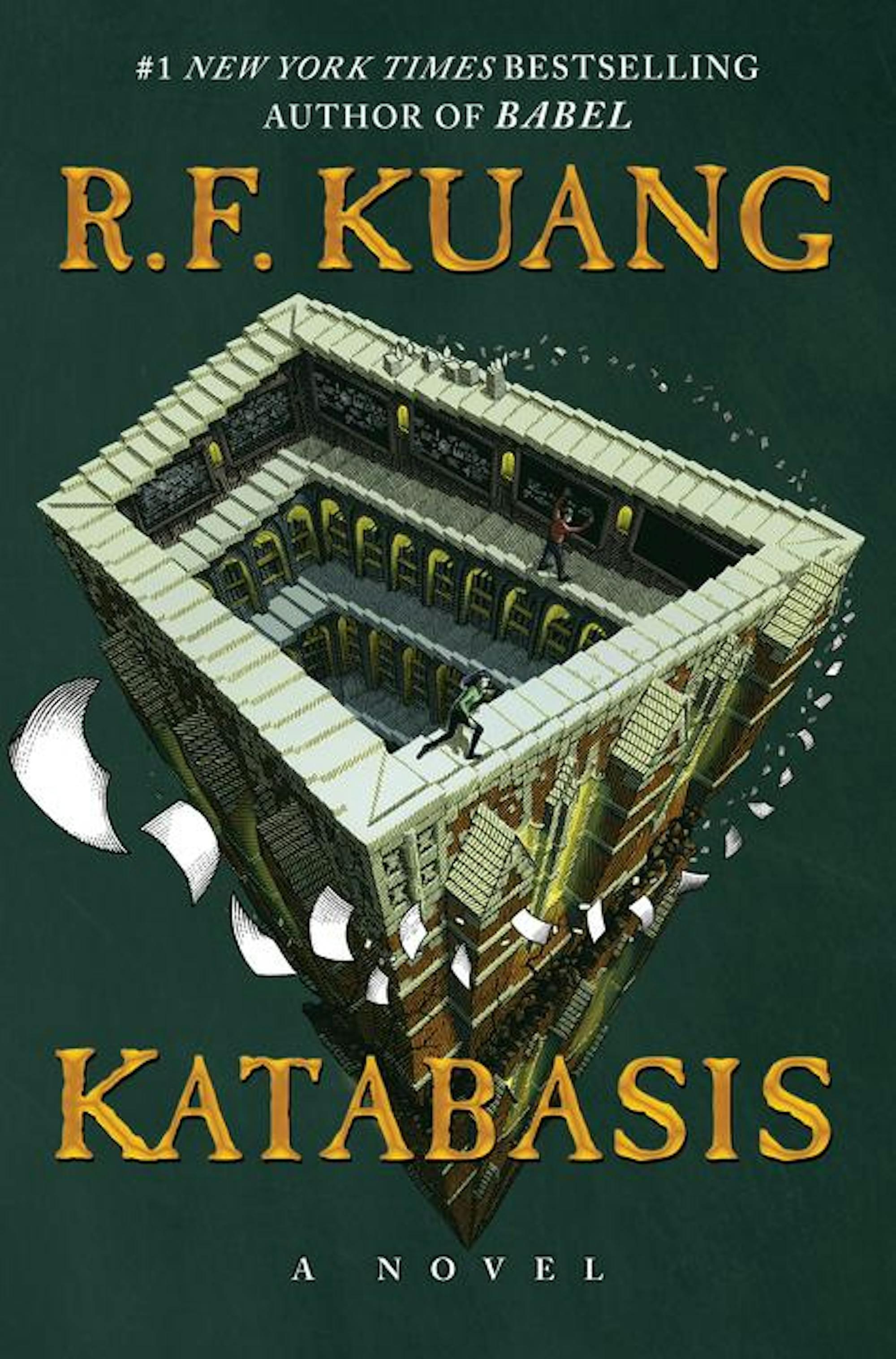
As Cornell students, we are all too familiar with the infernal grind academia so often demands. We know the feeling of pushing ourselves to the breaking point, writing until our eyes dry out and studying until our heads feel like they just might split apart. And especially around prelim season, our beautiful campus may start to feel like hell. Well in R.F. Kuang’s new novel, Katabasis, Hell actually is a campus.
In Ancient Greek, katabasis means the story of a hero’s descent to the Underworld. In Kuang’s Katabasis Cambridge graduate students Alice and Peter journey into Hell to rescue the soul of the recently deceased Professor Grimes. Grimes holds the key to Alice and Peter’s respective futures as their advisor in the department of Analytic Magick, so going to Hell seems like the logical leap in order to receive their golden letters of recommendation. Alice and Peter are adamant on making the trauma of their graduate experience worth it, even if this means rescuing the man at the root of their rivalry and trauma. Hell becomes a mirror of their lives above, stripped down to the barest, monotonous rituals of human life. Soon they begin to ask themselves, when you take away the struggle, the pain and the color of life, what is left? They begin to ask themselves: Why do I still go on?
Having read Babel before starting Katabasis, I had an idea of what to expect from R.F Kuang and her writing. Kuang has a way of luring you into her heavily researched world and making it the only reality you know. Her logic worms its way into your mind and can twist the reader’s beliefs, hopes, dreams and fears. Reading gives you a way to live a thousand lives and feel pain you may not understand in your own reality and no one does it better than Kuang. Like the silverworking magic system of Babel, the math, logical paradoxes and chalk pentagrams of Katabasis are fantastical elements that feel tangible, almost real.
Katabasis is a whirlwind, picking up very quickly from the start with the characters journeying from Cambridge to Hell within the first chapter. In fantasy novels, there is almost always a change in location that needs to happen and Katabasis’ quick exposition really drew me in rather than bogging me down with the usual onslaught of worldbuilding information. On worldbuilding, it is clear Kuang poured a lot of effort into researching and creating Hell. From hyperbolic geometry to mythological deep dives, Katabasis’ Hell truly is its own living breathing world. The fact that the whole basis of the fantasy is built upon literature of our reality makes the novel feel accessible. Additionally, many of the theories are unfalsifiable, meaning they are immune to any refutations and thus can never definitively be shown to be incorrect, which works to convince the reader that all of this could be true. A piece of chalk and a logical paradox could technically be all that is separating us from magic.
That being said, much of the information is quite dense and not always explained so as to make sense for the layperson. And while I understand this is a trait of some dark academia novels, I often felt I was being talked down to by the author/characters for not grasping the concepts that are clear as day for the intellectual elite.
As readers, Kuang feeds us only what we need to know — just enough to grasp the concepts and increasingly more of the characters' backstories. Character backstories unwind throughout the book which suspends intrigue surrounding their motivations and behaviors. However, this often left me feeling disoriented especially as the plot direction diverged from how the novel was described in the blurb. Katabasis is described as two students’ journey to rescue their advisor yet I would argue this is not true of the majority of the novel nor is it reticent of its themes. A lot of my critiques of Katabasis could be solved by simply suggesting the reader let go and let the book take you away. Don’t get caught up in the math, don’t think too hard about what you don’t know yet; just let go.
The main character, Alice Law, undergoes one of the most dramatic character arcs that I have read in a while. She starts as a highly motivated student that is not afraid to sacrifice her morals to get what she wants. She epitomizes the archetype of a true academic weapon. Food, the outside world, bodily needs, they are all second to her dissertation. Specifically, with Professor Grimes as her advisor. Her relationship with Grimes starts from pure idolatry and eventually devolves into a rotted carcass of hatred as she develops.
But really, her development is an unraveling. The more time Alice spends in Hell, the more her grip on her sense of self becomes uncertain. In Hell, immortality is no gift. Amongst Hell’s monotony, Alice starts to long for the vulgarity of life, the beating, pulsing, clawing viscera of it. She begins to instill this indomitable force within herself, convinced that since death will come for everyone, we must strive to make it all count. Kuang writes Alice so that we as readers do not pity her as she loses her mind, instead we see it as her triumph. We do not cringe away from her snorting chalk and covering herself in blood, we smile along with her.
In the end, Hell reminds Alice to take in the vitality of the world. As such, Katabasis is a reminder for all of us to rediscover all the wonders of life; to revel in it. Enjoy the taste of a cinnamon roll, the way the air feels in fall, the joy of a deep conversation. Katabasis is a reminder to breathe, to look up and “rebehold the stars.”
A fun part of Alice’s background is that she went to Cornell for her undergraduate degree! Magic already feels close in this novel, but maybe for us at Cornell it’s even closer. We just have to look.
Thank you to HarperVoyager for an ARC of Katabasis.
Ayla Kruse Lawson is a junior in the College of Human Ecology. She can be reached at akruselawson@cornellsun.com.
Ayla Kruse Lawson is a member of the Class of 2027 in the College of Human Ecology. She is a staff writer for the Arts & Culture department and can be reached at akruselawson@cornellsun.com.