Editor’s Note: This is a special guest edition of Sydney Levinton’s column Test Spins.
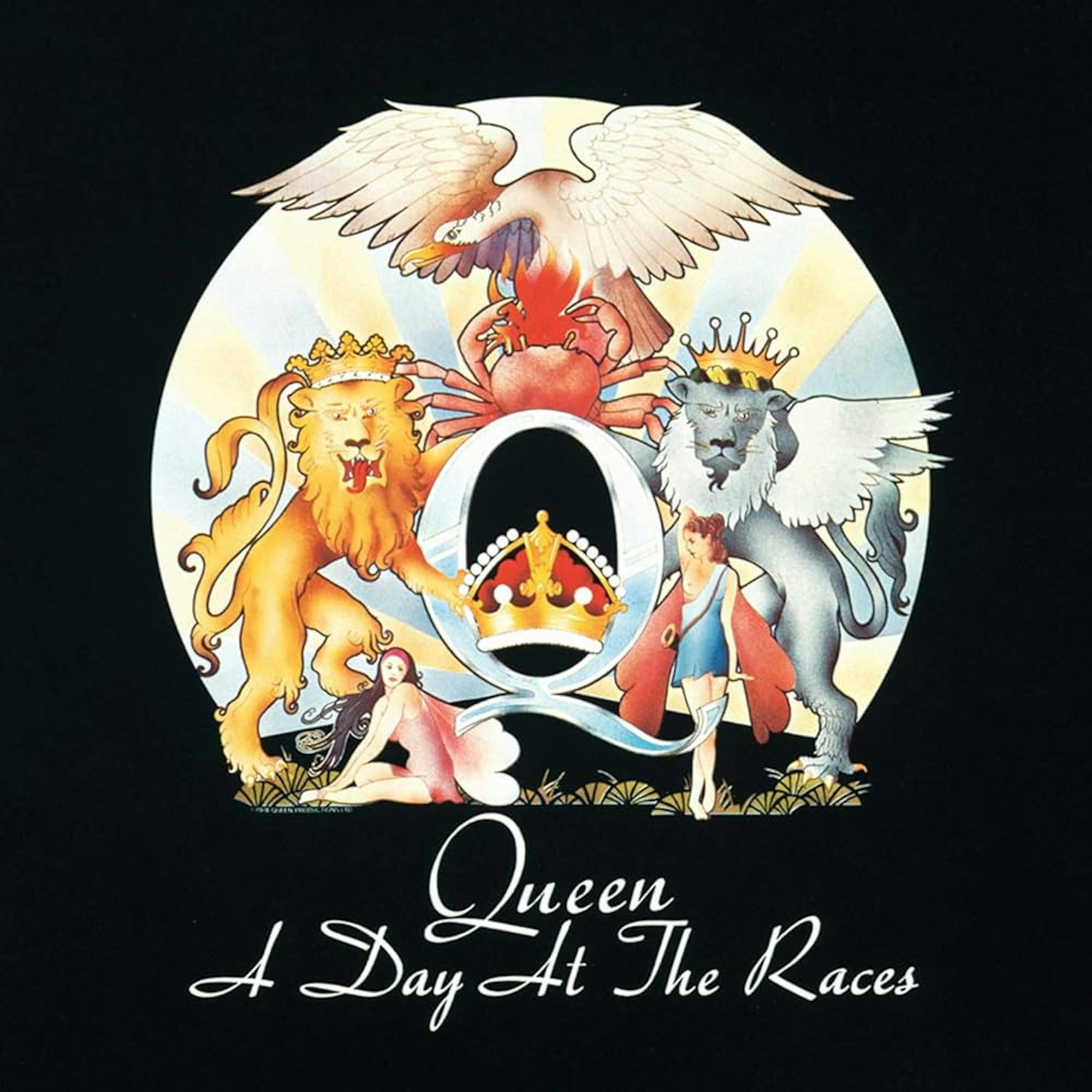
I cannot possibly refrain from geeking out about Queen. For you to understand just how much this ’70s rock band means to me, allow me to briefly describe the state of my bedroom back at home. Lining one wall are my Great Uncle Alan’s Queen albums, proudly in pristine condition. Covering the door to my closet are posters documenting each phase of Queen’s career. Cluttering my bookshelf are Queen magazine issues, complete discographies, autobiographies… As you can imagine, I have to fight for my dad’s permission to use his record player. So where does my passion for Queen go here at Cornell? Into this history lesson. Today’s subject is Queen’s fifth album, A Day at the Races (1976) — it only feels right to honor the band that got me through the most trying of my teenage years. Does it hold a candle to their magnum opus ‘A Night at the Opera’ released the year prior? Get comfortable, grab a cup of tea (optional is a hot cup of Earl Grey, Mercury’s favorite), and listen with me.
Queen’s A Day at the Races begins with the legendary opener, “Tie Your Mother Down.” With thunderous acoustics to match the (nearly lethal) explosions that filled the stage of their promotional video, Queen truly started with a bang. If the line “Take your little brother swimming with a brick, that’s alright” took you aback, then astrophysicist guitarist Brian May did his job; May competed with lead singer Freddie Mercury for a nastier opening track. The year prior, Mercury wrote the vicious opener “Death on Two Legs,” a jab at their corrupt record producer, Norman Sheffield. May wasn’t about to let his flamboyant bandmate show him up for fighting words.
In stark contrast to our fiery first track is Freddie Mercury’s “You Take My Breath Away.” Any previous adrenaline from Roger Taylor’s driving drumline quickly dissipates, now upstaged by the vulnerability of Mercury’s every breath. Brian May’s guitar rolls with an encompassing warmth. By the bridge, within each new note that May strums there lies a subtle break in the chord. Breaking like a voice might in desperation, yearning for some long-lost lover.
I also couldn’t help but notice their subtle nod to the Beatles through the song’s creative close — in a cacophony of noise, the band can be heard repeating the line, ‘Take My Breath Away’ on an endless loop. I guess Queen grew up to emulate their idols, who were crossing Abbey Road in 1969, right around the time the young Queen members began to rehearse.
Our third track, “Long Away,” begins with a rising, almost electric vitality, punctuated by the country twang of Brian May’s twelve-string. With the simple ease of May’s lead vocals, we get a glimpse of how the band might have looked without the added dynamism of a roaring Freddie Mercury.
With “The Millionaire Waltz,” we are back to Mercury’s antics. Queen is excess. Queen is good fun. As the orchestral piano and the flitting and floating vibrato of Freddie Mercury flood into the song, the sometimes farce, imperial playfulness to Queen’s sound brings a smile to my face. There is just so much to be enjoyed. At one moment, we are in a Sondheim ballad, the next, we are snapped into the blazing climax of rock, Mercury howling on lead vocals, backed by the full power of May, Taylor, and Deacon.
Up next is “You and I,” John Deacon’s contribution to the album. The bassist, although self-effacing, loved Queen with a fervor that distanced him from the band after Mercury’s death. I can’t help but laugh hearing Mercury utter the words “We’re gonna stay together, just you and I,” when he was by no means known for his chastity. Oh well, at least John Deacon was (somewhat) monogamous to his wife, Veronica Tetzlaff. Nearly 50 years later, and they’re still together!
I’d be lying if I said “Somebody to Love” doesn’t have a special place in my heart. It is through songs like these, much like the album’s second track, that we begin to see the deep emotionality that existed within the lead singer’s every creation. Mercury, largely known for his camp persona on stage, was otherwise quite the introvert (a tea-drinking cat lover). In this incredible composition, however, we see not the duality within each facet of his character, but the intersection between them. With each plodding chord on his piano, Mercury funnels his quiet observations, his desire to love and be loved, into the power of his music.
Queen’s seventh track, “White Man” picks up the same silence with which the previous track concluded. Rather than that of tender longing, however, this silence is full of contempt, of warning. The conscious hush to Mercury’s voice connotes the burning rage, further made apparent by the vocal’s interplay with May’s guitar. And so, with the momentum created in the first verse, the fever breaks, and (finally) John Deacon’s bass line rings out in agreement.
And, with “Good Old-Fashioned Lover Boy,” we are brought back to the flowery and ornate — decidedly Mercury’s domain. With a coolness to his voice, along with the (perhaps purposeful) ambiguity of his lyrics, he seems to explore all aspects of sexuality: is he the ‘Lover Boy,’ or is this courteous male lover the subject of his desire?
Roger Taylor’s track, “Drowse,” describes the doings of the self-proclaimed Tenement Funster. With each vocal’s nonchalance, I can almost picture the rocky rebellion of Taylor’s youth: singing with boys far older than he, laying in the grass, going to the Pool House, and skirting between cars across the Norfolk streets.
Marking the final track on the album are Mercury's trembling vocals, cutting through with a sharpness that would hardly suggest just how worn out Queen’s recording machinery was getting from the copious overdubs. “Teo Torriatte,” Japanese for “let us cling together,” was written by May to be sung with their adoring fans in Japan — a testament not only to Queen’s worldwide fame but also to the care with which these four musicians crafted their music.
And so concludes an ode to the band that decorated my bedroom walls and filled my brain with beautiful music — a love letter to the sweetest inheritance from a Great Uncle to his niece, to her daughter. I hope you enjoyed your listen as much as I did. It’s always nice to pay a visit to a childhood friend.
Alessandra Giragos is a sophomore in the College of Arts and Sciences. She can be reached at asg287@cornell.edu.
Test Spins is a weekly throwback column reviewing and recommending classic and underrated albums from the past. It runs every Friday.