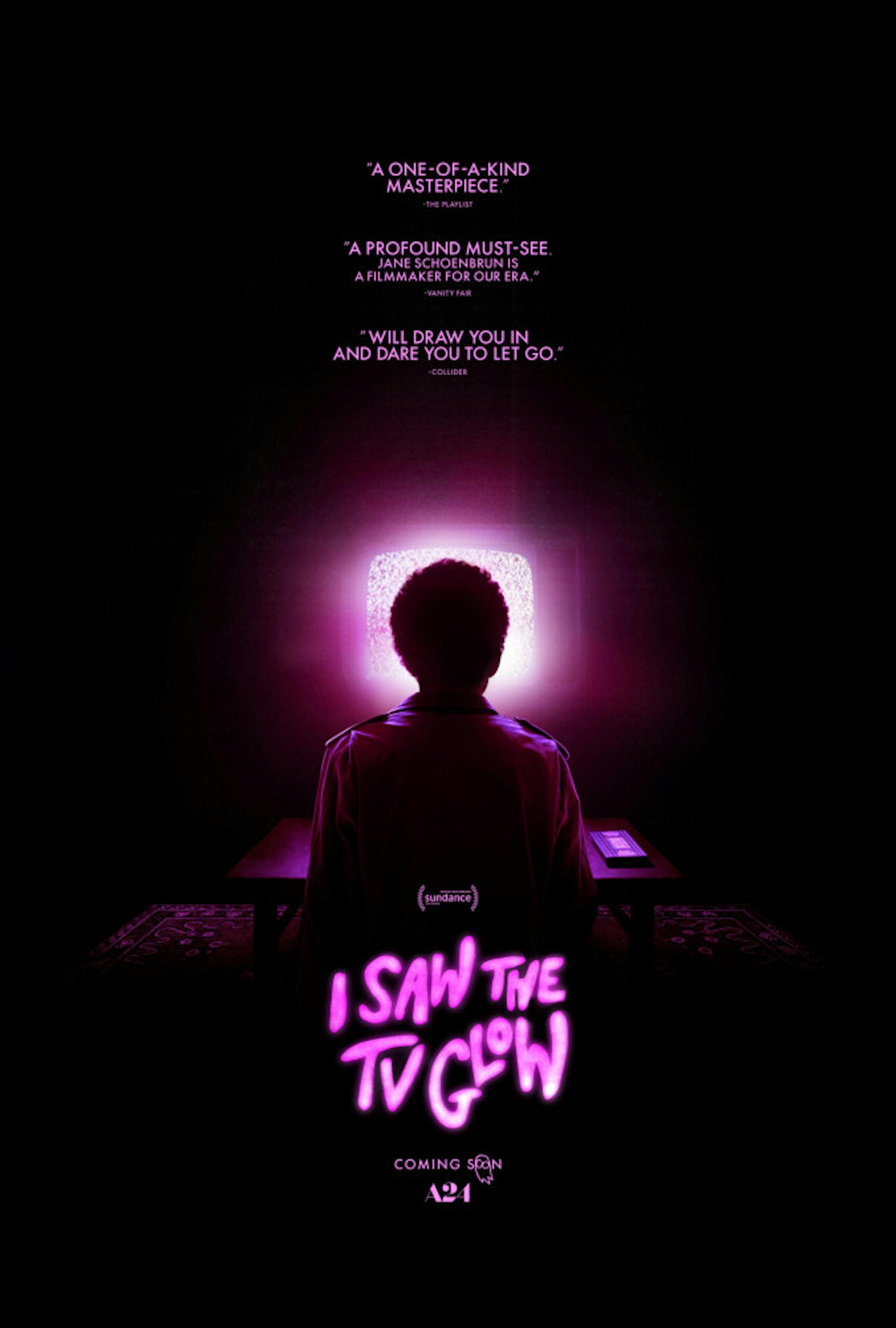
Spoilers for I Saw the TV Glow (2024) and Interview with the Vampire (2022-).
I have a visceral fear of being buried alive. To waste away slowly, trapped and confined and rotting away in a place where no one can find me. Suffocating under layers of dirt, not able to live or die. Watching I Saw the TV Glow, in which a character is buried alive, I could not help but think: what an apt metaphor for the queer — and especially transgender — experience.
I Saw the TV Glow is a psychological horror movie directed by Jane Schoenbrun following Owen and Maddy through their teen and adult years as the TV show they are obsessed with, The Pink Opaque, leads them to question their identities. The Pink Opaque centers on two fictional teens – Tara and Isabel. The movie slowly blurs Tara-Maddy and Owen-Isabel until its dreadful reveal: Owen is Isabel, and Isabel has been buried alive in her reality. Owen is the version of reality she has been condemned to. This revelation arrives with a haunting composition: Owen's head pushed into the TV screen, sparks buzzing around his head as he tries to realize the truth.
The horror that unnerved me so deeply in I Saw the TV Glow is that the queer identity is not realized. The two queer characters split farther and farther as the narrative moves on. Maddy vocalizes what so many of us have felt: she can't stay in her town, stay stagnant, or she'll die. So she runs: she tries on new names and eventually buries herself alive to become Tara, trapping herself under layers of dirt in a transition that feels like death but ultimately liberates her. Owen cannot push past his fear of that often violent internal revolution of self-acceptance. Whereas Maddy buries herself and sets Tara free, Owen lives and Isabel stays underground, both of them suffocating.
I Saw the TV Glow never allows Owen to fully accept himself, barely allows him to see and understand before he apologizes for just that glimpse to a society that does not care. The horror of the film is devastatingly magnified if you are queer. And as a closeted (well, maybe not so much now) nonbinary trans person, I understood the desperation with which Owen slices his chest open, begging the thing inside to come out. There really is that feeling of two bodies, two identities.
One scene that haunts me is when Maddy begs Owen to come with her to the football field, where she plans to bury them alive to reach their true selves. Owen comes with her but ultimately runs — we can do nothing but watch as he runs farther away, and then out of view entirely.
"I thought [Tara] would come back and force me to go," Owen confesses to us. But she never does. She never will. Because she cannot, no matter how much Owen wants or we want someone to pull the words out of our mouths and force our own acceptance of ourselves for us.
AMC's Interview with the Vampire also grapples with queer themes through horror, specifically using vampirism as a way to explore the queer experience and abuse outside of the traditional heterosexual narrative.
Louis, the interviewed vampire, describes his turning as a death, but Lestat, his maker, characterizes it as something greater. He specifically tells Louis, "Be all the beautiful things you are, and be them without apology." Despite this, Louis consistently tries to deny his vampiric nature. Once again, transition is compared to death, but Louis living on after his transformation visually rejects that death.
This tension is perhaps most visible in the arc of Claudia, Louis and Lestat's daughter. Claudia did not have a choice in becoming a vampire. Being trapped in her body subverts Louis's vampirism as liberating queerness; Claudia resembles the Isabel-Owen entrapment from I Saw the TV Glow. Part of the horror surrounding her is being trapped in a body that is not yours. But Claudia likes being a vampire and the new life it has given her. She wants to find a home in the vampiric world. Her desperation to find a community is something I think a lot of queer people experience when they first really begin to understand themselves. When they finally stumble across more vampires, Claudia dares Louis, asking him if he does not feel pride when she describes the belonging she feels as she watches them drain a mortal. Her euphoria is so familiar – the joy of finally being "out and proud."
Claudia's arc, still, ends in tragedy. The new community she finds executes her immediately after she finds someone who actually accepts her, sees her for who she is. The macabre backdrop of the theater of vampires in season two is yet another exploration of abuse and violence within a community.
In both these pieces of queer horror media, there is an element that I think can only be truly understood by a queer audience. There is also a common theme that begs the viewer to look inward. Owen asks after leaving Tara: "What if she had been telling the truth? What if I really was someone else? Someone beautiful and powerful. Someone buried alive and suffocating to death. Very far away, on the other side of the television screen."
Throughout I Saw the TV Glow, there is scribbly pink and blue sidewalk chalk that seems to follow Owen around. These marks are Tara, begging and begging Owen to follow her. The last words we see from her are: "there is still time." A reminder from Tara to Owen that it is not too late. With the dynamic of viewer and screen, it becomes a reminder that there is still time for you to accept yourself.
Pen Fang is a freshman in the College of Arts & Sciences. They can be reached at amf337@cornell.edu.
Pen Fang is a member of the Class of 2028 in the College of Arts and Sciences. They are a staff writer for the Arts & Culture department and can be reached at pfang@cornellsun.com.