


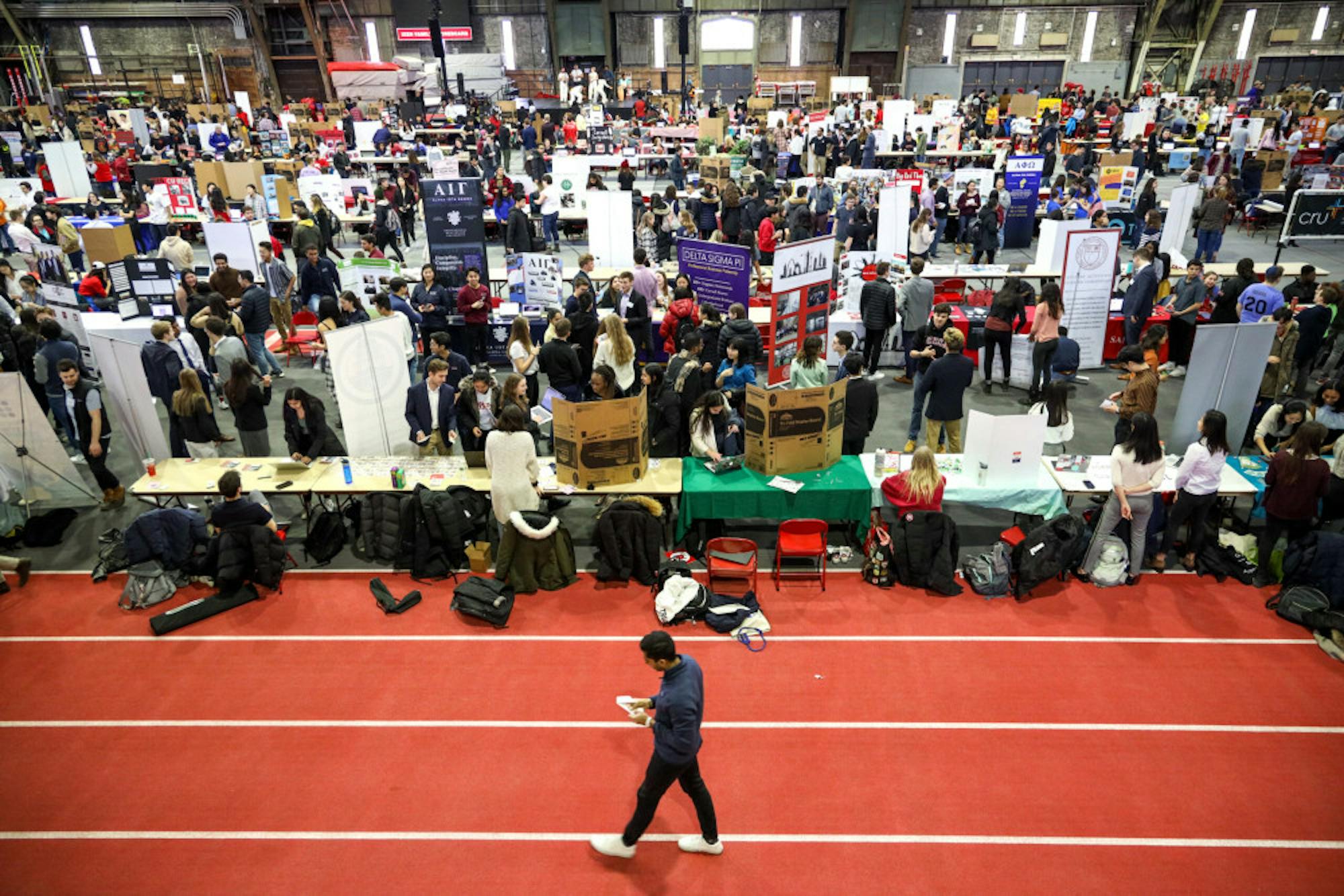
Black, Native American and Hispanic student enrollment at Cornell significantly decreased in the first class admitted after the ban on race-conscious admissions.
Leaders of engineering student organizations that center students from these demographic groups said they have noticed a decrease in new members.
In previous years, several affinity groups received comprehensive lists of incoming Black and Hispanic students from the Office of Inclusive Excellence in the College of Engineering and the Engineering Undergraduate Admissions Office, while Native American students were identified through the American Indian and Indigenous Studies Program. These lists allowed the organizations to directly contact potential new members in their target demographic.
However, since the overturn of affirmative action, academic racial affinity groups no longer have access to these lists, which leaders say significantly restricts their recruitment efforts.
The Sun spoke to several academic affinity groups to discuss the impact of the affirmative action ban on organizations whose missions center on promoting and supporting underrepresented students at Cornell.
National Society of Black Engineers
Cornell’s chapter of the National Society of Black Engineers works to increase the enrollment, retention and success of Black engineers. Last year, 54 first-year students attended NSBE’s kickoff event at the beginning of the semester, according to NSBE President Chimdi Anude ’25. However, only eight first-year students attended the same event this year.
“We haven't changed anything in the way [NSBE does] things,” Anude said. “The only difference is that we just don't have the data that we usually have.”
In contrast to the comprehensive list of Black students in the College of Engineering NSBE previously received from the Engineering Undergraduate Admissions Office, the organization was given a list of only 23 incoming students this year.
Since the admissions office is no longer able to filter students by race, Anude said, the provided list compiled incoming students who receive scholarships within the Office of Inclusive Excellence, formerly known as Diversity Programming in Engineering.
NSBE previously emailed all incoming Black engineering students over the summer, informing them about the organization and inviting them to events before the semester began. Without access to a comprehensive list, NSBE now relies on word-of-mouth outreach and promotion through the umbrella organization Black Students United to connect with first-year students.
According to Anude, there are fewer applicants for the NSBE freshman representative position.
“Being a Black engineer at Cornell can be very lonely. And now that there's not a lot of them, … I'm afraid that they won't have the support system that they need,” Anude said. “[The freshman representative] role is very needed at this point because community and support is the only way you're going to make it through this University.”
Anude said that despite being from different places, “being Black and Black engineers we underst[and] going into our classrooms, we're facing the same thing — [it’s] a bonding experience.” She highlighted NSBE’s crucial support as the only Black woman in her graduating class of electrical and computer engineering.
“I feel like I wouldn't be where I am academically or professionally if not for NSBE. I found all my mentors through NSBE,” Anude said.
Underrepresented Minorities in Computing
Underrepresented Minorities in Computing seeks to promote diversity in computing and empower underrepresented groups through academic support, community and professional development.
Celeste Naughton ’25, co-president of Underrepresented Minorities in Computing, also said recruiting incoming students has been challenging without access to the lists of incoming Black and Hispanic students interested in computer and information science previously provided by the Office of Inclusive Excellence.
In previous years, URMC would send personalized emails to minority students about the club and its upcoming events, but since the repeal of affirmative action, the club is not able to reach out to potential new members in this way, Naughton said.
Naughton noticed a decrease in engagement in URMC, with a drop in applications for the organization’s freshman representative position, attendance at their welcome back barbeque and interest in their mentorship program.
“11 percent to seven percent is a lot in terms of students in our community — [a] four percent [drop] of, let's say it's 1,000 students, right?” Naughton said, referencing this year’s drop in Black first-year enrollment. “Four percent of 1,000 students is 40 students. That's a good class of people within the engineering department or within [computer science].”
During the 2023 fall semester, URMC hosted a class on software engineering recruitment. URMC’s advisor informed them that the event application form had to be open to all students, not only URMC members.
“We had to be very cautious about language and wording,” Naughton said. “We couldn't ask ‘How do you identify?’ It has to [be asked more creatively], like ‘Tell me a story about this particular aspect of your identity.’ And that helps to not explicitly ask.”
American Indian Science and Engineering Society
Cornell’s American Indian Science and Engineering Society aims to advance American Indian scholars in STEM by providing academic support, community and professional development, creating a space where Native students feel supported and less isolated in a challenging field.
Peter Thais ’25 — co-president for the American Indian Science and Engineering Society and the internal relations chair of Native American Indigenous Students at Cornell — said the decrease in incoming Native American students has created a noticeable impact on a community that is already very small on campus.
Native American student enrollment decreased from 1.8 percent of the 2023 incoming class to one percent of the 2024 incoming class. Last year, AISES got just two applications for the freshman representative position. This year, AISES saw zero applications.
The American Indian Science and Engineering Society did not receive a list of all incoming Native American, Pacific Islander and Alaskan Native students through the American Indian and Indigenous Studies program as it had in previous year.
According to Thais, the Native American Mentorship program previously had at least 10 incoming student participants per year. This year, only two students signed up for the program.
“We will work around their time because we want to make sure that these two people are being given as much attention as possible,” Thais said. “Since Indigenous student admission has gone down, I think the best you can do is at least try to improve Indigenous retention.”
Importance of Academic Affinity Groups
Leadership of affinity organizations hold monthly meetings with the Office of Inclusive Excellence in the College of Engineering. During this month’s meeting, leaders from numerous organizations including NSBE, URMC, AISES and five other organizations discussed an overall decrease in first-year students.
“Something that we're all working on together as these groups for underrepresented peoples is to emphasize the importance of identity and community within our organizations,” Thais said. “All of us as senior leadership in that meeting stressed that these organizations have been integral to our professional development and overall student wellbeing at this University,”
Thais emphasized the personal significance of leading an affinity group in creating opportunities for other Native American students.
“I think it's important for myself to want to be a leader in these kinds of communities, because I feel like from a cultural standpoint, I was taught to make my ancestors and those that came before me proud and lead the way for those that come after me.” Thais said.
Looking to the future, leaders of affinity groups hope to collaborate on events to boost student engagement and provide community and resources to as many underrepresented students as possible.
“I'm doing all of this so five years down or 10 years when I've gone off, … people are still reaping the benefits of the hard work and the cycle to increase the number of Black engineers continues,” Anude said. “So being able to participate in such a legacy is such an honor.”
Correction, Oct. 3, 6:25 p.m.: A previous version of this article incorrectly abbreviated the American Indian Science and Engineering Society.

Sofia Loayza is in the College of Agriculture and Life Sciences. She is a senior writer for the News department and can be reached at sloayza@cornellsun.com.
Isabella Hanson is a member of the Class of 2027 in the College of Arts and Sciences. She is a senior writer for the news department and was a news editor for the 143rd Editorial Board. She can be reached at ihanson@cornellsun.com.


