On ancient monsters, interpersonal geometry and the impossibility of keeping literature in its proper place.
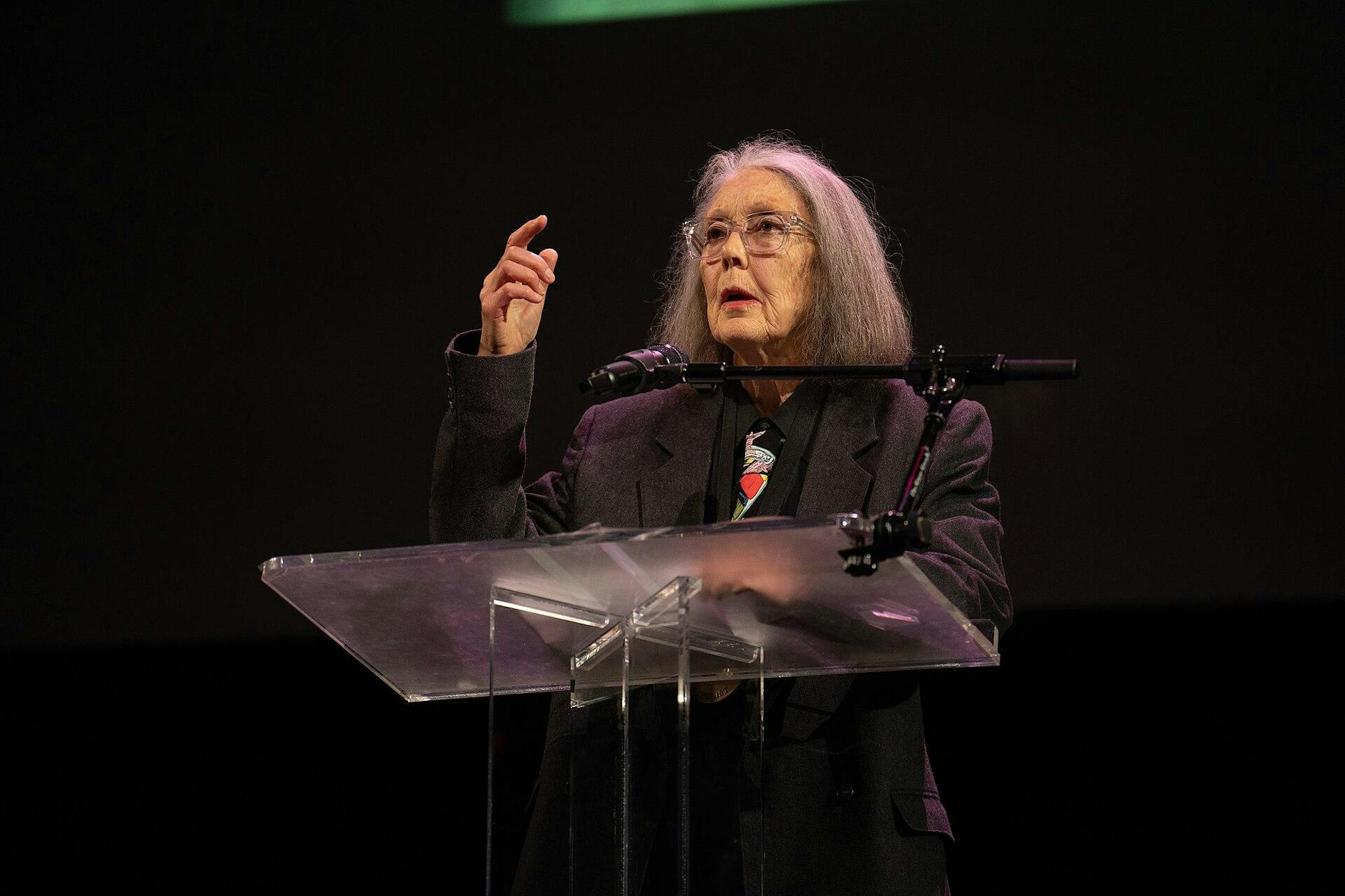
On Oct. 8, Anne Carson won the Nobel Prize in Literature, an honour that seems, in her case, both entirely deserved and faintly beside the point. The Swedish Academy cited her playful dialogue with the classical tradition and her creation of new forms for contemporary literature. One imagines Carson receiving the news much as one might receive an unexpected invitation to a dinner party: With interest, perhaps, but with an eye on the book one was reading beforehand. Here is a writer who has spent decades making the categories by which literature is organized look provincial. To award her the highest distinction in letters, is, among other things, to institutionalize a resistance to institutions.
Carson is a poet, a classicist, translator, essayist, dramatist and occasional troublemaker in the taxonomy of books. Her work contains ancient Greek lyric, philosophical inquiry, photographs, stage directions, adolescent heartbreak and the sort of footnotes that threaten to become the main event. She is not so much a writer who crosses genres as one who appears not to have been informed that there are borders at all.
Take Autobiography of Red, her 1998 verse novel, in which Geryon, a red-winged monster from Greek mythology, becomes a sensitive adolescent in the contemporary world. Classically, ancient poet Stesiochorus depicts Geryon being slain by Heracles in order to steal his cattle. Carson, with the composure of someone rearranging the furniture in a museum, gives the monster a camera, a backstory and a crush on his eventual destroyer. The result is a coming-of-age story in which the protagonist’s monstrosity is a condition of being alive. Geryon is red, winged, vulnerable and yet rather like the rest of us. Sadly, the rest of us haven’t been designed by an unusually sympathetic mythographer.
The title promises an autobiography, that most self-assured of literary forms: a life arranged into a story, made legible through narration. But Geryon’s life arrives through fragments, photographs and a myth that has already been told by somebody else. Here, Carson’s trick is to suggest that the self may be most truthfully described by a form incapable of containing it.
She has been interested in this conflict since Eros the Bittersweet, her 1987 study of desire in Ancient Greek literature. Its central proposition is painfully inconvenient, that desire is inherently a paradox defined by distance. We want what we do not possess; as such, the beloved must essentially remain elsewhere. Carson augments this geometry through the archaic Greek poet Sappho, whose surviving poems render longing as a physical affliction, and in the ancient understanding of Eros as a force organized around absence. The argument even has a habit of escaping the book. One closes it and discovers that a disappointing romance has acquired the proportions of a classical problem. Carson suggests that heartbreak has its intellectual history.
This is one of her characteristic maneuvers: She makes scholarship and antiquity intimate without making it confessional. Our ancient past is not a means to decorate our present with a little cultural prestige. We must examine it as a means to estrange the modern. The past is a stranger whose resemblance to us is faintly unnerving.
Then comes Nox, her extraordinary book-length elegy for her estranged brother, Michael, who died in 2000. Built as an accordion-fold facsimile, the work assembles photographs, dictionary entries and fragments around Carson’s translation of Catullus 101, a poem mourning the death of a brother in a foreign land. The form is almost comically literal in its message: grief, too, must be unfolded. The reader extends the book across a surface, moving through the remains of a life as though the correct arrangement of its evidence might finally make the absent person available.
It does not. The archive grows, the emotions compound, yet the dead tragically remain dead. In Nox, Carson’s scholarly instinct — to examine, translate, annotate and understand — encounters its limit. There is something quietly devastating about this. Language can preserve traces without restoring their sources. The book is at once a mind-numbingly intellectual display of linguistic prowess and an admission that talent cannot complete the work of mourning.
In If Not, Winter, Carson translates Sappho’s fragments with a generous spareness, letting the gaps remain visible and allowing missing words to haunt the page. In Antigonick, Sophocles’ tragedy is reimagined through contemporary language, drawings and the figure of Nick, a mute personification of time. In Norma Jeane Baker of Troy, Helen of Troy enters into conversation with Marilyn Monroe, two women whose beauty has made them public property. Carson’s interest cannot be boiled down to just making the ancient modern. It is in discovering what survives and is lost when a story changes form.
That is why the label genre-defying, as commonly as it is articulated, begins to feel inadequate. It suggests a writer breaking rules that everyone else has silently agreed to obey. Carson’s more unsettling proposition is that the rules were never quite as natural as we thought. The form with which we express a thought dictates how far that thought can grow.
Institutional accolades like the Nobel Prize may encourage us to prescribe to a standard set of norms, or settle on a definite description: the classicist who reinvented poetry, the scholar who made the Greeks contemporary, the writer who refused to be classified. Anne Carson presents a more entertaining possibility, that the forms keep multiplying because no single one can tell her whole truth.
The mistake becomes asking what Anne Carson is, when her work is so concerned with what things become.
Even upon ascending the Laureate’s apex and receiving the ultimate imprimatur by the Stockholm synod, Carson leaves us with no final form — only the enduring impression of a writer who remains, even after the world has named her, gloriously beyond a final definition.
Ali AlSaif is a member of the Class of 2029 in the College of Arts and Sciences. He is a staff writer for the Arts & Culture department and can be reached at aea252@cornell.edu.