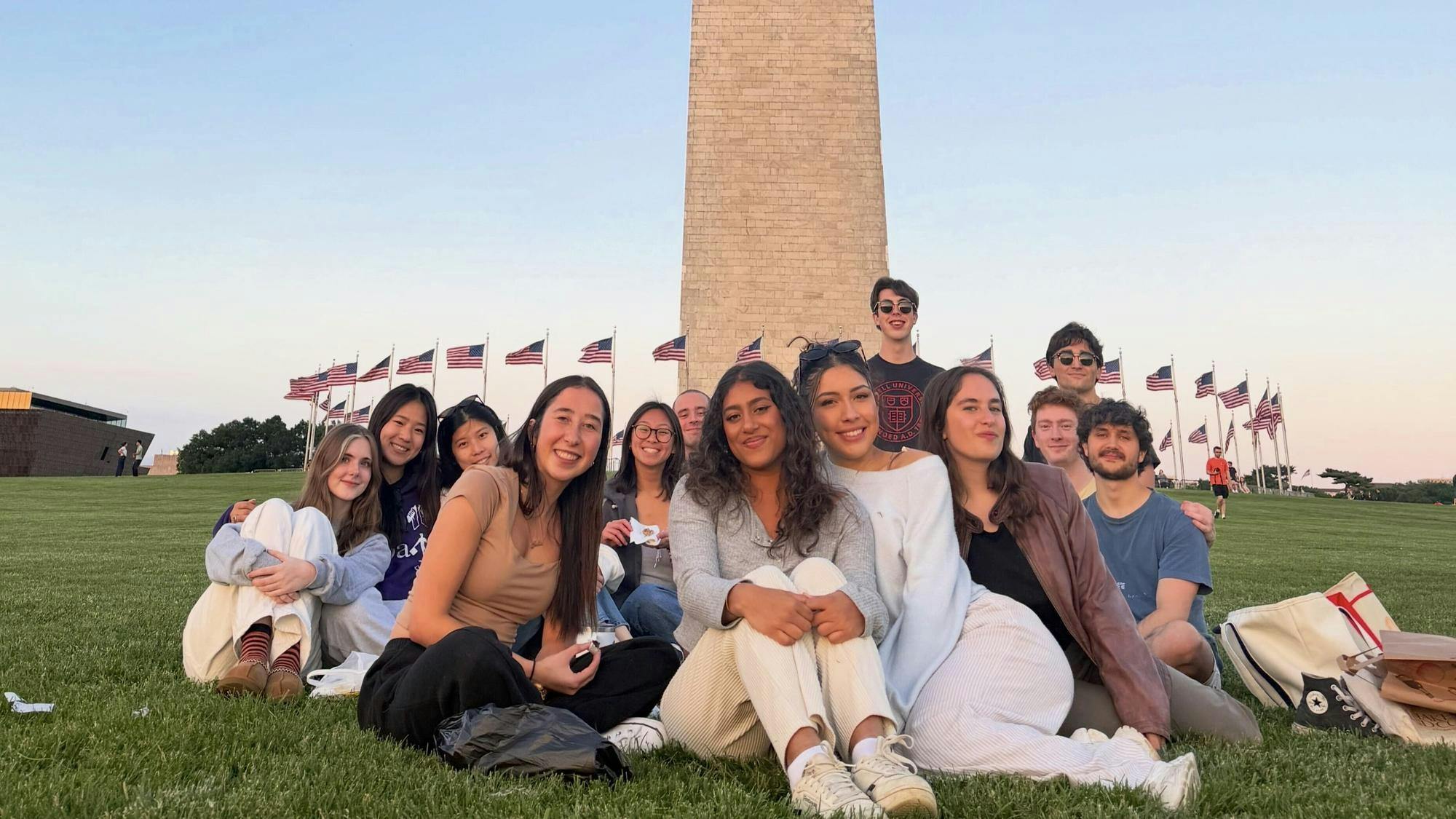
Many students studying government and public policy, at some point in their academic journey, face the arduous decision of whether or not to leave Ithaca and set their sights on our nation's capitol: Washington, D.C. This was the dilemma I found myself in last October while going through what could only be described as a mid-college life crisis. I felt unsatisfied with my clubs, like the odd one out in my freshman-year friend group and increasingly anxious about my bleak resume. More than anything, I just desperately needed a change.
The concept of Cornell in Washington — and the opportunity to escape the freezing cold for a semester while getting some semblance of a fresh start — felt like a beacon of hope. Looking back, I am so grateful I took the leap. CIW gave me an internship I loved, unexpected friendships and the chance to experience a different side of college life. Though, the experience was not what I had initially anticipated, and there are some things about the program that I wish I had known before cancelling my spring housing license.
Cornell in Washington’s D.C. Connect Program gives Cornell undergraduate students the opportunity to live, learn and intern in D.C. during the spring and summer semesters. While in D.C., the students all live within the Wolpe Center — an apartment-style dormitory in Dupont Circle — and attend classes in one large classroom on the first floor. The class schedule is designed to allow students three full days a week to take on a part-time professional internship.
For anyone considering CIW, I highly recommend reaching out to the Jeb E. Brooks School of Public Policy Career Services early on in your internship search. Their support ended up giving me such a positive D.C. experience. They helped me navigate the internship hunt, even when it felt like I was just getting rejected left and right, and they connected me with an amazing internship that was the perfect fit for me and my career goals. The internship aspect of CIW — many of my cohort members can agree — quickly became one of my favorite parts of CIW and made the semester as a whole so much more rewarding and formative.
One of the things that initially attracted me to CIW was the possibility that the course offerings would potentially allow me to complete the rest of my government major requirements while in D.C. I enrolled in CIW confident it would help me get ahead in my course load, only to find the course selection was more limited than I had anticipated.
After much delay, the CIW course list finally dropped weeks past the traditional spring semester enrollment period. There were only four total classes offered and only two of them were cross listed with government. Since the pre-enroll timeline had already lapsed, it was nearly impossible to change my mind and stay on the Ithaca campus. I found myself feeling like I was falling even further behind.
This does not mean the classes were in any way not worthwhile. In fact, the small CIW cohort meant that I always had a study-partner in all of my classes. Moreover, the classes that I initially felt I would have no interest in ended up being my favorites, like PUBPOL 3515: American Defense Policy & Military History from the World Wars to the Global War on Terror, simply because the CIW professors are just amazing at what they do: They find a way to make everything engaging with simulations and field trips around the city.
Another CIW surprise was finding out that I was the only one assigned a random roommate. Now this might not sound like the end of the world for some, but as an only child who had somehow managed to live in singles all throughout college, this was the ultimate devastation.
Upon arriving at the Wolpe, I found that there were a few additional administrative surprises. We were required to cut our winter breaks short and arrive a week early to the Wolpe for a mandatory orientation, which I felt could’ve been announced in an email. Additionally, the mandatory $400 “meal plan” was also very different from what I would traditionally spend my Big Red Bucks on. Rather than offering ham and brie baguettes, it was a storage room full of single-size snacks. While helpful in a pinch, I would not expect it to account for a sizable portion of your meals throughout the semester.
Within my first week, I quickly discovered that D.C. is a very expensive city. Cooking for yourself seems straightforward until you realize you also need to budget groceries, cleaning supplies, toiletries and transportation costs on the salary of an unpaid internship. Thankfully, there are resources available: The Cornell Club of Washington offers The Barber B. Conable Stipend to one student in the D.C. Connect program per semester.
My first few weeks in D.C. were a major adjustment period. But once I settled in, I found that D.C. and the Wolpe are truly magical places. Some of my favorite D.C. memories have nothing to do with internships or public policy. CIW also gives you about 30 built-in best friends. One night, we all ended up downstairs in the Wolpe lounge playing video games together for what seemed like six hours straight. Other days someone will suggest grabbing a bite or taking a spontaneous trip to the Smithsonian Zoo. There will always be something to do and someone to do it with.
So, would I recommend CIW? Absolutely! Yet, not for the reasons that initially convinced me to apply. CIW gave me the fresh start I was craving but not entirely in the way I had imagined. If you are considering CIW, don’t expect a perfect semester but go in with an open mind and embrace the unexpected. In the end, you may find that the semester you really needed looks nothing like the one you first imagined.
Natalie Chamberlain is a member of the Class of 2028 in the College of Arts and Sciences. She is a staff writer for the Lifestyle department and can be reached at ngc32@cornell.edu.