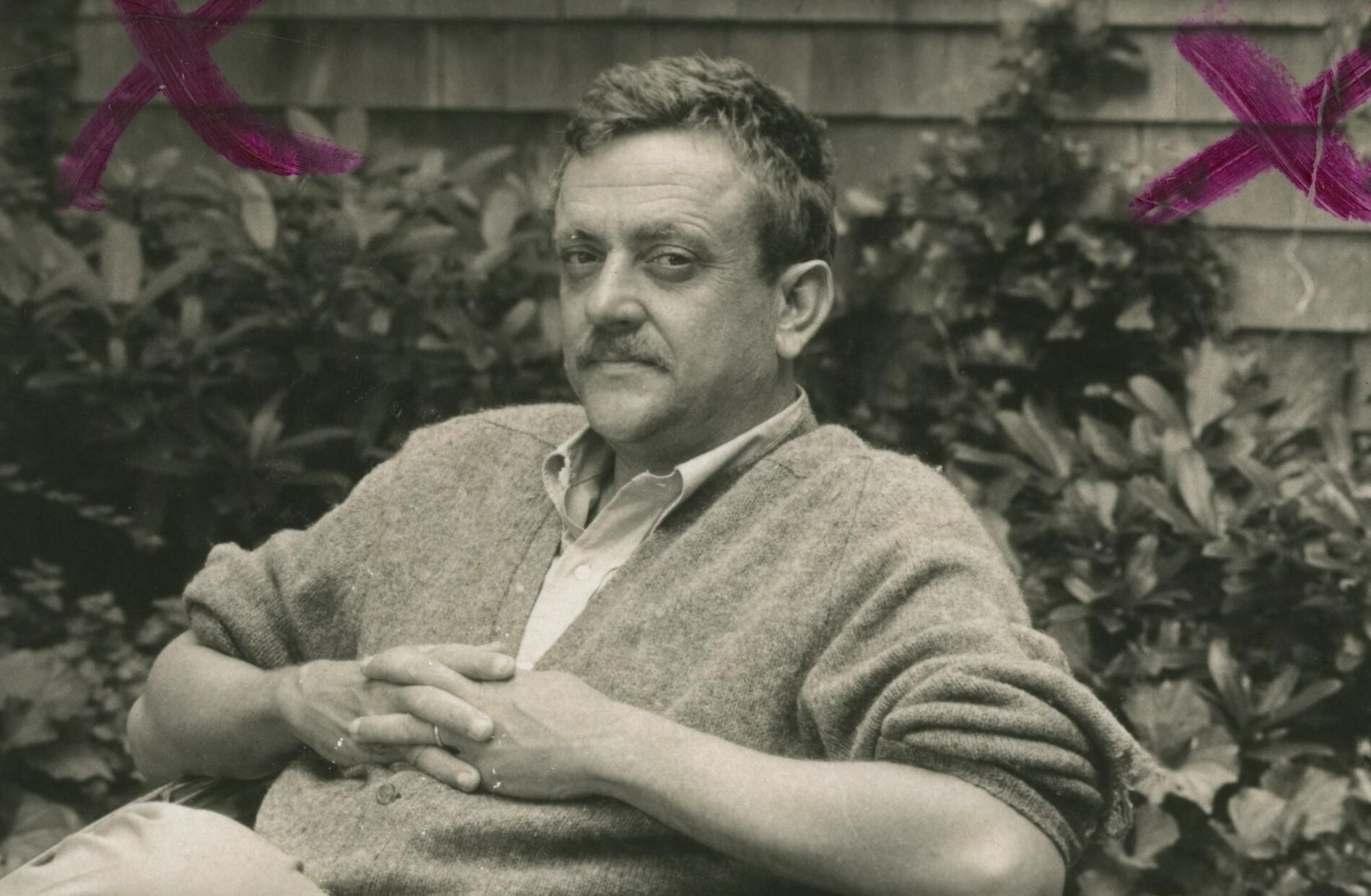
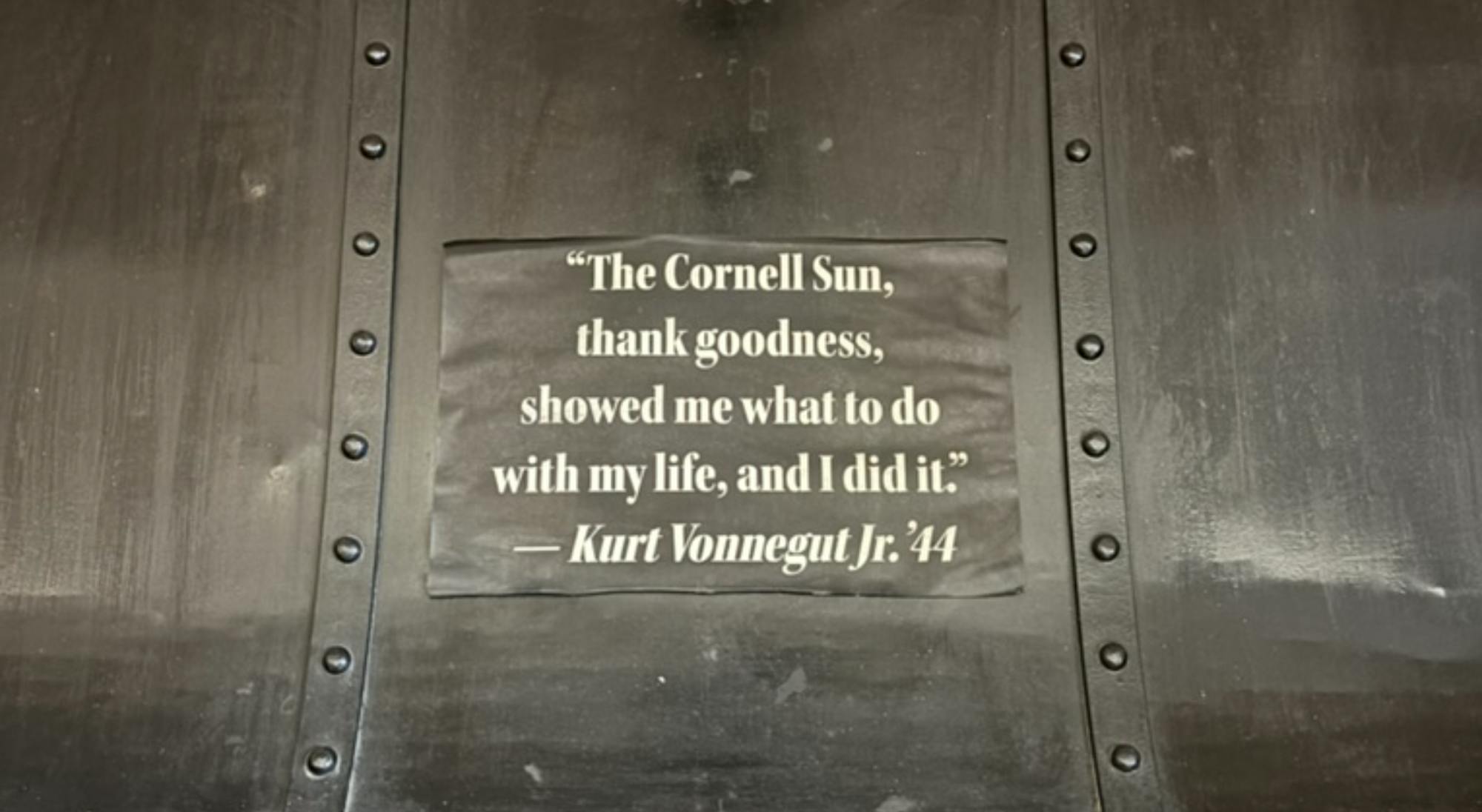
Kurt Vonnegut ’44, author of such novels as Cat’s Cradle (1963), Slaughterhouse-Five (1969) and Breakfast of Champions (1973), studied chemistry at Cornell and served as associate editor of The Cornell Daily Sun. He never graduated, having been drafted to serve in World War II (more on that later), but nevertheless remains a revered Cornellian and Sun legend. In the Sun office downtown on 139 W State St., above the fireplace hangs one of his quotes: “The Cornell Sun, thank goodness, showed me what to do with my life, and I did it.”
This pride in our collective connection to Vonnegut looms so large that, in Cornell’s Division of Rare and Manuscript Collections, we keep thousands of pages of his correspondence across a dozen boxes. Being a longtime Vonnegut fan (not to brag, but I wrote my Common App essay about Cat’s Cradle), I’ve made a couple trips to the archives to poke my nose in his 50-plus year old business. In anticipation of The Sun’s 146th birthday on Sept. 16, I took another peek last week.
While sifting through the archives, I came across a letter addressed to Vonnegut from the Student Mobilization Committee to End the War in Vietnam chapter at the University of Texas, Austin. In it, they invited him to speak at a rally on their campus: “Your lecture, on the University of Texas campus, would attract many students … it would help to build the movement here.” In the 1960s and ’70s, Vonnegut was a cultural symbol for the student anti-war movement across the United States, and it’s especially poignant that a relic of this phenomenon exists in Cornell’s archives today.
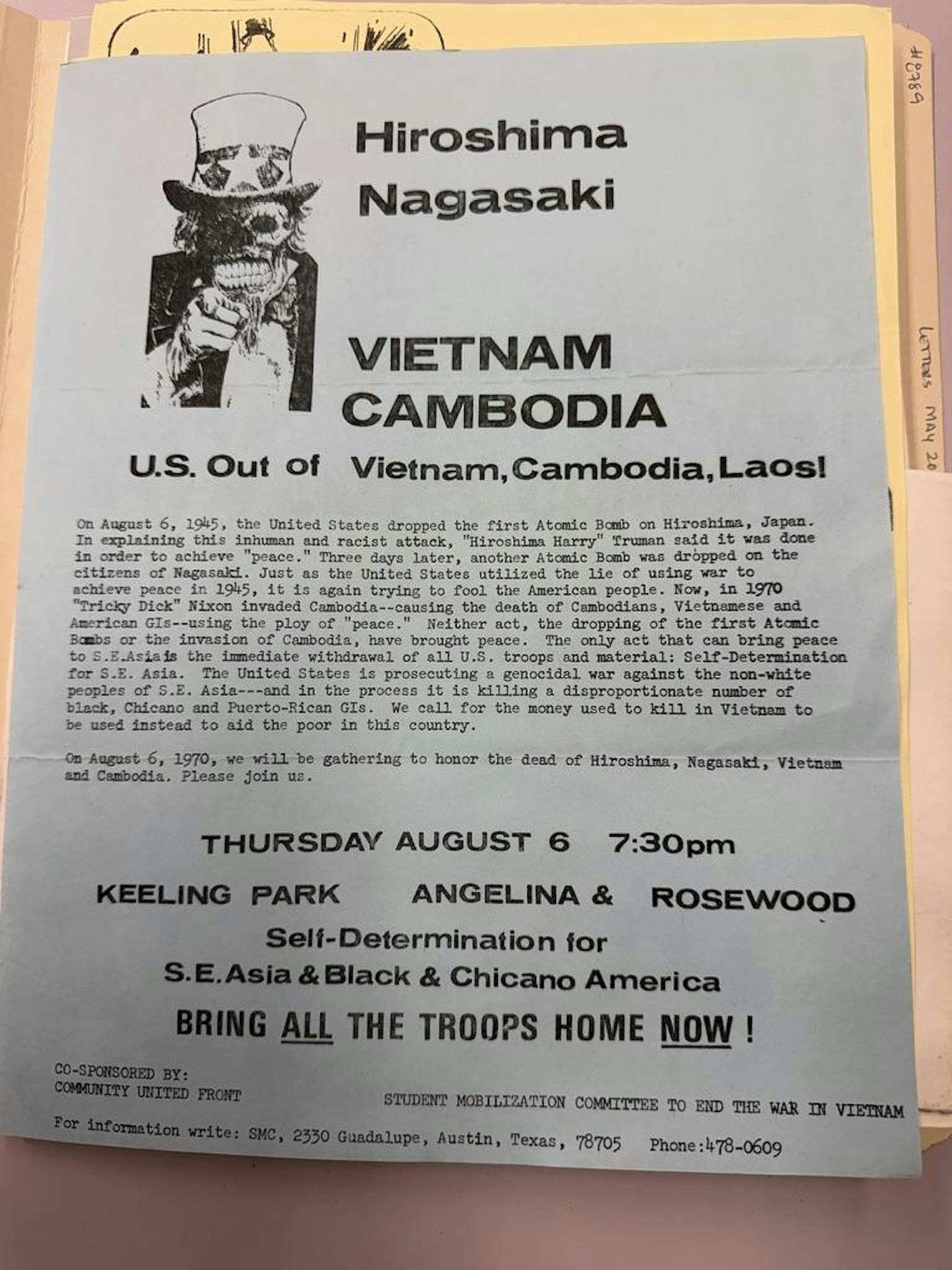
Along with this letter, the SMC attached several flyers they had created. One, printed en masse on light blue paper, was headed with a graphic of Uncle Sam with a skull face. Aligned with Skeletor-Uncle Sam’s top hat are the words “Hiroshima,” and then directly under it, “Nagasaki.” With an inch-or-so’s vertical space, the words “VIETNAM,” and “CAMBODIA” are aligned with Skeletor-Uncle Sam’s fist. The heading under reads: “U.S. Out of Vietnam, Cambodia, Laos!” The connection the student group was making isn’t tough to draw; in appealing to the hindsight-gifted ethical detestability in Former President Harry Truman’s decision to drop atomic bombs on Hiroshima and Nagasaki, largely civilian targets, the SMC compared the atrocities committed by the U.S. in World War II to the contemporaneous atrocities it was committing in Vietnam, Cambodia and Laos. In the paragraph beneath the eye-grabbing headers, the activists wrote:
“Just as the United States utilized the lie of using war to achieve peace in 1945, it is again trying to fool the American people. Now, in 1970 ‘Tricky Dick’ Nixon invaded Cambodia — causing the death of Cambodians, Vietnamese and American GIs — using the ploy of ‘peace.’”
In another flyer the SMC shared with Vonnegut, they referred to the U.S. invasion of Cambodia as “the April-June ‘blitzkrieg’”; in World War II, the Nazi Wehrmacht’s strategy of rapid, brutalizing attack formations was called ‘blitzkrieg,’ which literally translates from German to English as ‘lightning war.’ The theme of protesting U.S. involvement in Vietnam by drawing comparisons to the Second World War was effective — and also not new to Vonnegut.
Vonnegut’s call to arms as an anti-war figure came about from his 1969 American classic Slaughterhouse-Five, or, The Children’s Crusade. The novel is semi-autobiographical with science fiction elements and centers on Vonnegut’s experience as a prisoner of war during the firebombing of Dresden in 1945. It focuses on the youth of soldiers sent to the front, the senseless loss of life there and the shattering of the image of heroism through battle and death. Hitting bookshelves at the height of the Vietnam war draft and opposition movement, activists latched onto the book as an anti-war magnum opus. Vonnegut did nothing to dilute that conception, by not only making appearances at but leading anti-war rallies throughout the period. His most fondly remembered work stands as an emblem of the anti-war movement and culture of the 1960s and ’70s.
On The Sun’s 146th birthday, it’s relevant to think about the legacy of its past writers and editors, and its resonance in the world of Cornellians today. Vonnegut’s legacy is tied to the organization of student resistance movements over 50 years ago. That legacy is still visible today, if taking a different shape — or approach. In the Kroch Library Reading Room, it was hard not to think of the Students Not Bombs movement while paging through leaflets and letters from anti-Vietnam War groups. Organizing demonstrations in places as central to campus life as Ho Plaza, student mobilization is alive and well.
Students Not Bombs is protesting Cornell’s investments in weapons manufacturers, including Lockheed Martin, Boeing and L3 Harris. Their demands, including an institutional ethical review board and a redirection of investments to local affordability and academic opportunity, are more localized than those of the student movements against the Vietnam War. Centering their objectives around what Cornell in particular should be doing, Students Not Bombs takes a step forward in specificity and rallies institutional responsibility to the cause of campus mobilization. In reflecting on the legacy of Kurt Vonnegut and on the heritage of student protest movements, it’s fascinating to see how they’ve evolved over time.
The Sun has a long history of covering student movements; during the 1969 takeover of Willard Straight Hall, Sun reporters were on the scene documenting and crystallizing it. In the early 2000s, during the early days of the War on Terror, The Sun reported on a demonstration of students and faculty at McGraw Hall opposing preemptive military action in Iraq. While it would be inappropriate to draw direct equivalences between this protest and that, in celebrating the 146th anniversary of The Sun, we too should celebrate its history of voicing the diverse concerns and perspectives of Cornellians, and celebrate its continued mission of doing just that.
Alexander Walters is a member of the Class of 2028 in the College of Arts and Sciences. He is a staff writer for the Arts & Culture department and can be reached at apw65@cornell.edu.