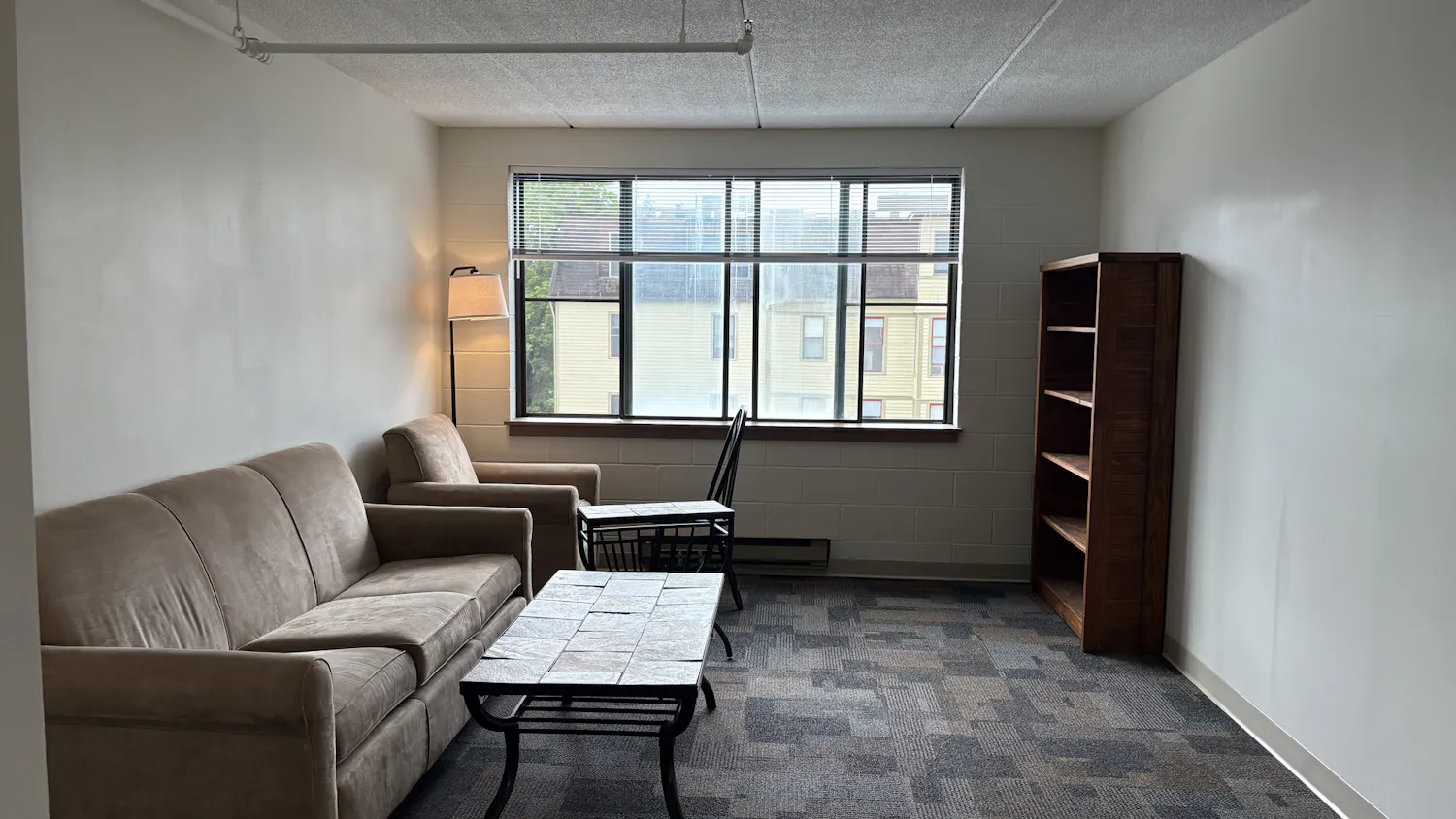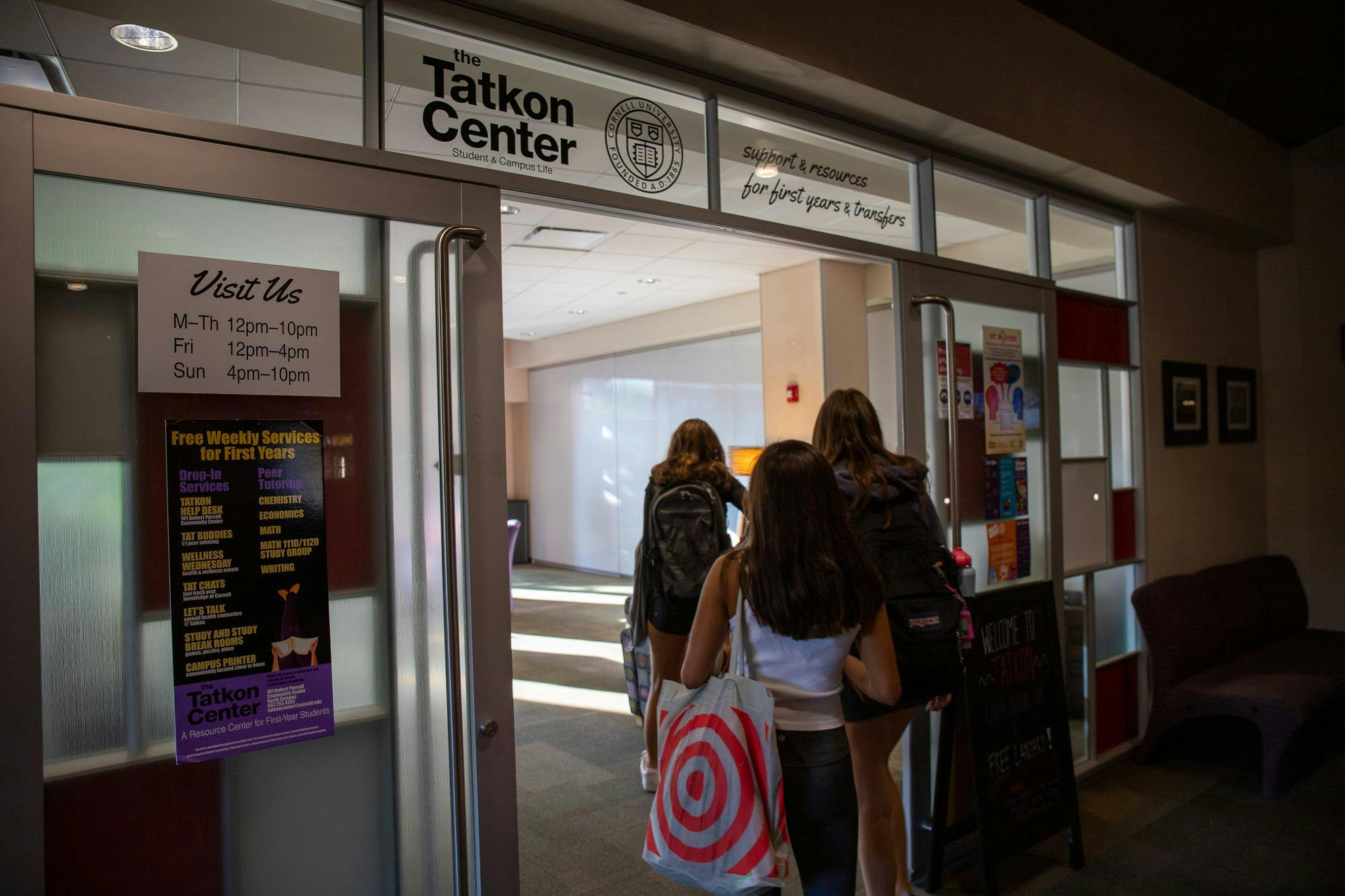
Tucked into a corner of Balch Hall, the Tatkon Center for New Students plays a central role for incoming first-year students. The Sun spoke with student workers and the director of the center to learn about the history of the center as well as the resources available for first-years.
The Tatkon Center, located in the south wing of Balch Hall on North Campus, is dedicated to supporting first-year and transfer students throughout their first year. It offers a staffed study and community space open into the evening, along with workshops, peer mentoring, orientation programming and referrals to academic and wellness resources across the University.
“A lot of the times when [students] come into the space, they’re like, ‘What is the Tatkon Center?’” said Skylar Minerva-Medina ’27, a student programming assistant at the center. “I think it’s kind of hard to match the physical space to the office that you’re getting tons of emails from.”
History of the Tatkon Center
The center opened in Balch Hall in 2003 in honor of Carol Tatkon ’59, who served as president of Balch Hall and as a Cornell trustee. The facility was designed to improve campus life for new students.
The center just finished its first full year back in its renovated space in Balch Hall, which underwent construction from 2021 to 2024, reopening fully in 2025. During this time, the center was re-located to the Robert Purcell Community Center. Though the center is now back in its original location, it still hosts a classroom in RPCC.
Tatkon Center Director Kevin Perry, who has led the center since 2022, said that the center’s mission is built around five guiding principles: agency, connection, community, support and readiness.
“We like to say that we serve as the conduit,” Perry said. “We bring resources from across the University to North Campus so that students can make an initial connection, and they’ll know more about that resource, as well as our office. Then they know where to go find them when they need them again.”
Passive and Active Programs
Perry splits the center’s offerings into two categories: active and passive. Active programs have the goal of providing students with structured engagement, like a workshop presentation or small-group conversation. Passive programs, on the other hand, allow students to “choose how [they] want to engage” with the center’s space without structured activities, Perry said.
The center plans out passive programs for “high stress key times,” such as establishing quiet hours, bringing in snacks for students and doing workshops to make self-care kits, Perry explained.
This year, the center introduced trivia nights as a new active program. Hosted by student staff, they act as a way for students to meet new people, Perry said.
The center offers students a community and study space as late as 11 p.m. most nights, staffed after 5 p.m. by a rotating team of 14 student programming assistants who sit at the front desk, check students in, answer questions and run their own programming like tea time and a slime night.
Minerva-Medina said that programming helps students form connections and friendships.
She also helped organize the center’s National Transfer Student Week, drawing on her own experience as a transfer student.
“I would have definitely loved to go to these events as a transfer because I wanted to make connections, but I didn’t know where to do that or who to do that with,” Minerva-Medina said.
The full range of activities offered during the semester are found on the center’s public event calendar. Alongside workshops on topics like building study skills, mindfulness meditation and navigating a first career fair, the Tatkon Center co-hosts Cornell on Ice with Campus Activities each spring, offering free entry and skate rentals at Lynah Rink.
An ‘Optimistic Foundation’ for First-Years
While the Tatkon Center has programming all year long, they are especially active during orientation week. Each night of that week, the center hosts or runs events for incoming freshmen.
Daniel Silva ’29, an orientation leader, said his own orientation week experience gave him “such an optimistic foundation” that he wanted to recreate it for others.
His role is now split between running small group sessions, where new students do icebreakers and ask questions, and evening events like movie or glow nights, where orientation leaders handle everything from checking students in to handing out water and snacks.
Silva said he advises incoming students “[to not] be afraid to put yourself out there” and “to be that positive ray of sunshine in someone else’s life.”
Lauren Wilkes ’27, who has been an orientation leader for three years, said she had an easy transition to Cornell and wants to pass that ease along.
“I was very lucky that I had a very smooth adjustment to college,” Wilkes said. “It made me realize that a lot of the worries I had coming in were things I didn’t need to worry about.”
Wilkes also explained how the job has produced its share of full-circle moments. She recalled a student who was quietly struggling to find community that she checked in with throughout the semester.
“At the end of last semester, I saw them and they’re doing incredible now, and really found their people,” she said.
Tatkon’s Future
When looking to the future, Perry said he hopes the center becomes a place that students “can really rely on throughout their Cornell journey.”
He recounted stories of students returning to Tatkon to work as student programming assistants or as orientation leaders with fondness.
“That full life cycle is something I’m particularly proud of,” Perry said. “Students aren’t just coming to Tatkon to receive information … they are coming to give back.”
Perry also explained his goals for the center to come up with “creative ways” to support transfer students even though many of them live far from Tatkon’s North Campus office.
He said that in five years, he hopes that returning students will talk about the Tatkon Center as something that was “instrumental in helping them build their foundation for their Cornell experience, whether that meant finding a community, navigating a challenge, figuring out the academics, or simply just having a place where they felt comfortable asking a question.”
‘Planting [the] Seed’
Underneath the trivia nights and orientation icebreakers, Perry sees the center’s job as helping students navigate the challenging landscape of high academic expectations, mental health concerns, financial pressures and uncertainty about the future.
Perry circled back to one lesson he wants every new student to internalize: asking for help is a sign of strength.
“Successful students are not the ones who don’t need help,” Perry said. “They’re the ones who recognize and ask for help, and recognize that as a strength.”
When asked whether students bear the responsibility for seeking out help themselves, Perry also described the center’s goal as “planting a seed.”
“The student ultimately has to pour and water that seed, but there are also multiple touch points in that first-year experience designed to say, ‘We don’t expect you to find the watering can by yourself,’” Perry said.
Harlan Flamm is a member of the Class of 2029 in the School of Industrial and Labor Relations. He is a contributor for the news department and can be reached at hpf7@cornell.edu.