


With each passing roll call of Congress, more bills are proposed and voted on that appear to be “litmus tests” on Israel. On Sept. 3, Representative Josh Riley (D-N.Y.) voted in favor of one such piece of legislation: the misleadingly named “Protect Economic and Academic Freedom Act,” which requires universities that receive federal funding to certify that they “will not engage in a nonexpressive commercial boycott of a major strategic partner of the United States.”
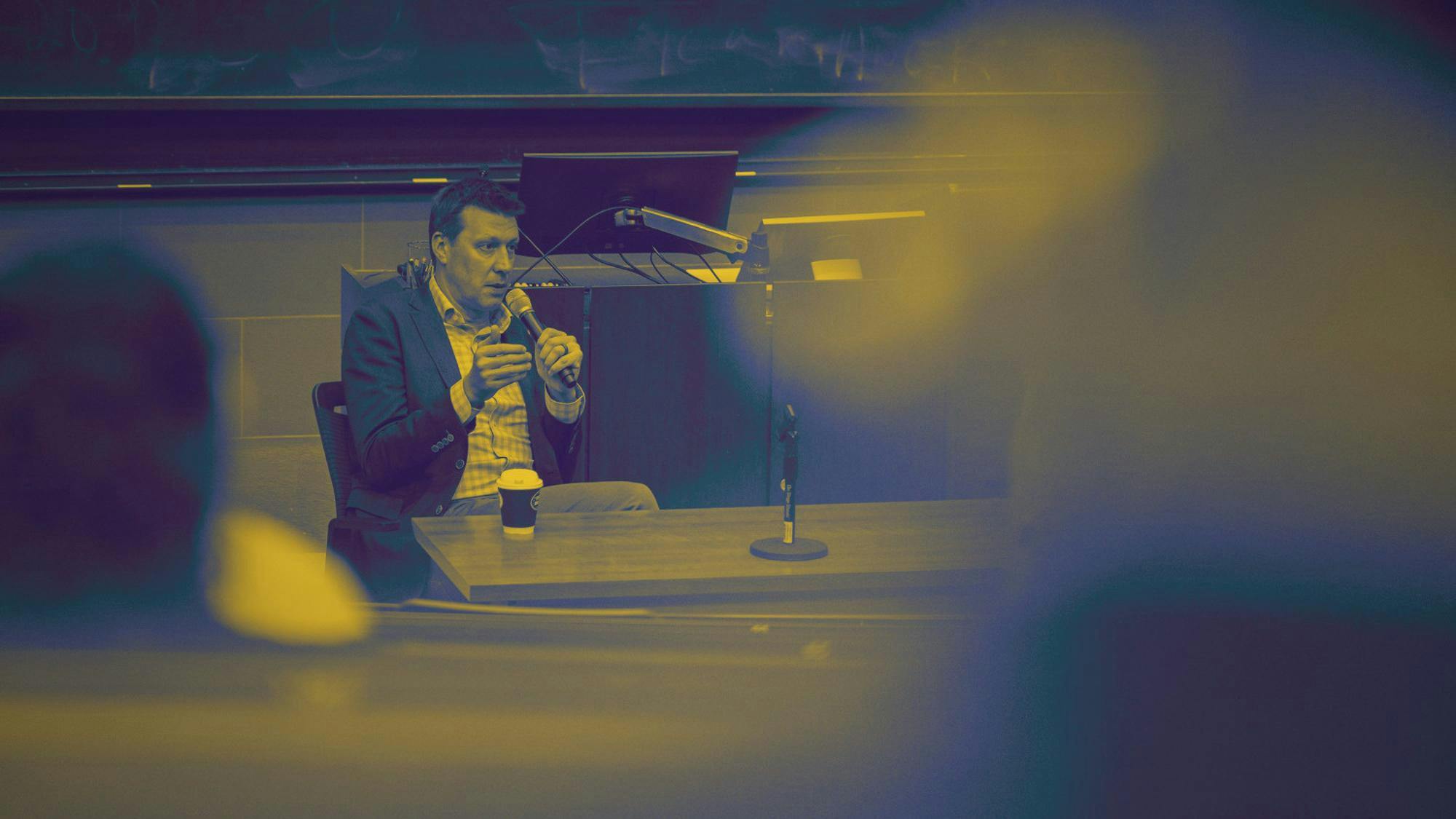
At a recent Q&A event at the Cornell Law School, Riley called this act a “non-discrimination bill at a time when antisemitism is rising on a lot of our campuses,” and asserted that “if you look at the definition of ‘strategic partners’ in [the bill], it’s a pretty long list.” The latter is patently false. The law is crystal clear. It defines a “major strategic ally” of the United States as “a country described in section 4 of Public Law 113–296.” Section 4 is a single sentence: “It is the sense of Congress that Israel is a major strategic partner of the United States.”
The final vote tally was bipartisan, though not entirely: 237–169. Nevertheless, this bill should not be seen as a referendum on the U.S.-Israel relationship and certainly not protecting freedom. It fundamentally curbs the rights of people and institutions in America to express themselves freely. With his yea vote, Riley voted to curtail that hallowed freedom.
To be clear, the official boycotts and prohibitions on student involvement in Israeli-linked programs that the bill seeks to prohibit do not exist and have been rebuked by University administrators. The “boycott-divest-sanction” movement is popular among the progressive flank of Cornell students, but highly unlikely to secure administrative or trustee endorsement. Riley himself stated that he knew none of the schools in his district were in violation of the bill and that factored into his vote in favor of it. Thus, in voting for the bill, Riley legitimizes and engages in the same witch hunt the Trump administration has been undertaking in its search for rampant antisemitism on college campuses.
Riley represents New York’s 19th District, which encompasses not just Cornell University, but also Ithaca College, SUNY Binghamton and other universities within and outside of the SUNY system. It is true that many of these universities’ students are expats to Riley’s district and not a part of his constituency. However, the universities themselves are. These universities are some of the finest institutions of higher education in the State of New York, yet he chose to cast a vote that is the antithesis of the academic freedom and integrity that universities ought to stand for.
During Riley’s 2022 campaign for Congress, he emphasized the importance of the preservation of democracy and of students’ civic engagement. Paramount to both is the right of individuals and organizations to spend — and withhold their spending — as they wish. Riley has succumbed to the tempting siren’s call of expression repression masquerading as protection against antisemitism and voted for a law that is in every respect retrograde to the constitutional right to boycott. In Buckley v. Valeo, the Supreme Court ruled that spending money is a form of constitutionally protected speech. This reasoning implies the reverse is also protected; the withholding of financial resources in an act of dissent is the exercise of free speech too.
The passage of this bill reveals a striking duplicity in both parties. Republicans have long defended the personhood of corporations and their right to spend money as they like for political causes. Democrats have positioned themselves as the defenders of the Constitution in the battle against the Trump administration’s alleged censorship campaign. In passing this law, both have engaged in mental gymnastics to justify their votes to no avail, as the hypocrisy behind their thin veil is plain to see.
While this bill must still pass muster in the Senate, receive the President’s signature and beat the civil litigation sure to come its way before becoming law, the bipartisan support in the House is cause for concern. Riley is running for re-election in New York and faces a test of his electoral mandate in the November midterm elections. The Sun calls upon him to explain his vote, as many of his colleagues have, and prove to his constituents that he still defends the most fundamental and inviolable right in a democracy: freedom of expression.
The Cornell Daily Sun’s Editorial Board is a collaborative team composed of Editor-in-Chief Sophia Dasser ’28, Associate Editor Sophia Romanov Imber ’28 and Opinion Editors Zara Cheek ’28 and Rayen Zhou '29. The Editorial Board’s opinions are informed by expertise, research and debate to represent The Sun’s long-standing values. The Sun’s editorials are independent of its news coverage, other columnists and advertisers.


