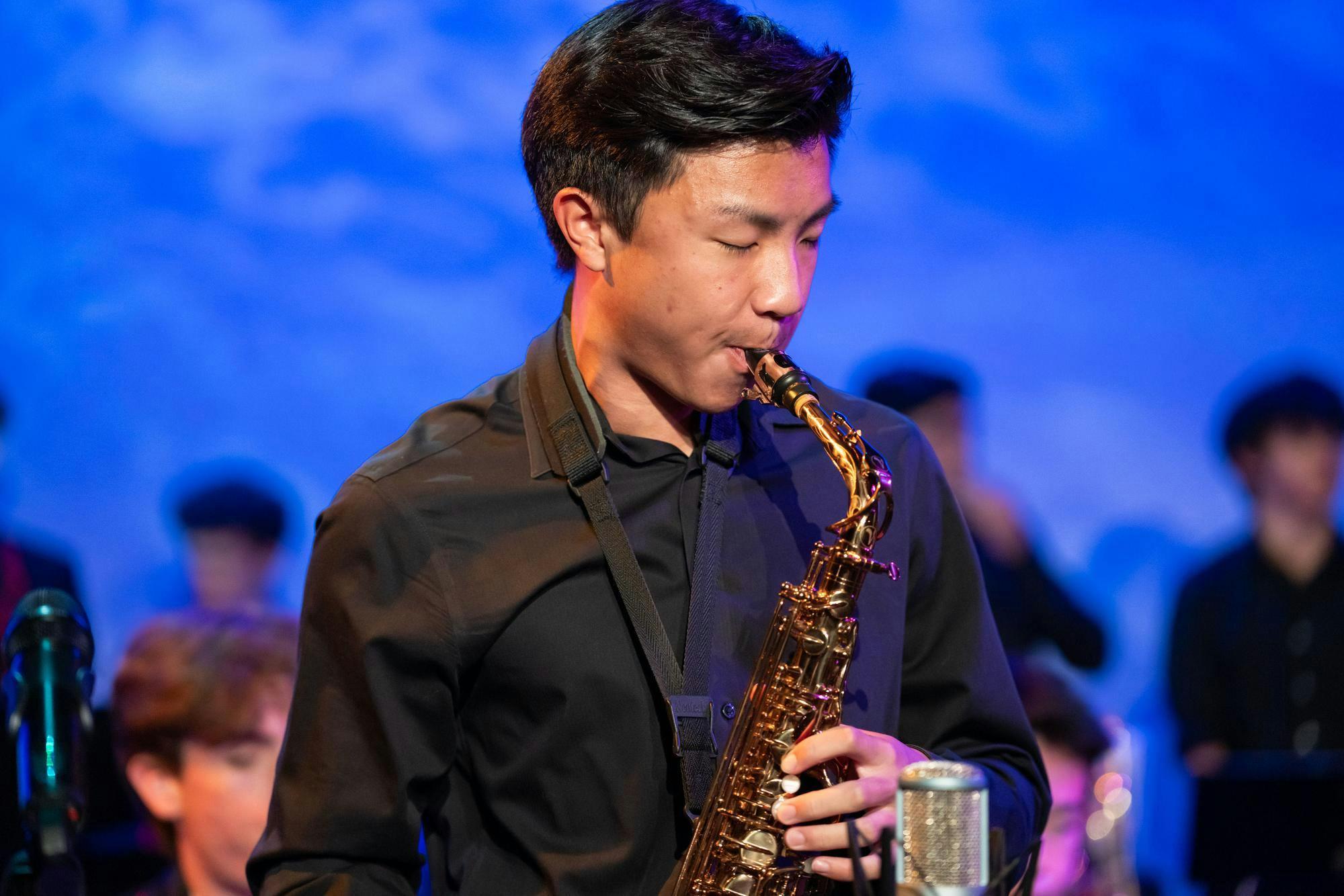
Interested in learning how to play an instrument but don’t have the resources to do so? Reharmonize, an all-new web application created by Ethan Tai ’29 gives people the opportunity to teach themselves how to play jazz tunes. It covers over 1,500 jazz standards, ranking them by harmonic similarity.
Launched in March 2026, the purpose of the website is to give access to lessons and sheet music for people passionate about jazz who otherwise couldn’t afford the barrier to entry.
The website is a free tune similarity tool for jazz students that helps them find new songs to learn based on what they already know.
As an example, “a student learning blues for the first time can find other tunes with related chord progressions to study next,” Tai explained.
Tai built Reharmonize over the course of his freshman year at Cornell as someone who felt the roadmap to learning jazz was challenging.
“After learning my first jazz tune, no one told me what to do next,” he told The Sun. “There wasn’t a roadmap for getting from beginner to good. So I built one.”
Tai, who has been playing the alto saxophone for seven years, emphasized the importance of mentorship while students follow their passion for music.
“The students who get good at jazz are usually the ones with great teachers,” Tai said. “I wanted to build something for the students who don’t have that. Kids figuring it out alone in their bedroom.”
The website offers AI tutors that answer questions and suggest music to learn alongside a companion blog with articles written by Tai offering tips and tricks.
“It’s free and always will be,” Tai said. “I'm not trying to build a business. I'm trying to make jazz education more accessible for students who don’t have access to top music programs.”
A handful of Cornell students have found the tool useful for their own learning endeavors, noting the usefulness of being able to navigate through tunes based on their harmonic similarity.
Ted Crall ’29 started playing jazz his freshman year of high school. One of the biggest challenges he faced when pursuing his passion is the high barrier to entry.
“When you first start, practice isn’t fun. Learning your instrument and the basics of music takes a ton of repetition, and I think about 90% of young musicians quit before they ever reach that positive feedback loop,” he wrote in an email statement to The Sun.
Nathanial Choi ’28 also started playing jazz in high school, seven or eight years ago. The hardest part of pursuing his passion was being able to expand his repertoire.
“You’re expected to know hundreds of standards,” he said. “Up until this point, the traditional way to go about it was grinding through the book with a collection of all the tunes with no real map.”
Choi added that unlike classical music, jazz has no structure.
“The music is beautiful but daunting,” he said. “There’s no obvious structure in what you might see in a classical music studio. You have to take ownership of your own process.”
Ali Awada ’28, the manager of the Collegetown Jazz Club band, uses Reharmonize whenever the band is performing.
“It’s very accessible to pretty much anyone. You don’t need to build an account and there are no ads.” he said. “You can tell it’s created purely for the love of music and jazz.”
All three students have found Tai’s website useful in being able to recommend similar songs for those who are familiar with the basics of their instrument.
Crall noted that the application is even useful for musicians who have already mastered their skills.
“Once you reach the point where you know your instrument well and are actively learning the music, it becomes especially useful because it makes it easy to find everything in one place,” he wrote.
Choi likes that Reharmonize builds upon the tunes that people have already learned, and has used it as a way to continue honing his own skills.
“The app helps you work off of a tune that isn’t totally foreign,” he said. “I’ve used it to find tunes that I probably wouldn’t have touched for another year otherwise. But because they already lined up with what I’ve been playing, I was able to get around to trying them out sooner.”
Awada noted that the tool’s ability to find similar tunes based on harmonic similarly assists his band in keeping a consistent flow of energy.
“We can’t transition to completely different songs during our performances because people become inherently uninterested, breaking the flow.”
As Tai continues to expand and develop Reharmonize, Crall, Choi and Awada expressed that rather than having a fixed key, it would be more practical for the application to have a feature that allows the toggling of keys to match the recordings.
“It would be much more useful if you could change the key to match whatever recording you want to play along with,” Crall wrote.
“I think that incorporating a transposable element to the charts would be helpful,” Choi said. “More often than not you play these tunes in all different kinds of keys.”
Awada pointed out that the application being locked onto the most common key is a limiting factor for vocalists who are unable to perform certain songs in the common key.
“As the app continues expanding, I would like to see more unique keys,” he said.
Keeping this in mind, Tai is working on a major launch in mid-August featuring a unified AI-powered chat interface where users can ask any jazz pedagogy question.
“It’s the platform vision I’ve been building toward,” he said. “I really want this to help underserved populations.”
Chloe Yu is a member of the Class of 2027 in the College of Arts and Sciences. She is a staff writer for the science department and can be reached at cyu@cornellsun.com.