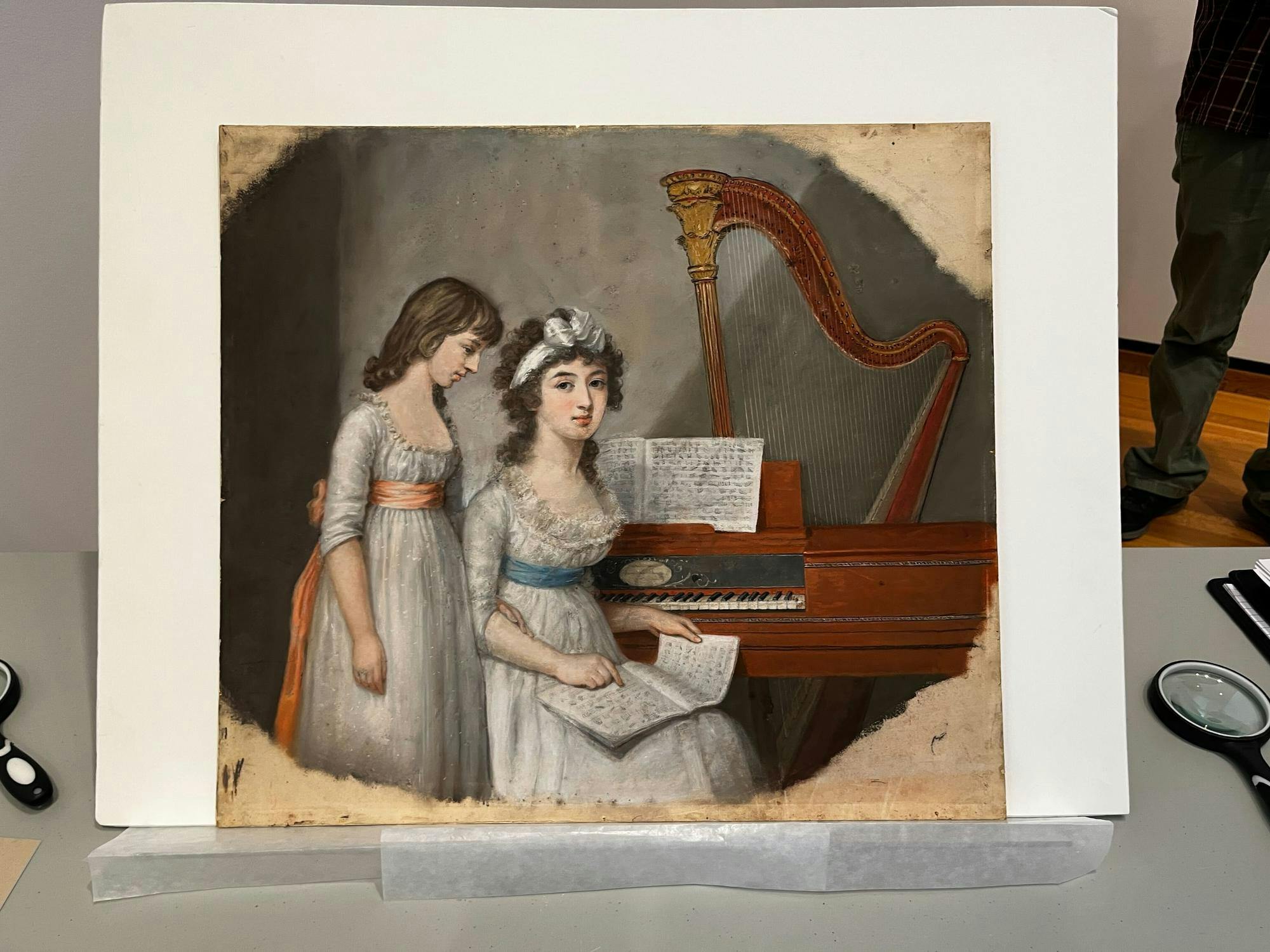
At the front of the room stood a podium, a piano and a harpsichord. Displayed beside the musical instruments was a 1795 pastel illustration by Italian artist Anna Tonelli, depicting two young women and a piano. This was the setup for “Piano Portraits: Art and Music-Making in London, ca. 1800,” the last in a series of three piano-focused events this semester at Cornell’s Johnson Museum of Art. The combined lecture and concert, organized around the Johnson Museum’s recent acquisition of Tonelli’s piece, beautifully intertwined British art and music of the time period by alternating between presentations on various female artists and composers and live performances of the music they composed.
The newly acquired artwork, descriptively titled “Portrait of Amelia and Harriet Harding-Newman of Nelmes, Essex, at their Music Lesson,” is an illuminating glimpse into the world of Tonelli and her contemporaries. The lecture opened with a discussion of Tonelli’s life and art — including other portraits she completed, her time in London and works she created during her travels in India — and continued with a biographical overview of the Harding-Newman sisters themselves. In the pastel, Tonelli depicted Amelia and Harriet at around ages 14 and 16, respectively.
After sharing more information about Tonelli and her work, the Johnson Museum event transitioned to a performance segment with Patricia García Gil, a postdoctoral associate and artist in residence, on harpsichord; Prof. Roger Moseley, music, on piano; and Addi Liu, Ph.D. candidate in music and sound studies, on violin. These musicians brought the audience a taste of the music that might have been played in the Harding-Newman sisters’ drawing room, beginning with a sonata by Maria Cosway, an artist and musician who was the subject of the following lecture. Later performances featured only one or two musicians, inviting the audience to focus on the intricacies of a single instrument at a time, before ending the event with all three performers playing together once more on another Cosway sonata.
Over the course of the event, the presenters imparted more knowledge about women’s art and music in 1800 Britain. At the time, in addition to being a pleasurable activity and art form, music was seen as a key ‘accomplishment’ in a woman’s education. The musical performances between lectures included works by composers Theresia Paradis, Maria Hester Park and Jane Mary Guest, each of whom I gained familiarity with as the afternoon progressed. The presentations included not only biographical information, but also images, such as portraits of the musicians themselves and images of real letters they had written. The musicians of Piano Portraits brought these composers’ music to life in a way that beautifully illustrated the content of the presentations.
After the presentations and performances ended, I went up to the front of the room to look more closely at Tonelli’s pastel, which will eventually be on display in the Johnson Museum. The older sister, Harriet, is shown sitting down on the piano bench with a book of sheet music in her lap, while the younger sister, Amelia, stands next to her, gently holding Harriet’s arm and looking down at the musical score. Another book of sheet music appears open on the piano. Up close, I was in awe at the sheer level of detail Tonelli captures in her pastel work. The lace on the girls’ dresses, each string of the harp and every note of the sheet music are all rendered with remarkable care. Far from cheapening Tonelli’s intricate use of detail, her artistic liberties such as sometimes drawing four lines instead of five on a staff of sheet music allow the details to fade into the background and invite the viewer’s attention to linger on the artwork’s focal point, the faces of the two sisters.
This event in the Piano Portraits series, by combining the two traditional styles of lecture and concert, immersed its audience more fully in the musical and artistic world of Regency London. While the lecture provided enriching context for the concert, the concert brought the lecture’s factual information to life. I found it fascinating to hear live performances of these women’s compositions in conjunction with learning about the role of music and art in their lives.
Raina Lockwood is a member of the Class of 2027 in the College of Arts and Sciences. She is a staff writer for the Arts & Culture department and can be reached at rl978@cornell.edu.