


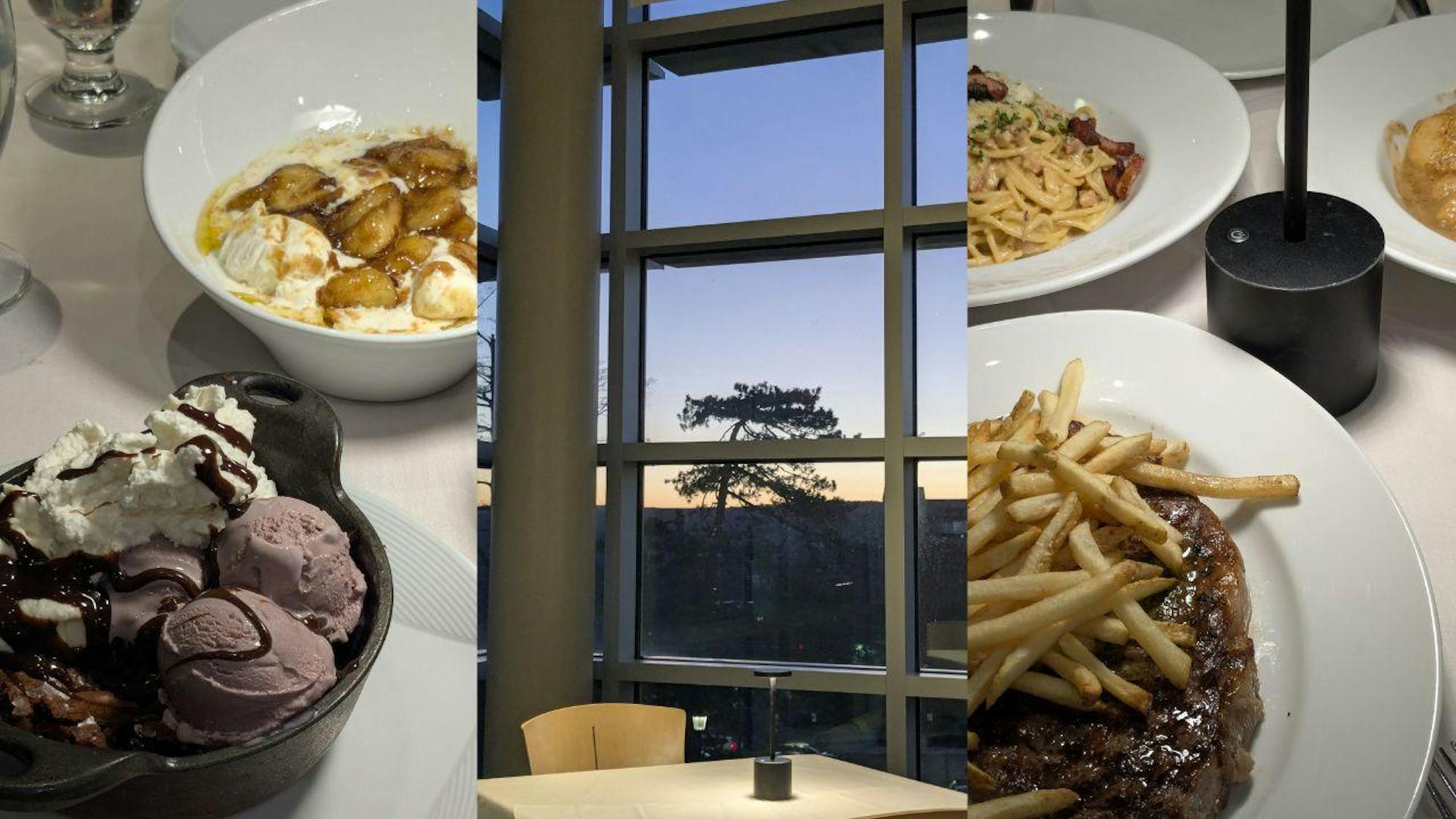
“Reservations open at 10 a.m. and we probably book out by 10:30 in the morning, opening [reservations] three weeks out,” said Professor Heather Kolakowski ’00. This exclusive, limited-time restaurant is Statler Hall’s “Establishment.” I interviewed Professor Kolakowski , a senior lecturer who teaches the associated course for this restaurant, to learn more.
In brief, Establishment is a core Hotel School class in which students “lead the show”: staffing a restaurant as cooks, hosts and servers, supported by TAs who have previously taken the course or “who have a lot of culinary experience.” Most are learning on the go, with “Establishment” being their first introduction to food and beverage service. In addition, for one night, they work as managers in a group of three to four students, during which their responsibilities include “creating a specials menu” in addition to a core menu, developing a “financial breakdown of their evening” and managing their peers.
I first learned about Establishment when I was invited to a mutual friends’ managerial debut. The friendly atmosphere, with the “dining room [being] mostly students, the friends and family of the managers” along with availability limited to week nights, is the main reason for the quick sell-out. Occasionally, however, a “live guest” will make an appearance — someone that no one on the team knows and who has seemingly stumbled upon the restaurant independently. Either way, ‘lab’ is in session.
The course is counted as a seven-hour lab for hotelies: 2:55 to 9:55 p.m. once a week in addition to a lecture. The course is not new to the Hotel School; Kolakowski stated that “any alumni from the Hotel School has taken this course in some way shape or form.” She continued, “You could ask any alumni … ‘tell me about your management night’ and they’d remember,” with Kolakowaski recalling her theme of “Argentinian Fine Dining.”
I decided to put this to the test and reach out to my aunt, a Hotel School alum, who recollected her own debut: a Ski Lodge theme serving trout amandine (along with the general difficulties of being a server and running a restaurant). And while I had the impression that the Hotel School was mostly filled with students who want to work in hotels, Kolakowski clarified that this comprises only “about 25 to 27% of our students,” with the rest going into “finance or real estate or consulting” — but all of them have to take this restaurant course.
Kolakowski also defended the course against popular generalizations that it is merely a “napkin folding class,” asserting that it is “the culmination of several different disciplines” — assembling financial statements, “multitasking, guest relations,” “working with a team in a high pressure [kitchen] environment,” unexpected problem solving (which is common since “every single night someone’s new to their task”) and gaining “experiential hands on learning of management.” Lessons on management are especially significant to the course because of how applicable it is to the variety of career paths Hotel students pursue. Finally, she emphasized that “all of our students are going to be in a food and beverage experience as a client, with an employer, with a partner … and being able to see what goes into that gives [students] a little bit of empathy and understanding.” Overall, she described the class as many things: “intense,” “a commitment,” “a challenge,” a “bonding experience,” “a real-world group project” (which is slightly terrifying) and “the embodiment of the hospitality experience.”
She also sees room for development for the course and the associated kitchen: They recently renovated and hope to re-introduce a cooking course for non-hotelies. In addition, figuring out “hydroponic growing to be able to utilize herbs, microgreens and maybe a little bit of produce” for the kitchen is a goal. With this rendition of the course as the Establishment being relatively recent (2012), it’ll certainly be interesting to see how it continues to evolve in the future.
Beyond the course itself, Establishment provides an amazing guest experience. Before even entering, the students were all extremely polite and accommodating. My group also got amazing window seats and saw the sunset (supposedly due to my friend’s connection with the manager, who also checked in with us a few times that night). As a group of four, we decided to share a mix of appetizers, mains and desserts — and splitting the bill evenly was super easy.
One of the guests at my table had attended before and told us the dishes she enjoyed (and those she didn’t) — and noted that she had a bit of a long wait for food when she attended. Having one of the last reservations at 7:30 p.m., we did not have a similar problem: the food came out quickly, which in hindsight makes sense since everyone wanted to be cleaned up and out by 9:55 p.m. The entire meal was delicious, with my favorite dish being the scallop gnocchi. It was my first time trying scallops: I loved the new texture and adored the white wine cream sauce that made its way into every bite. The desserts were also appetizing, especially the vanilla and berry ice creams. With the splitting of the various dishes among four people, the bill was about $30 each, which is relatively low given a ban on tipping (it is, after all, still a class). This also felt extremely reasonable given the quality of the food, ambiance, service, and overall experience. I left delighted that I had decided to try the restaurant out, and if you know someone making their managerial debut (or just want to go as a “live guest” for fun), I would definitely suggest trying to snag an invitation.
Melanie Delfosse is a sophomore in the College of Human Ecology. She can be reached at md2262@cornell.edu.
Melanie Delfosse is a member of the Class of 2028 in the College of Human Ecology. She is a staff writer for the Lifestyle Department and can be reached at md2262@cornell.edu.


