Ph.D. candidate in chemistry and chemical biology Russell Burgett filed an appeal to the National Labor Relations Board to reconsider a previous ruling that granted graduate students bargaining power and union representation. If approved, the appeal would effectively overturn graduate student unions, including the Cornell Graduate Student Union, making their bargaining power obsolete.
The appeal, filed on Feb. 10, seeks to overturn the NLRB’s August 2016 Columbia University decision, which ruled that graduate students are employees and subject to the National Labor Relations Act, granting graduate students bargaining representation.
Burgett’s current appeal surrounds CGSU’s “Union Shop” policy, which states that all graduate students in the University who are part of the bargaining unit are required to pay a fee of 1.44% of their stipend each month or make a charitable donation of the same amount if they hold a religious, moral or ethical objection.
A graduate research assistant’s stipend was $47,548 annually, translating to a monthly fee of approximately $57.
Burgett did not respond to a request for a comment or interview about the appeal from The Sun.
This appeal follows a previously filed federal charge by Burgett in July with free legal aid from the National Right to Work Legal Defense Foundation, an organization which advances Right to Work laws — laws that prevent unions from forcing employees to join or pay fees.
The filed federal charge, in opposition to the Columbia University ruling, argues that graduate students are not employees because even if they do research and other academics work for the university, they are primarily students and thus ultimately customers of the university. Thus, they would not be considered employees by the National Labor Relations Act and would not be given bargaining power under the law.
The appeal is addressed to the NLRB General Counsel Crystal Carey, who was nominated to the position by President Donald Trump in March 2025 and confirmed by the Senate in December. Carey was previously a partner at Morgan Lewis & Bockius LLP, which pursued the legal argument that the NLRB structure is unconstitutional. In her prior private practice, Carey represented clients, including Amazon and Trader Joe’s, against unionization efforts of their employees.
“[We feel that] if the National Labor Relations Board in Washington D.C. hears this case and rules neutrally as to what the law says, they will find that Russell Burgett … is correct,” NRTW Vice President Patrick Semmens said in an interview with The Sun. “[Graduate students] are not employees as intended to be covered by the National Labor Relations Act.”
“Burgett, who is not a member of the Cornell Graduate Student Union (CGSU-UE, an affiliate of United Electrical), opposes the radical ideology and agitation of CGSU agents on campus,” a news release by the NRTW stated.
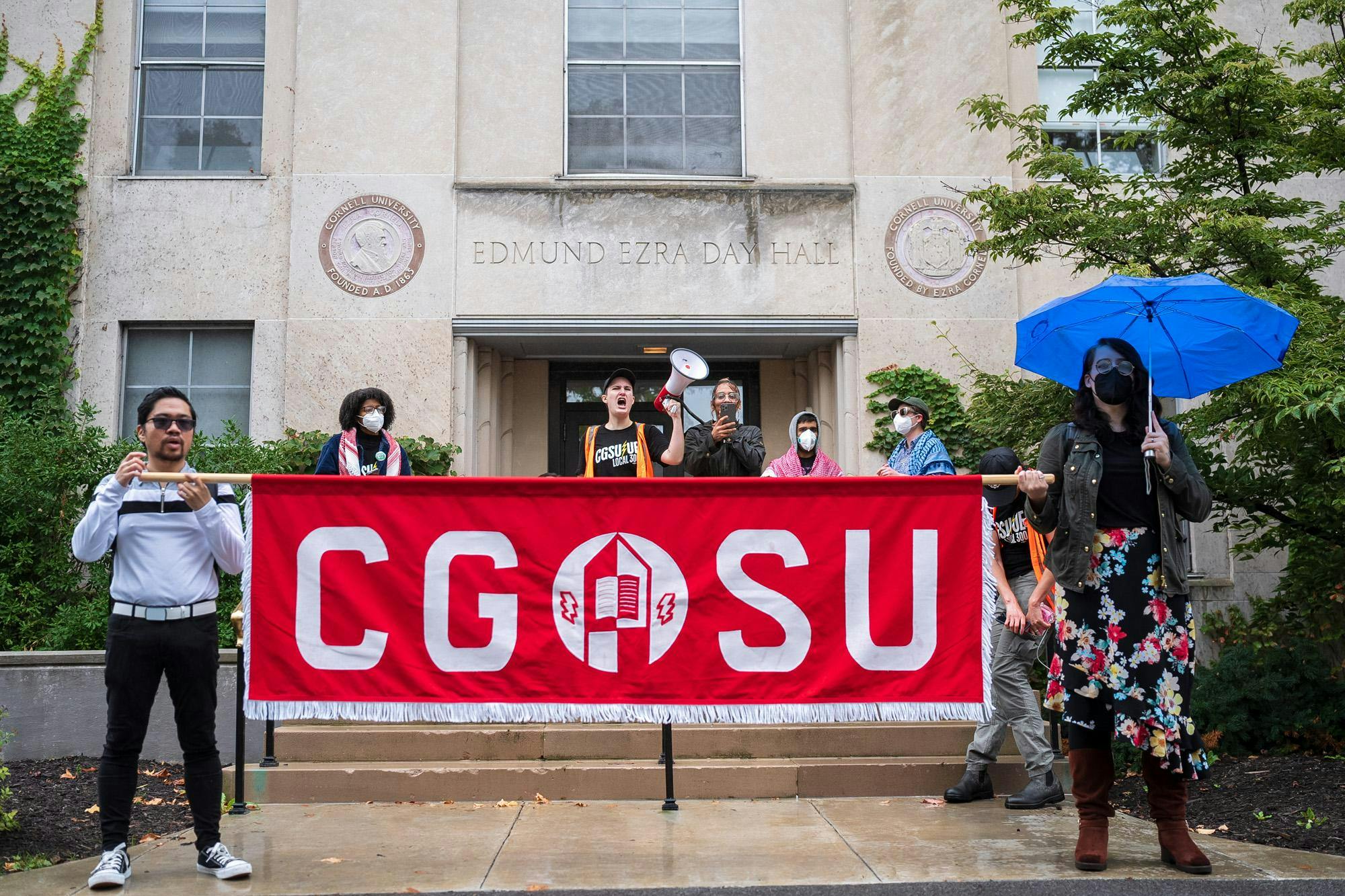
Ewa Niżałowska, CGSU president and fifth-year Ph.D. candidate in government, said that union shops are necessary for graduate students.
A union shop “ensures that we are able to … fight for the rights of graduate workers,” Niżałowska said.
Niżałowska said that this power is especially important as theTrump administration’s policies threaten international graduate students, whether by revoking student visas or deploying Immigration and Customs Enforcement on college campuses.
“Cornell has done very little to protect graduate workers from ICE, even as we've seen graduate workers at other institutions get literally snatched off the streets,” Niżałowska said. “Graduate students need an organization that fights for our rights, that stands up against Cornell's multibillion-dollar endowment and the interests of the billionaires on the board of trustees.”
If a graduate student objects to joining the union on ethical or moral grounds, they are given the option to donate to any of three charities as an alternative, according to the contract between Cornell and CGSU-UE.
According to the NRWF’s news release on the appeal, the CGSU did not allow Burgett to pursue this alternative because his objection was not submitted during the designated period.
The Columbia University decision states that, “the [NLRB]has the statutory authority to treat student assistants as statutory employees, where they perform work, at the direction of the university, for which they are compensated.”
If Burgett wins, this result would be overturned, meaning graduate student unions across the country would lose federal recognition unless voluntarily recognized by their respective universities.
“When we filed our cards before the Union existed, we asked Cornell to voluntarily recognize us. They denied us,” Niżałowska said.
Niżałowska explained that graduate students were able to obtain legal recognition as a union in 2023 through a popular vote by the graduate students, where 96% of graduate students in the election voted in favor. Overturning Columbia University would strip the approximately 9,000 students across the University of bargaining rights.
Niżałowska also rejected the claim that graduate students are customers rather than employees.
“We get paychecks,” Niżałowska said. “It is a settled question in the law and in practice that graduate workers are not only workers, but [that] we do some of the most essential work [for universities]” Niżałowska said. “We teach classes, we teach sections. We are up on our feet for many hours of the day, working in labs. We are doing the groundbreaking experiments that advance scientific knowledge.”

Rajorshi Chatterjee is a member of the Class of 2029 in the College of Agriculture and Life Sciences. He is a staff writer for the news department and can be reached at rchatterjee@cornellsun.com.