


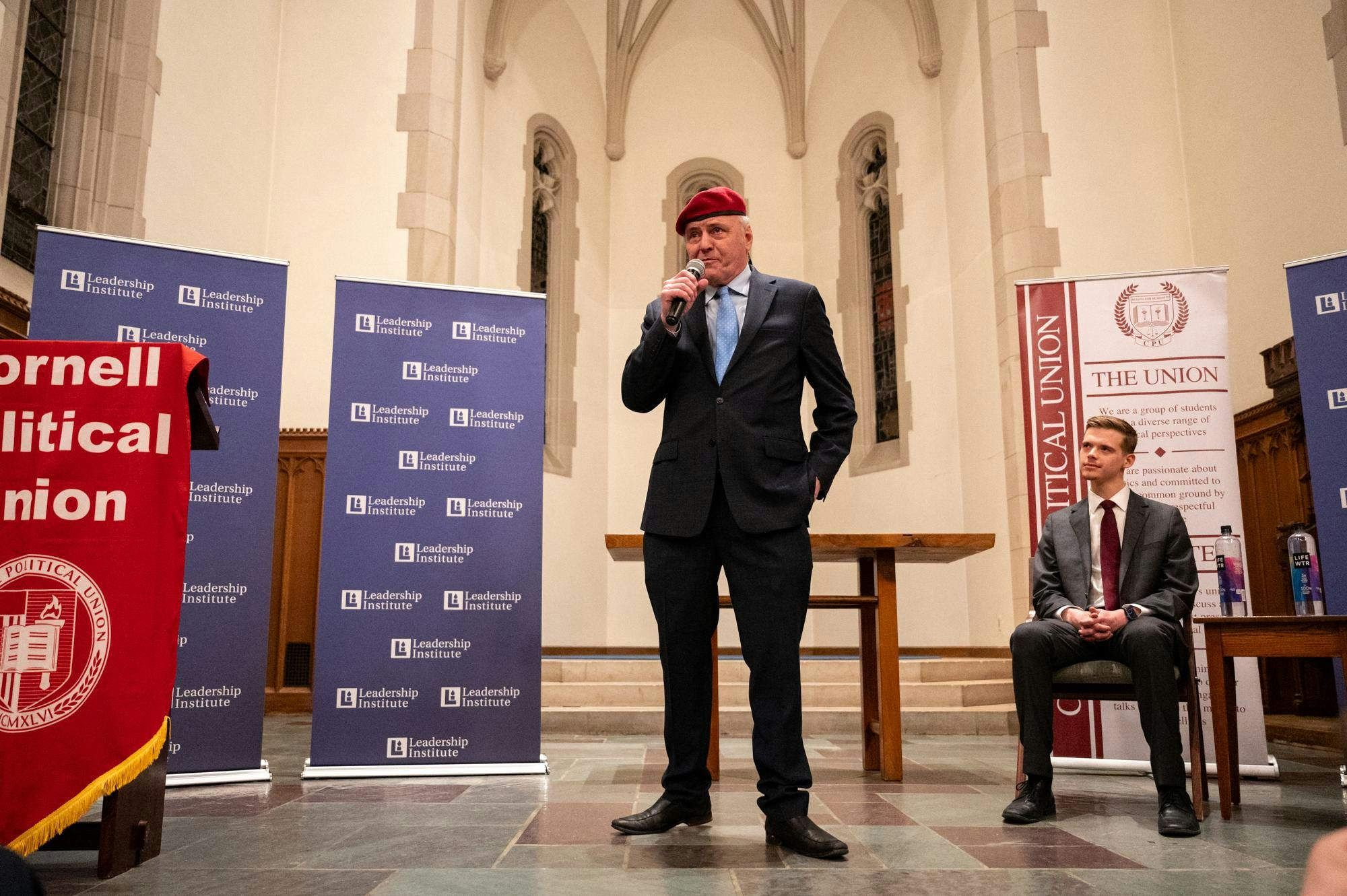
The Cornell Political Union hosted a debate which featured Curtis Sliwa, two-time Republican nominee for mayor of New York City and founder of the Guardian Angels on Tuesday evening. Over 125 students attended the event at Anabel Taylor Hall Chapel to hear Sliwa and the debaters speak.
Debaters were given the resolution “community over government” to address. Sliwa, who CPU invited as a guest speaker, provided opening remarks before the debate in agreement with the resolution. The debate was open to all students to attend, and the debate floor was open to CPU members only.
Sliwa, donning his staple red beret, was greeted by a thunderous applause upon entering the chapel and giving his opening speech.
“First off, let’s get the rules straight,” Sliwa said to the crowd. “You can’t be glazing me tonight.”
Going on to voice his support for the resolution, Sliwa emphasized the importance of community organization, which he regarded as more proactive than government involvement.
“If you're just going to wait for the government, they're going to be a dollar short and a day late,” Sliwa said.
He then called on the audience to take action to improve their communities.
“I'm a doer, not just a talker, and that is what each and every one of you should be,” Sliwa said. He also implored the audience to question authority and the government, saying “We need to be curious. First and foremost curious.”
Sliwa, born and raised in Brooklyn, New York, founded the Guardian Angels, a nonprofit volunteer organization dedicated to crime prevention, in 1979 in response to rising crime and violence rates in New York City, according to its website. The organization now spans 14 countries and over 130 cities, specializing in safety-patrols, self-defense training and homeless outreach.
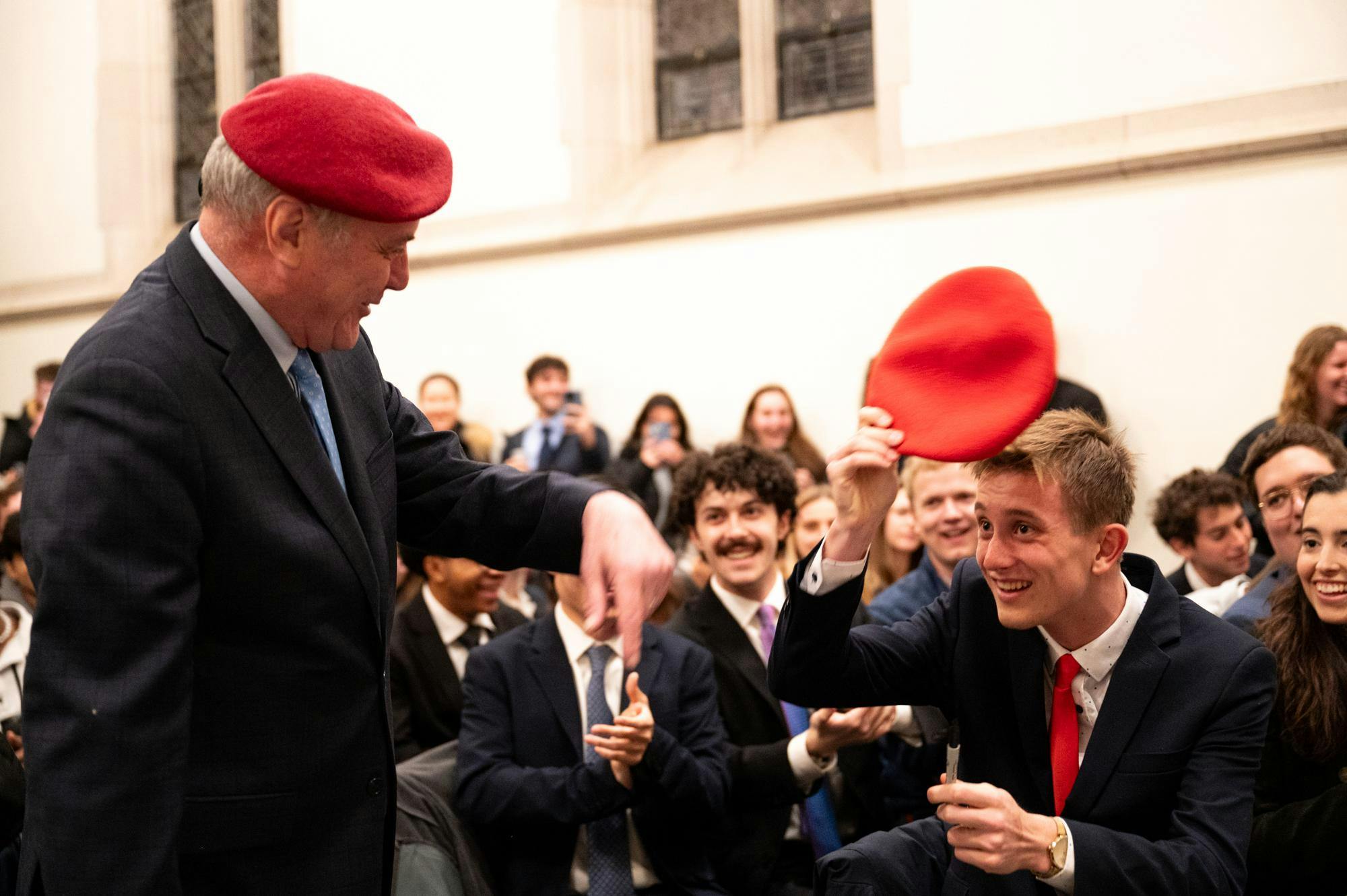
He continued his community outreach efforts by running for mayor of New York City in 2021 and again in 2025. Although Sliwa received only 7% of the vote, his campaign received a wave of support from Gen-Z on social media. He stuck through the election, in spite of several calls to drop out of the race, disapproval from President Donald Trump and alleged bribes from several billionaires to step down. Some Cornell students previously commented on the 2025 mayoral race calling Sliwa “quite entertaining” and “the realest New Yorker [in the race].”
During his opening remarks, Sliwa also pointed out times in which he said the federal government has failed to act in the interests of its citizens, pointing to the war in Iran.
Since the U.S. bombed Iran on Saturday, nearly 800 people have been killed in Iran, 50 in Lebanon, 11 in Israel and six U.S. service members in Kuwait, in a series of attacks between the U.S. and Israel and Iran. Trump has given various justifications for the war, including preventing Iran from developing nuclear weapons and preventing Iran from funding proxy terrorist groups.
“Why? Can I ask, why? What the hell did they do over there at this point in our history, to deserve what we're doing to them at this particular moment? This is insanity” Sliwa said, followed by a roar of applause from the crowd.
He concluded his speech by encouraging students to “follow your principles, not the principle of your bank account, the principles of your belief. … Use the great education you're getting now to make a difference.”
Sliwa’s speech preceded the CPU debate, which started with two four-minute speeches, one given by Sun opinion columnist Leo Glasgow ’26 in the proposition, or in support of the resolution, and another given by Admir Cekic ’26 in opposition of the resolution.
Glasgow began his remarks by thanking the members of his community who got him to where he is today. He gave a shout out to his middle school, his music teacher, his building’s superintendent, all to point to the benefits of community, and then warned against when a government can isolate individuals from their community.
“So let me end by saying shoutout to my mom," Glasgow said to the crowd.
Cekic opened by pointing to the Founding Fathers and the Constitution, explaining that the government should come before community because the purpose of the government is to serve and work for the people.
“America is a nation composed of many communities,” Cekic said. He added that the government serves to protect these several communities, so they can exist in harmony.
After the opening speeches, the floor opened to debate amongst CPU members. Several members spoke, taking a variety of stances.
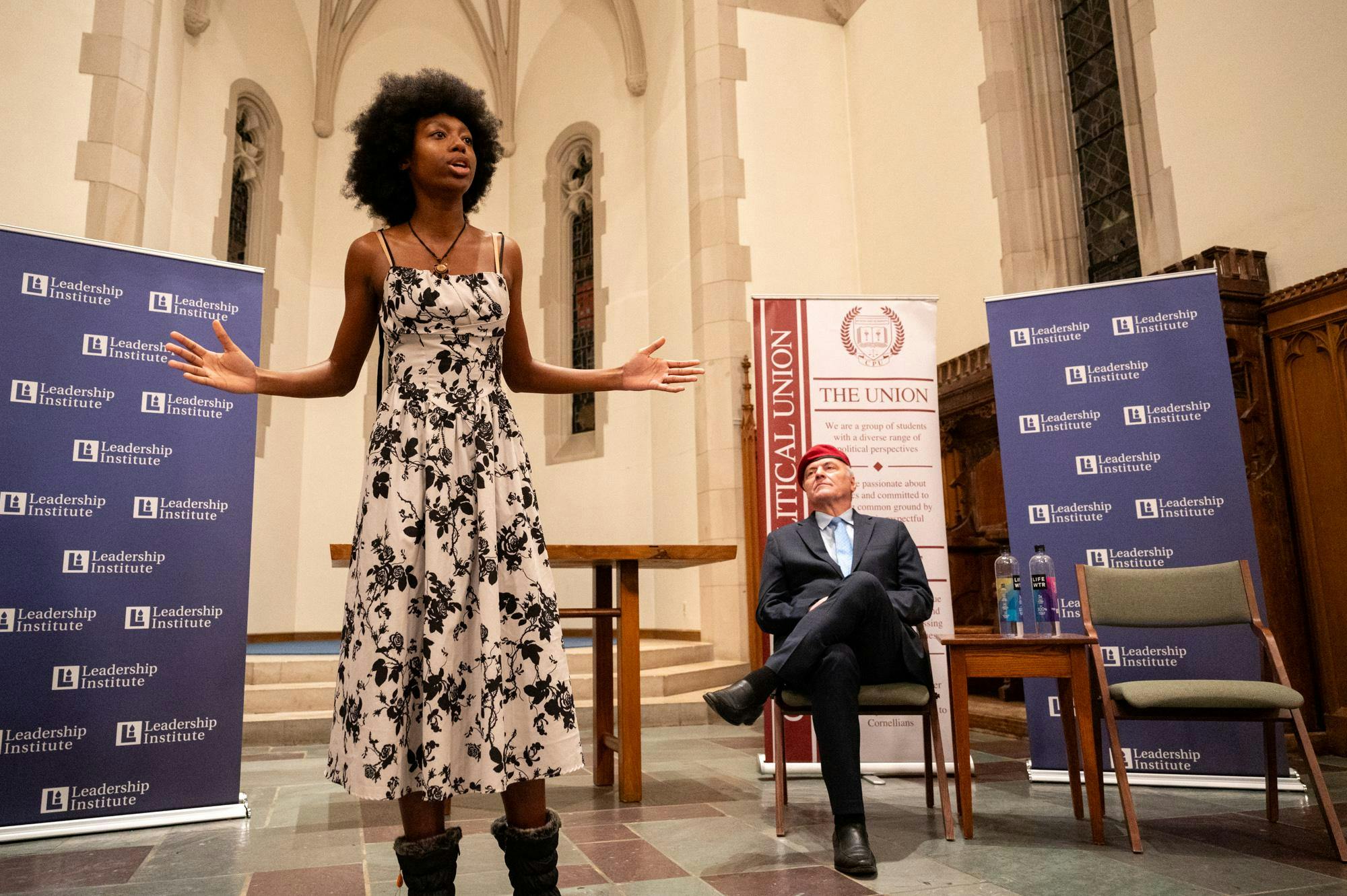
A student speaks while Sliwa and the crowd watches.
Max Troiano ’28 argued in favor of the government over community, emphasizing the role of the government in protecting its citizens.
“A beautiful community cannot prevent a war in Iran,” Troiano said. “A beautiful community cannot defend itself, and for that, we need a government.”
Sofia Etlin ’26 warned against the government's potential overreach in its authority.
“Look around, we are told we are freer than ever, and yet we are more managed than any generation in history,” Etlin said, “To who do we pledge allegiance to? … A state that will send us to Vietnam, to Iraq, [to] Iran. A state that will take away our healthcare. Tax us, but not billionaires. … I pledge allegiance to you, and to my community.”
Following the debate, Sliwa made closing remarks, thanking students for engaging in a debate that encouraged a variety of viewpoints.
“Trying to collaborate and come together with people of different points of view can be a very difficult thing to do,” Sliwa said. “You swim in a sea of negativity.”
To conclude the debate, CPU members held a vote on the resolution, rejecting it in a 16 to 19 vote.
After the debate, CPU members hosted a reception with Sliwa at Okenshields. Sliwa ate rice and vegetables during the reception and told The Sun that he “enjoyed [the food] and that’s why I had a second helping.”
Sliwa’s message left a lasting impression on several audience members.
“It was refreshing how much he did not care for establishment figures, how much he stuck to his guns,” said attendee Billy Stammer ’28.
Attendee David Rha ’26 was also impressed by Sliwa’s remarks.
“There's obviously a risk with a candidate like him, entering a very sort of typically perceived liberal space as Cornell University, but I think that his speech was, overall, incredibly compelling,” Rha said.
An overarching message that Sliwa imparted on the audience throughout the event is that they should try to make a difference in the world.
“What is going to be the mark that you leave on Mother Earth?” Sliwa asked the audience during his remarks. “You come in with nothing, you go out with nothing. Hopefully, you establish something that has helped other people.”

Mary Caitlin Cronin is a member of the Class of 2028 in the College of Agriculture and Life Sciences. She is a news editor for the 144th Editorial Board and can be reached at mcronin@cornellsun.com.


