As students walk across Central Campus for class, head to Uris Library for a study session or enjoy the sunset on Libe Slope, the chimes of McGraw Tower fill the campus with songs day in and day out.
From playing sentimental pieces like the “Married Life” theme from Up to more light-hearted tunes like “The Duck Song,” the Cornell chimes echo across campus. The music from the bells hosted in McGraw Tower have become a staple of University life, ringing three times a day for fifteen minutes at a time.
History of the “Heartbeat of Campus Life”
Described by Cornell as the “heartbeat of campus life,” the chimes have been part of the University since its founding. Cornell’s chimes first rang across campus on Oct. 7, 1868, making history as the first set of chimes to be housed and rung on a college campus in America.
In 1868, philanthropist Jennie McGraw Fiske donated Cornell’s first set of nine bells, which were played on a ground-level stand. In 1873, the chimes were moved indoors to McGraw Hall. Since McGraw Hall was never intended to be the chimes’ final home, the chimes were then moved to their permanent location in McGraw Tower in 1891.
Over time, more bells have been added to the chimes. From nine bells in 1868, McGraw Tower’s bell collection has grown to currently host 21 bells.
Behind the Bells
During the school year, the chimes are heard ringing every day across campus. These daily concerts are arranged and played by a small group of undergraduate and graduate students known as the Cornell Chimesmasters.
The Chimesmasters put on three concerts each day, typically hosting concerts at 7:45 a.m., 1:10 p.m. and 6 p.m on weekdays and 10:10 a.m., noon and 6 p.m. on weekends, according to the Chimes website. Each concert consists of traditional songs, themed arrangements and occasional requests from visitors.
“We have a policy of trying to minimize the amount that pieces are repeated. So we have to keep learning new things,” Serena Wu ’28, chimesmaster and Cornell Chimes outreach coordinator, told The Sun. “When we are taking requests from the guests, sometimes we just have to learn things on the fly.”
Chimesmaster Benjamin Isaacson ’27 currently serves as a librarian for the Cornell Chimes. In this role, Isaacson organizes and manages the physical and digital database of sheet music arrangements. No two sets of chimes sound or are operated the same due to the differences in number of bells, weights, tuning practices and structural design.
“Since we have a very unique instrument and that there's no other chime that's exactly like ours in the whole world, we have a need for custom arrangements,” Isaacson told The Sun.
Currently, the Chimesmasters have a database of over 3,000 custom arrangements that Chimesmasters can pull from during concerts.
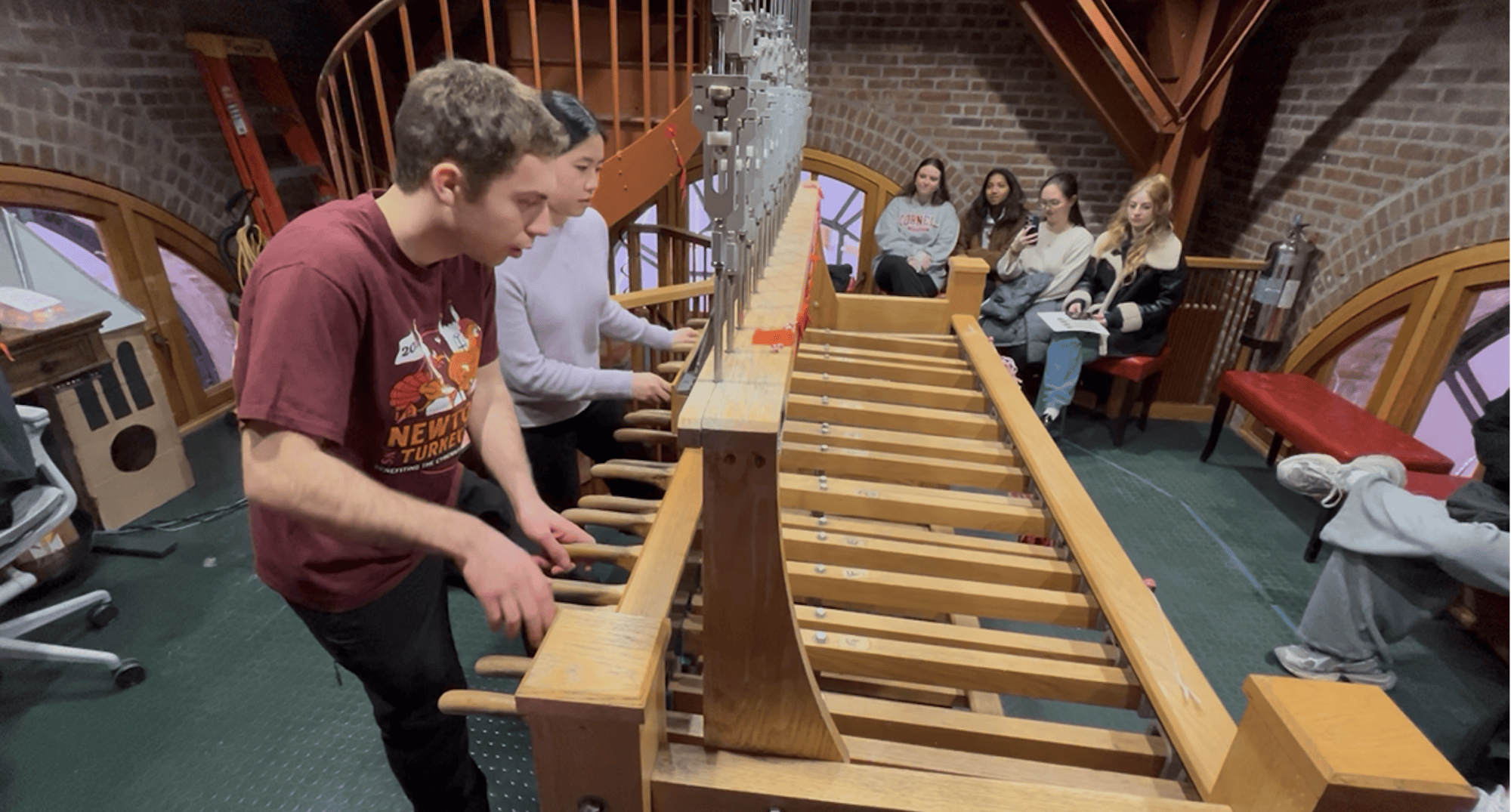
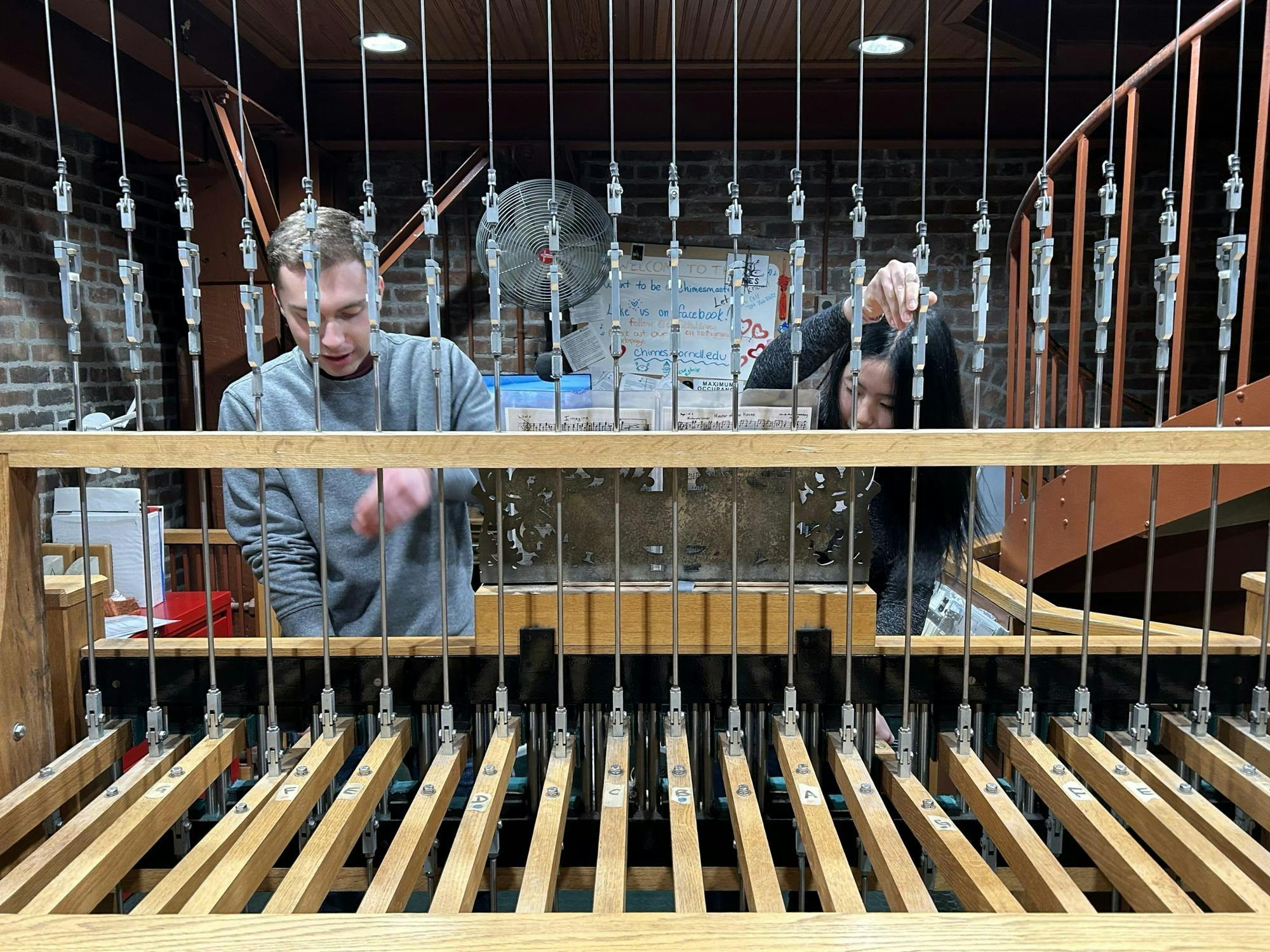
To play the chimes, the Chimesmasters use their hands and feet to push down levers that each correspond to a specific note. When pushed, the levers can move the clappers, the steel balls within the bells.
“The physicality of [the instrument is] definitely very difficult,” Head Chimesmaster Kevin Wang ’25 M.Eng. ’26 told The Sun. “The lowest bell is two tons, and we have to move it.”
Especially for faster paced songs, the Chimesmasters must be ready for an intense workout while playing, Isaacson added.
“It's a very physically demanding instrument since we’re using three of our limbs to play the instrument pretty quickly with pretty heavy levers,” Isaacson said. “It's more of a workout than I expected.”
With so many factors to consider while playing, Wu said that the Chimesmasters often let the music carry them through concerts.
“I feel like the entire outside world kind of melts away just a little bit when I'm up there,” Wu said.
Chimesmaster Competition
Running up the tower stairs for morning concerts, performing three to four times a week and setting aside additional time to practice new pieces is no simple feat. As a result, the process to become a Chimesmaster is rigorous, according to the Chimes website.
Every spring semester, the Cornell Chimesmasters organize a 10-week competition open to any student with at least four semesters left on campus or member of the Cornell community. According to the Chimes website, no prior bell-ringing experience is required, but all competitors should be able to “read music, climb 161 steps, and balance on one foot.”
During round one, participants, known as “compets,” are tasked with learning how to play three traditional Cornell pieces that are played daily on the chimes: “Jennie McGraw Rag” in the morning, “Cornell Alma Mater” in the afternoon and “Cornell Evening Song” in the evening. By the end of the first four weeks, compets must perform the pieces as part of a silent audition in front of the head chimesmaster and competition coordinator.
Compets selected to move to round two are assigned to learn from two experienced chimesmasters. Under their guidance, compets are expected to perform two full-length concerts per week.
For Pradhyum Rajeshkar ’29, a chimesmaster compet, the ramp up in difficulty between rounds has been challenging but fulfilling.
“You have to learn a full 15 minutes of songs for each concert, which [are] three days apart from each other, and they have to be different sets of songs,” Rajeshkar said.
To prepare for auditions and full-length concerts, compets like Rajeshkar dedicate hours of time towards learning new pieces and techniques.
“Now, I'm trying to practice as much as I can,” Rajeshkar said. “Whenever I have time, if there's an open spot, I put myself down, and I go and learn a song [on the practice stand].”
At the start of the spring semester, roughly 40 Cornellians entered the competition, according to Isaacson. By the end of the 10 weeks, the Chimesmasters extend invitations to two to five compets to join the group.
The Chimesmasters design the competition in such a way for participants to challenge themselves and enjoy learning a new skill, Isaacson and Wang expressed.
“Most of the competition comes from playing against yourself,” Isaacson said.
“We want to make sure that this [competition] process is as enjoyable as possible,” Wang said. “I want this to be a positive contribution to [a compet’s] life at Cornell.”
Performing with Passion
For Isaacson, the decision to join the Chimesmasters was rooted in the club environment.
“I approached [the clock tower], and [the Chimesmasters] were just having a blast, just playing the songs kind of very casually and very energetically,” Isaacson said. “From that moment, I remember thinking, ‘Wow, this is not just playing music. It's a whole experience that I want to be a part of.’”
The Chimesmasters are responsible for leading at least four concerts every week, but Isaaacson said the job is “not about perfection.”
“It’s about the fact that you're playing the bells for a huge quantity of people, and you get to have that influence on the campus,” Isaacson said.
For Wu, serving as a chimesmaster has been a “great honor” because her music gets to be part of the Chimes’s legacy and everyone’s Cornell experience.
“It’s a really cool experience … to know that I am playing a very small part in everyone's Cornell experience, just walking around and hearing the bells in the background,” Wu said.
For Wang, being a part of such the campus tradition allowed him to find his place on campus.
“[Being a Chimesmaster] definitely gave me a sense that I really belong at Cornell,” Wang said.
Tuned Into Community
Beyond daily concerts, the Chimesmasters also lead specialty concerts themed around holidays and Cornell activities. Past concert themes include love songs for Valentine’s Day, female empowerment songs for International Women's Day and dragon-themed pieces for Dragon Day.
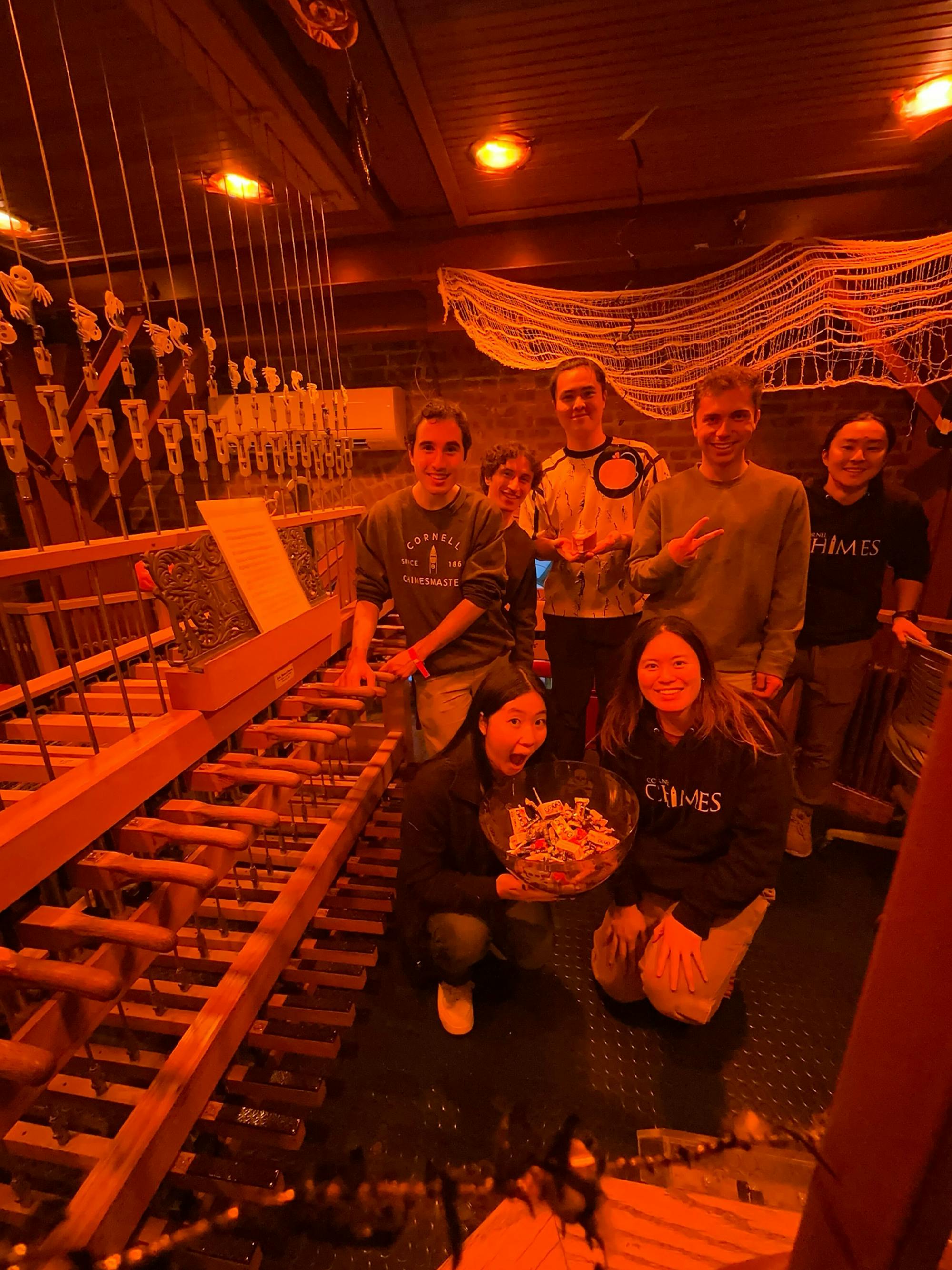
To boost spirit on campus, the Chimesmasters also decorate the clock face for holidays like Valentine’s Day and Halloween.
“Another fun thing … for us is when we put the cardboard cutouts on the clock tower,” Wang said. “During Valentine's Day and Halloween, when you look at the clock face, you will see a pumpkin or heart.”
In addition to spreading spirit to the whole campus, the Chimesmasters have also been involved in setting up intimate events like weddings and proposals for Cornellians.
“We get to see people at some of their happiest moments,” Isaacson said. “It’s very uplifting to see that and to see all that positive community and energy.”
For James Arachelian ’29, watching the concerts live has been a highlight of his college experience so far.
“It brings joy and whimsy to the campus,” Arachelian said. “I don't think you could go to any other college campus and find music just coming from the bells. It’s Cornell’s personal soundtrack.”
Teju Vijay is a member of the Class of 2029 in the College of Arts and Sciences. She is a staff writer for the news department and can be reached at tv95@cornell.edu.