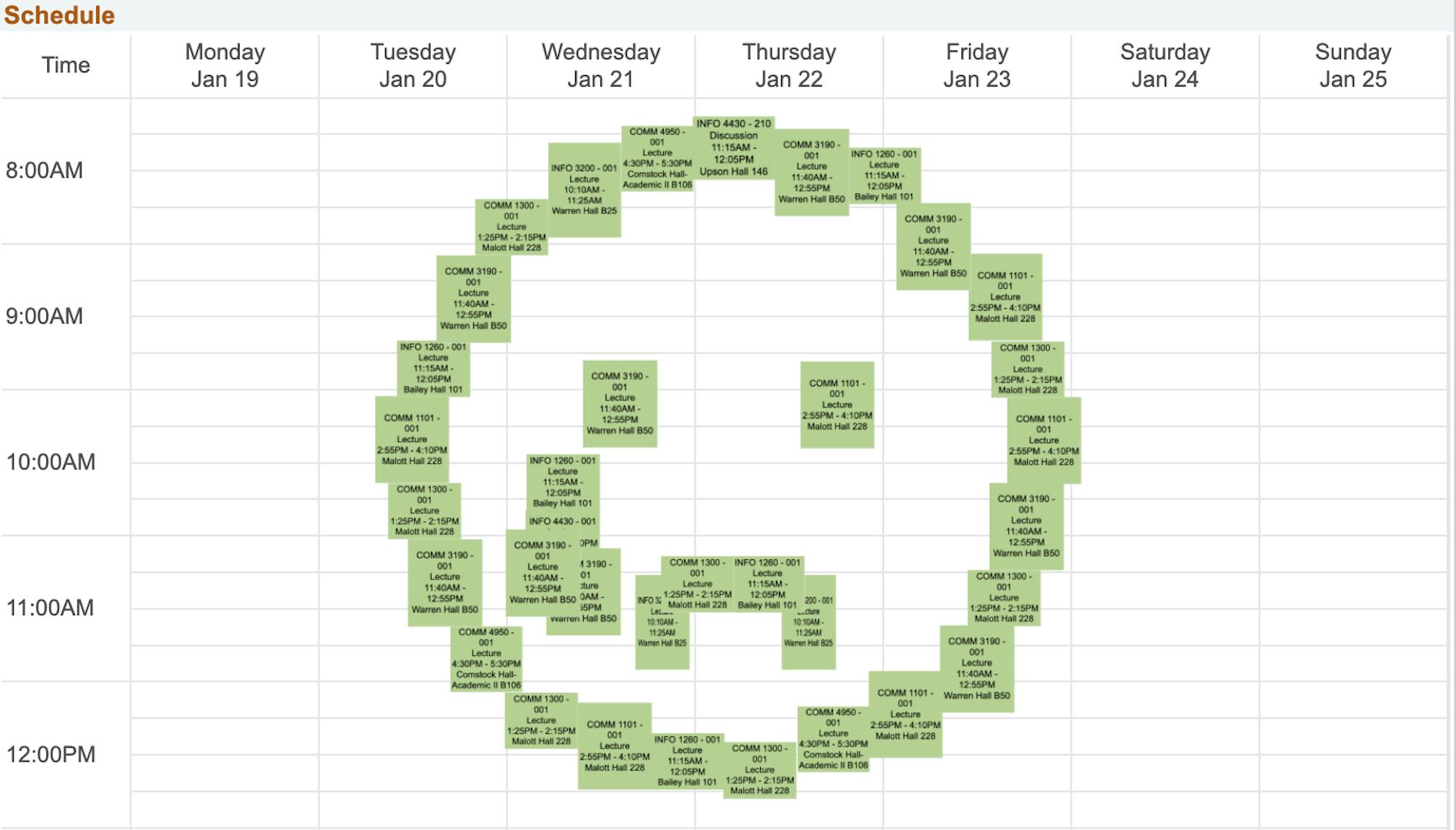
‘Tis the season of having countless browser tabs open scattered across CUReviews, Scheduler, decade-old Reddit threads and RateMyProfessor. Around this time of year, one of my favorite guilty pleasures during class time is to explore the course offerings for next semester. My half-dozen unrealistic, yet colorful, Scheduler creations really do bring me joy. Until it’s time to actually register for them, and the combination of my slow Wi-Fi and one-sixteenth of a second delay obliterate my Fridayless academic dreams.
I have always wondered if professors are checking what their previous students say about them on public forums. When they can’t sleep at night, do they stay up and stare at their deficient two-and-a-half star quality rating? Do those on the tenure track fear their RateMyProfessor scarlet letter? This career path is unique in the fact that performance reviews are aired out for the world to see and dictated by subordinates. But, I assume that the tenured, regardless of what students are saying about them, don’t need to worry about job security.
The information ecosystem on course reflections relies heavily on the gift economy. Feedback, after all, is a gift. A student doesn’t get anything out of sharing their experience except for the fact that they may be helping someone else who will soon be in their shoes. If you have benefited from reading up on a performance review or course evaluation, potentially think about writing one yourself. As the academic terms progress, professors change syllabi, faculty rotate in and out of teaching, and university-wide instruction policies change. The evaluations that are usually the most helpful are the ones that are most recent. You don’t think about it until the only information you can find online is a snarky Reddit comment from 2019.
Reviewing is labor, but it’s also an act of kindness — until a professor becomes so besieged with critique that positive experiences are nowhere to be found. If a lecturer really is hell on Earth, so be it. But, I am just curious if the feedback that is out there is created with the recipient in mind. If you search hard enough, you can find some really interesting comments. For instance: “Sometimes I would not wear a seatbelt driving around campus hoping I would crash so I wouldn't have to go to his classes anymore” or “the worst professor to exist but also one of the top ten worst humans ever.” Surely, these critiques read as hyperbolical rather than genuinely helpful, which is the main reason for having these public forums in the first place.
For the more controversially rated faculty, being inundated with criticism without suggestions for change or improvement certainly must not be fun. Should you expect the professor to improve and work on themselves if their feedback doesn’t include a call-to-action? By no means do I write this with the intent to discredit your learning experience. If a professor really did make you question your choice to become a student, please, do share. But, I wonder if all the reflections that are out there were written with objectivity in mind, instead of just an angry vent from receiving a truncated grade rounding.
The larger part of undergraduates will pursue careers where a GPA can be make-or-break. And, for being regarded as an extremely heavy grade-deflated school, this creates quite the challenge for that group of students, where course evaluations can act as a very helpful mitigant. So, if Cornell is interested in reducing such large quantities of sensationalist professor feedback, perhaps they might want to consider reintroducing the public posting of median grade averages. I have yet to meet a professor at Cornell who is apathetic towards their work and the art of exploration. But sadly, the system that is currently in place heavily critiques those who have committed to a lifelong journey of academia.
Education — at least, as we know it — is human-centered. It is also a space where students are essentially paying for a service, and thus criticism is completely appropriate. When you finish your semester, you will move on to newer and harder classes, but comments will take on digital permanence through searchable archives. Perhaps such comments could potentially detract a fellow student from participating in a class that works for their learning style and is impactful on their life. Again, I’m not saying to cease critique. I’m saying that critique should be written with more intention and with respect to all involved parties.
The classes where I’ve had the biggest struggle for a substantial grade are the ones that stuck with me the most. The passion for seeking out challenges is what esteems a Cornellian. Classes will fill regardless of a professor’s fatalistic narrative. The irony, though, is that at a school where “any person, any study” reigns supreme, the professors who demand the most are often the ones most heavily trivialized. We are taught the extreme importance of a healthy digital footprint. Yet we’re turning around and constructing unsolicited digital narratives for active working professionals. So, in the paradox of reflection, is there a way to keep feedback as a gift rather than a judgement or popularity contest? How can we rate learning outside of rating the people who make it possible?
Richard Ballard is a junior in the College of Agriculture and Life Sciences. He can be reached at rpb233@cornell.edu.

Richard Ballard is a member of the Class of 2027 in the College of Agriculture and Life Sciences. He is a staff writer for the Lifestyle department and can be reached at rballard@cornellsun.com.