If you fondly remember those “24 Hour Challenge” Youtube videos of people going to department stores and burrowing hideouts behind stacks of toilet paper and you wished you could penetrate into their minds with psychological depth through an investigative film, you have finally been bequeathed your golden text. It’s the film that was on the tip of our tongues, but we didn’t know to ask for; it’s doing what Taxi Driver did but for the modern age manchildren.
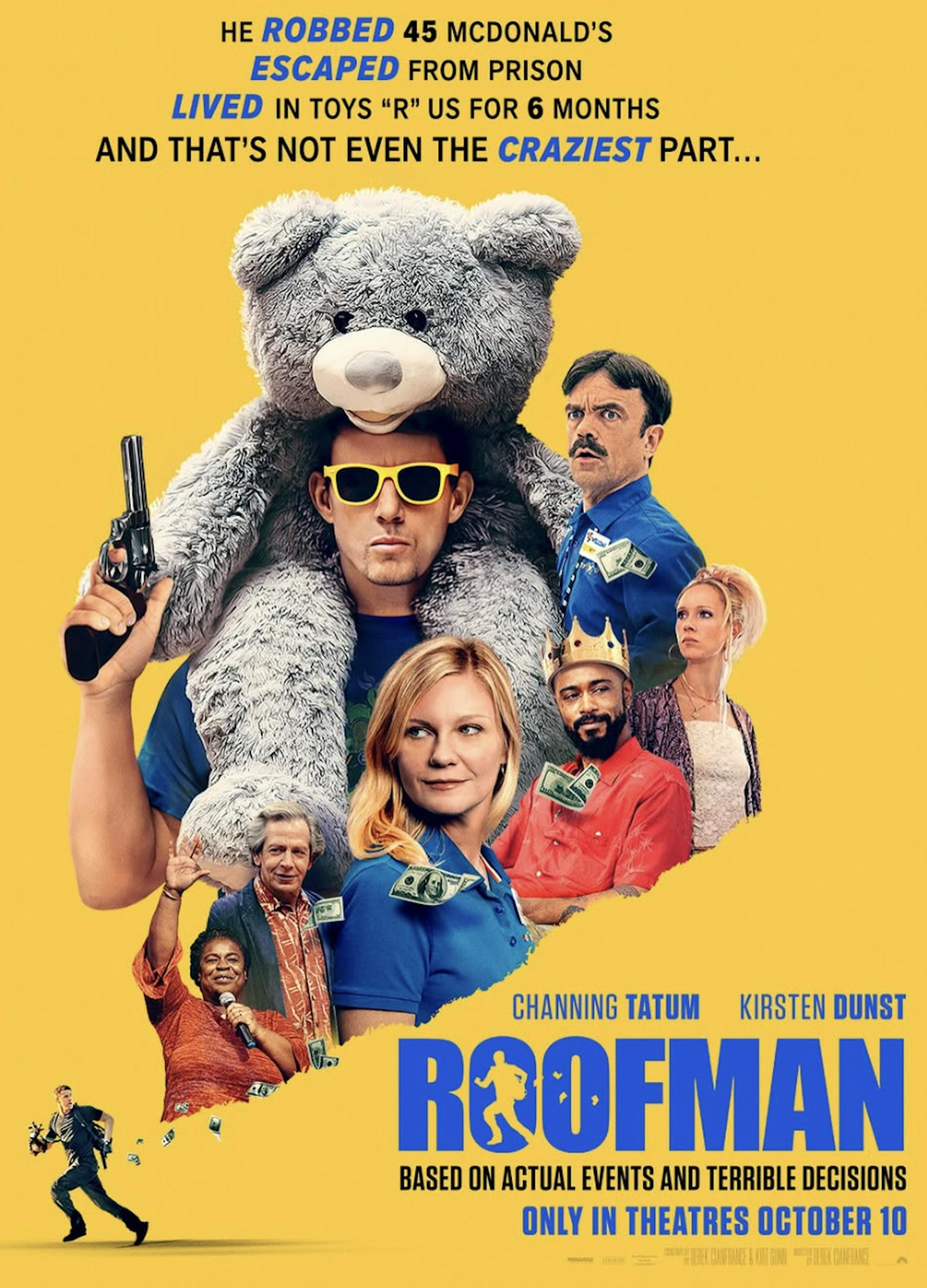
In seriousness, Roofman is a pretty good movie. The poster sports a floatie-wearing, teddy bear-toting Channing Tatum as Jeff, a man who lives in a Toys-R-Us for months surviving off of peanut M&Ms. Despite the similarity to 2010s harebrained fads, Roofman is actually about an escaped convict who lives there to keep a low profile, not to be an influencer. It’s based on the true story of Jeffrey Manchester who robbed McDonalds’ restaurants by entering through the roof for two years in order to provide for his family. Suddenly having become suspiciously rich, showering presents on his daughter for her birthday, he was apprehended in 2000. In 2004 he escaped and took shelter in the toy store. During his life on the lam, he developed new roots with a single mom (who happens to be a Toys R Us employee) and her two children, which comprises the main focus of the film. It treats the hardships of a man who just wants a family to love, and is pressed to crime to provide for them.
It’s solid. The performances are strong and Tatum stars in a somewhat more serious role than I would typically associate him with despite the “silly” imagery in the marketing. The film certainly blends comedy with action and drama in the sort of style we’ve begun to see in recent films like Anora, with wild midnight escapades in the Toys R Us acting as a fun diversion to more serious emotional moments. The wardrobe is often comically ridiculous, with Tatum wearing Teenage Mutant Ninja Turtles merchandise, undersized shoes and a pink boa in a chase sequence. Yet when the hard emotional quandaries come as Jeff has to choose between his families and freedom, you can feel the wrenching sacrifice through the quiet, pained moments of Tatum’s performance. The supporting performances of Kirsten Dunst, Peter Dinklage, LaKeith Stanfield and company all pull their weight in rendering a naturalistic acting style. The color grading/color production design is an interesting manifestation of the mood the film creates. Many of the scenes have a slight blue tint and while the toy store is populated by rainbow candy colors, blue retains primacy, straddling colorful comedy with realist gritty mournful desperation.
My favorite motif from the film is when Tatum accidentally turns on a laughing Elmo doll right after a phone call with his daughter where he hears her laughing as her new stepfather playfully tickles her, which incites him into a rage. The two sounds are eerily similar. It is a haunting, almost surrealist psychological observation: of the droning, reverberant pains that echo in our mind as memories try to insert themselves in the present moment. It is a good microcosm of the entirety of the film –– laughably ridiculous, childlike fronts belying intense submerged suffering.
To get a little more analytical, there is a unique subject matter the film explores which is a state of childishness. Obviously, this is seen in a grown man living in a Toys R Us section, but it’s also seen in the character’s specific behavior, such as when he gives his daughter an erectors building set for her birthday, ridiculously distant from the bike that she wants, half-oblivious to this letdown. LaKeith Stanfield’s character calls him, “the stupidest smart guy I’ve ever known.” The film captures the naivety of an adult who still has the spirit of a child and is actually seen as virtuous despite his criminal acts –– for living under a half-thought out, but well meaning creed where he will give someone his coat at the same time as he locks them in a freezer during a robbery. It’s an interesting case study.
In summary, Roofman is a balanced movie, both fun and emotional. And while it is somewhat atypical, it is a standard kind of Hollywood play-it-safe movie. Plot lines are straightforward and linear, the film doesn’t risk anything too extreme in its subject, psychology or humor. It’s among the better offerings in theaters today, but to be on the harsher side, it’s not the kind of movie that will stand the test of time to become either a classic or a cult film. It’s a good reason to get out and go to the theaters. 3 ½ Letterboxd stars.
Tommy Welch is a senior in the College of Arts and Sciences. He can be reached at tsw62@cornell.edu.
Tommy Welch is a member of the Class of 2026 in the College of Arts and Sciences. He is a staff writer for the Arts & Culture department and can be reached at twelch@cornellsun.com.